The Chevalier’s Lament
Behind the song
The singer wanted to put his father back on the throne. Now even the wild beasts have better shelter in the hills and valleys he claims as his father’s right. How can he ever repay the friends who followed him to ruin? [1]
Burns described trying words to Captain O’Kane, a friend’s favourite tune, as he rode between Galloway and Ayrshire. He said Cleghorn suggested a verse in the voice of Prince Charles Stuart after Culloden. It puts a name to the grief carried through the spring flowers and birdsong. [1][2][3]
Read the fuller story
Dick quotes a letter of 31 March 1788 in which Burns describes riding between Galloway and Ayrshire and trying words to a friend’s favourite air, Captain O’Kane. He says that Cleghorn suggested completing the song with a Jacobite stanza imagined as Prince Charles Stuart’s after Culloden. Cunningham also links the song with a friend’s enthusiasm for the air and subject, but the editors give the friend different first names: James in Dick and, tentatively, Robert in Cunningham. [2][3]
The complete Dick lyric has two eight-line stanzas, with the final four lines continuing at the top of the next page. Cunningham prints hawthorn trees where Dick has primroses and ends with a different formulation of the singer’s inability to reward his friends. Dick’s setting is Captain O’Kane, marked Slow; Cunningham’s tune heading spells the name O’Kean. Both readings preserve the passage from a flourishing landscape to a dispossessed political voice. [1][3]
Story references
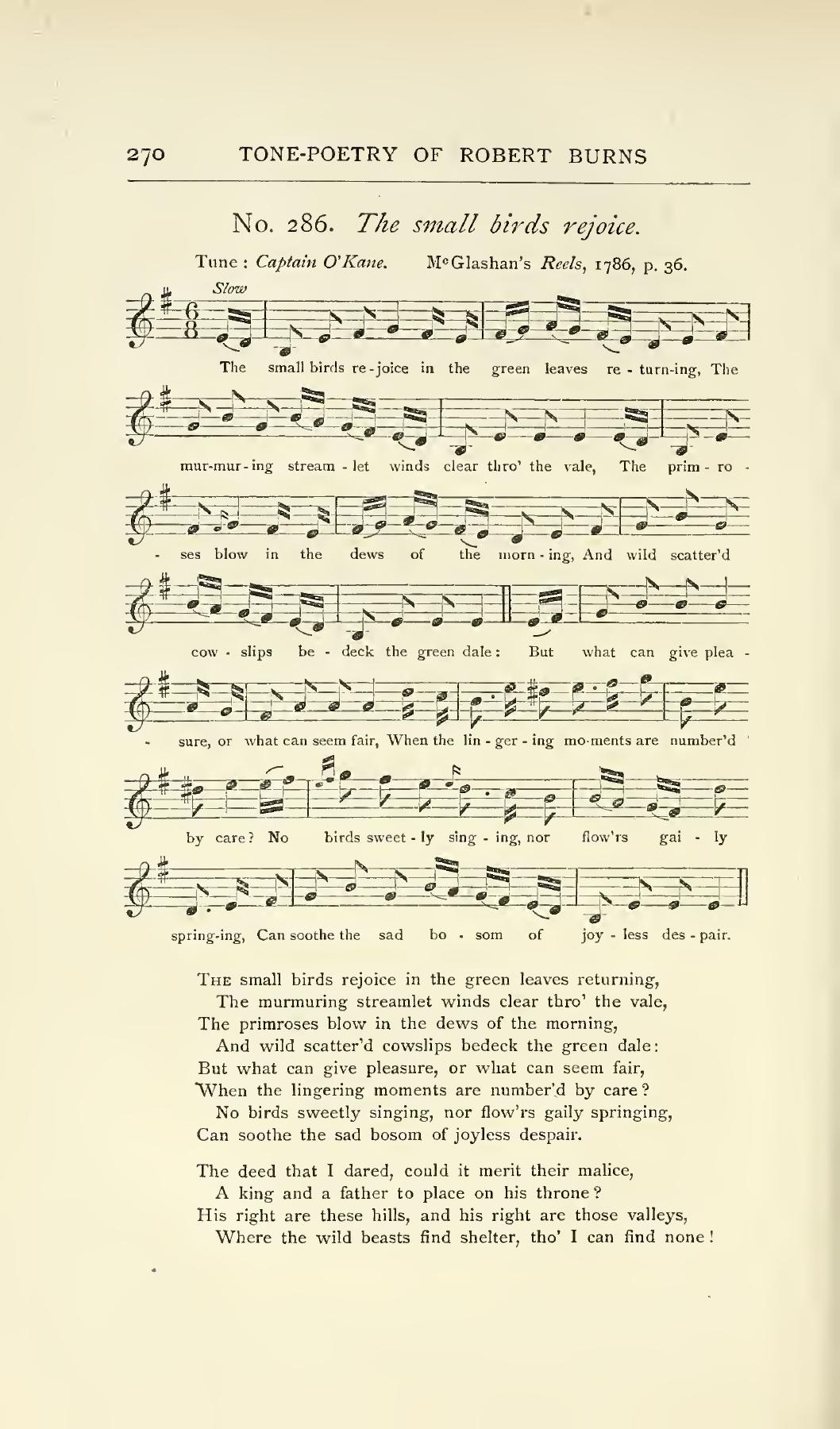 View score Dick’s Songs of Robert Burns (1903)
Lyrics
Choose an edition
Version notes
| Dick (1903) · no. 286 | Cunningham · 1855Ebook transcription |
|---|---|
| The primroses blow in the dews | The hawthorn trees blow in the dew |
| When the lingering moments | While the lingering moments |
| No birds sweetly singing, nor flow’rs gaily springing | No flow’rs gaily springing, nor birds sweetly singing |
| those valleys | these valleys |
More differences between these editions
| Dick (1903) · no. 286 | Cunningham · 1855Ebook transcription |
|---|---|
| tho’ I can find none! | but I can find none; |
| Your faith prov’d so loyal | Your deeds proved so loyal |
| Alas! can I make it no better return? | Alas! I can make you no sweeter return! |
| Captain O’Kane | Captain O’Kean |
Dick (1903) · no. 286
The small birds rejoice in the green leaves returning,
The murmuring streamlet winds clear thro' the vale,
The primroses blow in the dews of the morning,
And wild scatter'd cowslips bedeck the green dale:
But what can give pleasure, or what can seem fair,
When the lingering moments are number'd by care?
No birds sweetly singing, nor flow'rs gaily springing,
Can soothe the sad bosom of joyless despair.

The deed that I dared, could it merit their malice,
A king and a father to place on his throne?
His right are these hills, and his right are those valleys,
Where the wild beasts find shelter, tho' I can find none!
But 'tis not my suff'rings thus wretched, forlorn—
My brave gallant friends, 'tis your ruin I mourn!
Your faith prov'd so loyal in hot-bloody trial,
Alas! can I make it no better return?
View the source edition · no. 286; pp. 270–271
About this edition
Both versions have two eight-line stanzas. Dick’s lyric continues on the following page. Dick prints primroses/dews against hawthorn trees/dew, When against While, reverses the birds/flowers order and reads those valleys against these valleys. Its last lines have Your faith prov’d and a question about making a better return; Cunningham has Your deeds proved and a statement about no sweeter return. O’Kane/O’Kean differs in the tune headings.
Cunningham (1855)
The small birds rejoice in the green leaves returning,
  The murmuring streamlet winds clear thro’ the vale;
The hawthorn trees blow in the dew of the morning,
  And wild scatter’d cowslips bedeck the green dale:
But what can give pleasure, or what can seem fair,
  While the lingering moments are number’d by care?
No flow’rs gaily springing, nor birds sweetly singing,
  Can soothe the sad bosom of joyless despair.

The deed that I dared, could it merit their malice,
  A king and a father to place on his throne?
His right are these hills, and his right are these valleys,
  Where the wild beasts find shelter, but I can find none;
But ’tis not my sufferings thus wretched, forlorn:
  My brave gallant friends! ’tis your ruin I mourn;
Your deeds proved so loyal in hot-bloody trial—
  Alas! I can make you no sweeter return!
Digital text from Project Gutenberg.
View the source edition · p. 260
About this edition
Both versions have two eight-line stanzas. Dick’s lyric continues on the following page. Dick prints primroses/dews against hawthorn trees/dew, When against While, reverses the birds/flowers order and reads those valleys against these valleys. Its last lines have Your faith prov’d and a question about making a better return; Cunningham has Your deeds proved and a statement about no sweeter return. O’Kane/O’Kean differs in the tune headings.
Music
View historical scores
Dick’s Songs of Robert Burns (1903)
no. 286; pp. 270–271