Such a parcel of rogues in a nation
Behind the song
The singer of Such a Parcel of Rogues accuses Scotland’s own leaders of selling the country. English steel had failed against them, he says, but English gold bought what war could never win. Both Allan Cunningham and James C. Dick read the song as an attack on the Union. [1][2][3]
The song takes leave of Scotland’s fame, glory and very name. It pictures the Sark and Tweed on the borders of an English province. The singer would rather lie dead with Bruce and Wallace than live to see what he calls treason. [1]
Read the fuller story
Both Cunningham and Dick frame the lyric as an attack on the Union. Cunningham's introduction shares its indignation and calls the loss of independence a sale. Dick sets the song beside earlier anti-Union satire and prints examples of the bitter language directed at Scottish political figures. These later editorial readings help place the song within a tradition of political invective. [2][3]
Dick's account goes further, repeating claims about payments to commissioners and presenting a sweeping picture of Scottish hostility to the treaty. Dick’s historical account takes the same polemical tone as the song. The song's own central force is its accusation: a small, cowardly group has betrayed a nation whose military past should have protected it. [1][2]
One word changes the final declaration between the editions. Dick prints “We're bought and sold for English gold”; Cunningham has “We've bought and sold for English gold”. The former makes the people the objects of the sale, while the latter gives the line a different grammatical turn. Both readings are kept beside a historical air headed A parcel of rogues in a nation. [1][3]
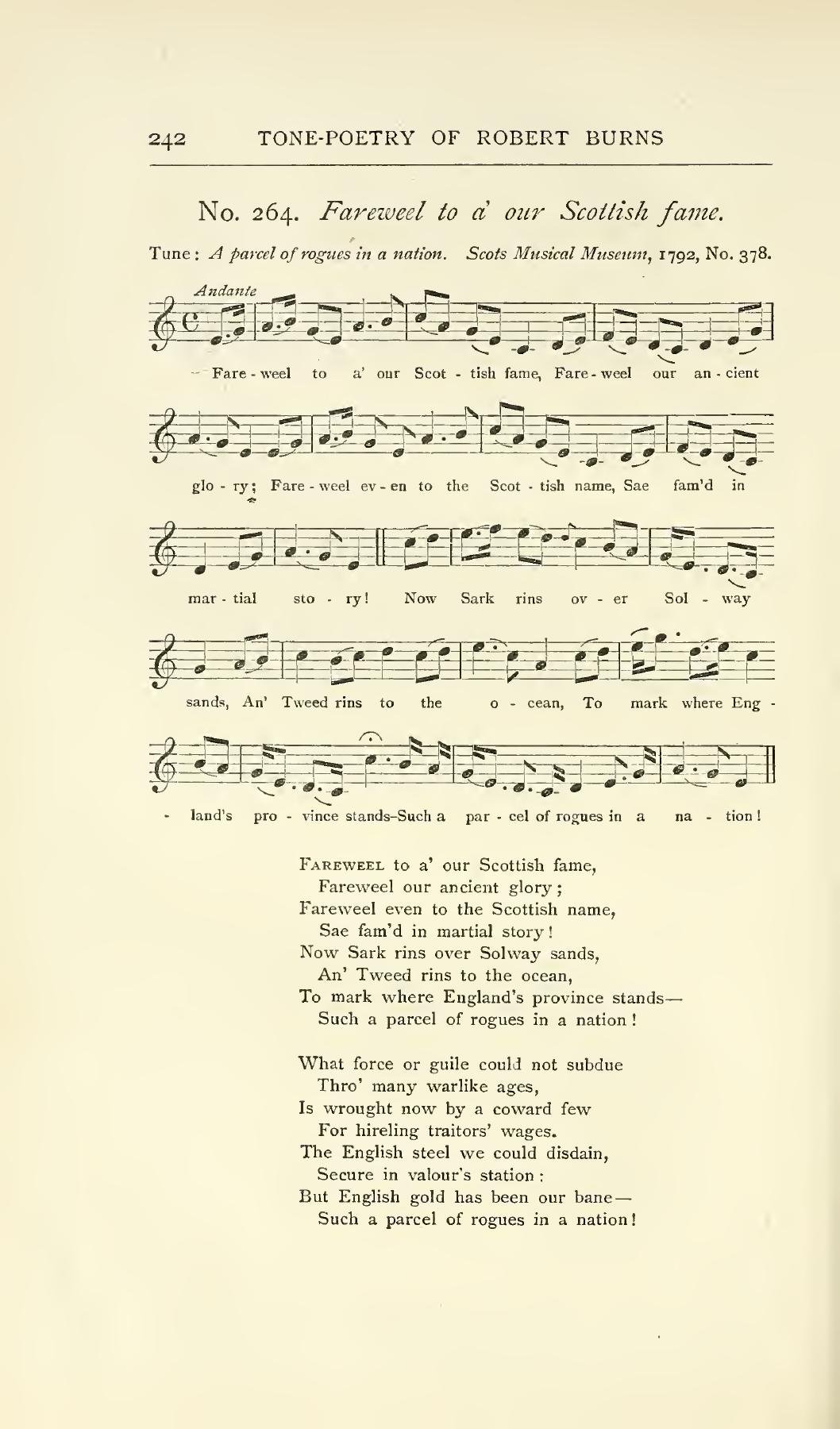 View score Dick’s Songs of Robert Burns (1903)
Lyrics
Choose an edition
Version notes
| Dick (1903) · no. 264 | Cunningham · 1855Ebook transcription |
|---|---|
| We’re bought and sold for English gold | We’ve bought and sold for English gold |
| traitors’ wages | traitor’s wages |
| grey | gray |
Dick (1903) · no. 264
Fareweel to a' our Scottish fame,
Fareweel our ancient glory;
Fareweel even to the Scottish name,
Sae fam'd in martial story!
Now Sark rins over Solway sands,
An' Tweed rins to the ocean,
To mark where England's province stands—
Such a parcel of rogues in a nation!

What force or guile could not subdue
Thro' many warlike ages,
Is wrought now by a coward few
For hireling traitors' wages.
The English steel we could disdain,
Secure in valour's station:
But English gold has been our bane—
Such a parcel of rogues in a nation!

O, would, or I had seen the day
That treason thus could sell us,
My auld grey head had lien in clay
Wi' Bruce and loyal Wallace!
But pith and power, till my last hour
I'll mak this declaration:—
'We're bought and sold for English gold'—
Such a parcel of rogues in a nation!
These are the words printed below the score.
View the source edition · no. 264; pp. 242–243
About this edition
Three eight-line stanzas in both. Dick’s final declaration reads “We’re bought and sold”; Cunningham’s ebook reads “We’ve bought and sold”. Dick prints “grey” and “traitors’”; Cunningham “gray” and “traitor’s”.
Cunningham (1855)
Fareweel to a’ our Scottish fame,
  Fareweel our ancient glory,
Fareweel even to the Scottish name,
  Sae fam’d in martial story.
Now Sark rins o’er the Solway sands,
  And Tweed rins to the ocean,
To mark where England’s province stands—
  Such a parcel of rogues in a nation.

What force or guile could not subdue,
  Thro’ many warlike ages,
Is wrought now by a coward few
  For hireling traitor’s wages.
The English steel we could disdain;
  Secure in valour’s station;
But English gold has been our bane—
  Such a parcel of rogues in a nation.

O would, or I had seen the day
  That treason thus could sell us,
My auld gray head had lien in clay,
  Wi’ Bruce and loyal Wallace!
But pith and power, till my last hour,
  I’ll mak’ this declaration;
We’ve bought and sold for English gold—
  Such a parcel of rogues in a nation.
Digital text from Project Gutenberg.
View the source edition · p. 258
About this edition
Three eight-line stanzas in both. Dick’s final declaration reads “We’re bought and sold”; Cunningham’s ebook reads “We’ve bought and sold”. Dick prints “grey” and “traitors’”; Cunningham “gray” and “traitor’s”.
Scots Musical Museum, vol. IV (1792) · no. 378
View the source edition · Volume 4, no. 378; p. 391
Music
View historical scores
Dick’s Songs of Robert Burns (1903)
no. 264; pp. 242–243