O Lady Mary Ann
Behind the song
Lady Mary Ann looks over the castle wall at three boys playing ball and singles out the youngest. The song imagines a year at college and a green ribbon round his hat to show that he is to marry. Its returning assurance is that the bonnie laddie is still growing.
Read the fuller story
Flowers and trees carry the promise of maturity. Mary Ann is a blossom made sweeter by time; young Charlie Cochran is a straight oak shoot, cherished by the sun and destined to become the pride of the forest. The last verse remembers summer and the days already gone, then trusts that better days will come again. The final return to the growing laddie keeps that hope attached to the young figure at the song’s centre.
Cunningham says Burns sent the song to the Museum in his own handwriting. He believes part of it to be old, while praising the skill of Burns’s interpolations and changes. His account leaves the extent of each contribution uncertain, presenting the selected song as an interweaving of inherited words and revision.[1]
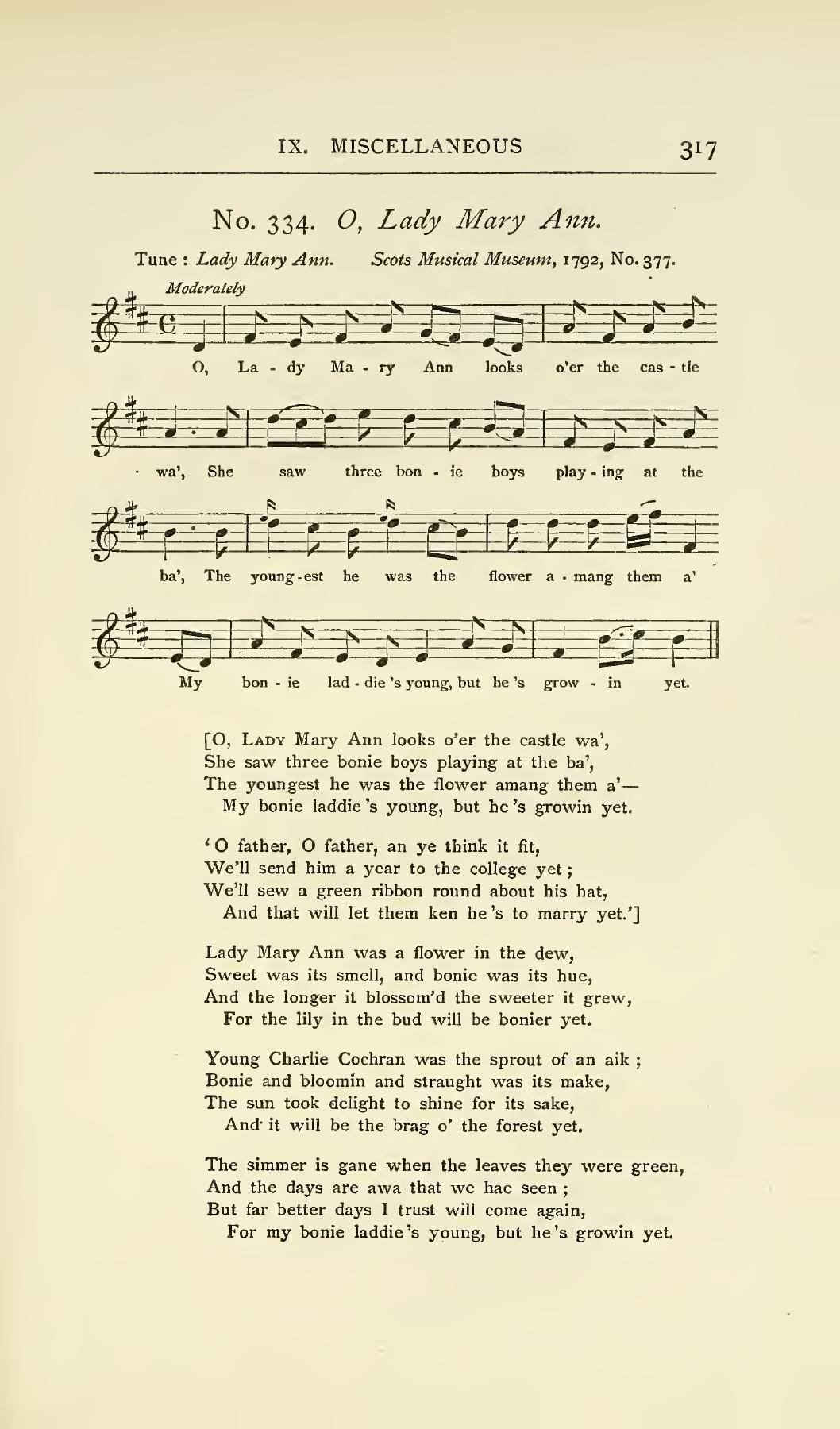 View score Dick’s Songs of Robert Burns (1903)
Lyrics
Choose an edition
Cunningham (1855)
O, Lady Mary Ann
  Looks o’er the castle wa’,
She saw three bonnie boys
  Playing at the ba’;
The youngest he was
  The flower amang them a’—
My bonnie laddie’s young,
  But he’s growin’ yet.

O father! O father!
  An’ ye think it fit,
We’ll send him a year
  To the college yet:
We’ll sew a green ribbon
  Round about his hat,
And that will let them ken
  He’s to marry yet.

Lady Mary Ann
  Was a flower i’ the dew,
Sweet was its smell,
  And bonnie was its hue;
And the langer it blossom’d
  The sweeter it grew;
For the lily in the bud
  Will be bonnier yet.

Young Charlie Cochran
  Was the sprout of an aik;
Bonnie and bloomin’
  And straught was its make:
The sun took delight
  To shine for its sake,
And it will be the brag
  O’ the forest yet.

The simmer is gane,
  When the leaves they were green,
And the days are awa,
  That we hae seen;
But far better days
  I trust will come again,
For my bonnie laddie’s young,
  But he’s growin’ yet.
Digital text from Project Gutenberg.
View the source edition · p. 258
About this edition
Cunningham’s preface discusses several poems he left out of the collection.
Dick (1903) · no. 334
The words are on the score page.
View the source edition · no. 334; p. 317
Scots Musical Museum, vol. IV (1792) · no. 377
View the source edition · Volume 4, no. 377; p. 390
Music
View historical scores
Dick’s Songs of Robert Burns (1903)
no. 334; p. 317
Reworking attributed to Burns
Cunningham credits Burns with interpolations and changes, while leaving the extent of older words uncertain.
Words Robert Burns and the earlier song tradition
Burns’s role Reworking attributed to Burns