Ye Banks and Braes o’ Bonnie Doon
Behind the song
The banks of the Doon are fresh, the birds sing and the flowering thorn offers its familiar shelter. To the abandoned lover who speaks, that continuing beauty is painful. The bird recalls departed happiness; the rose recalls a love that has left its thorn behind. The landscape carries both the memory of pleasure and the present hurt. [1]
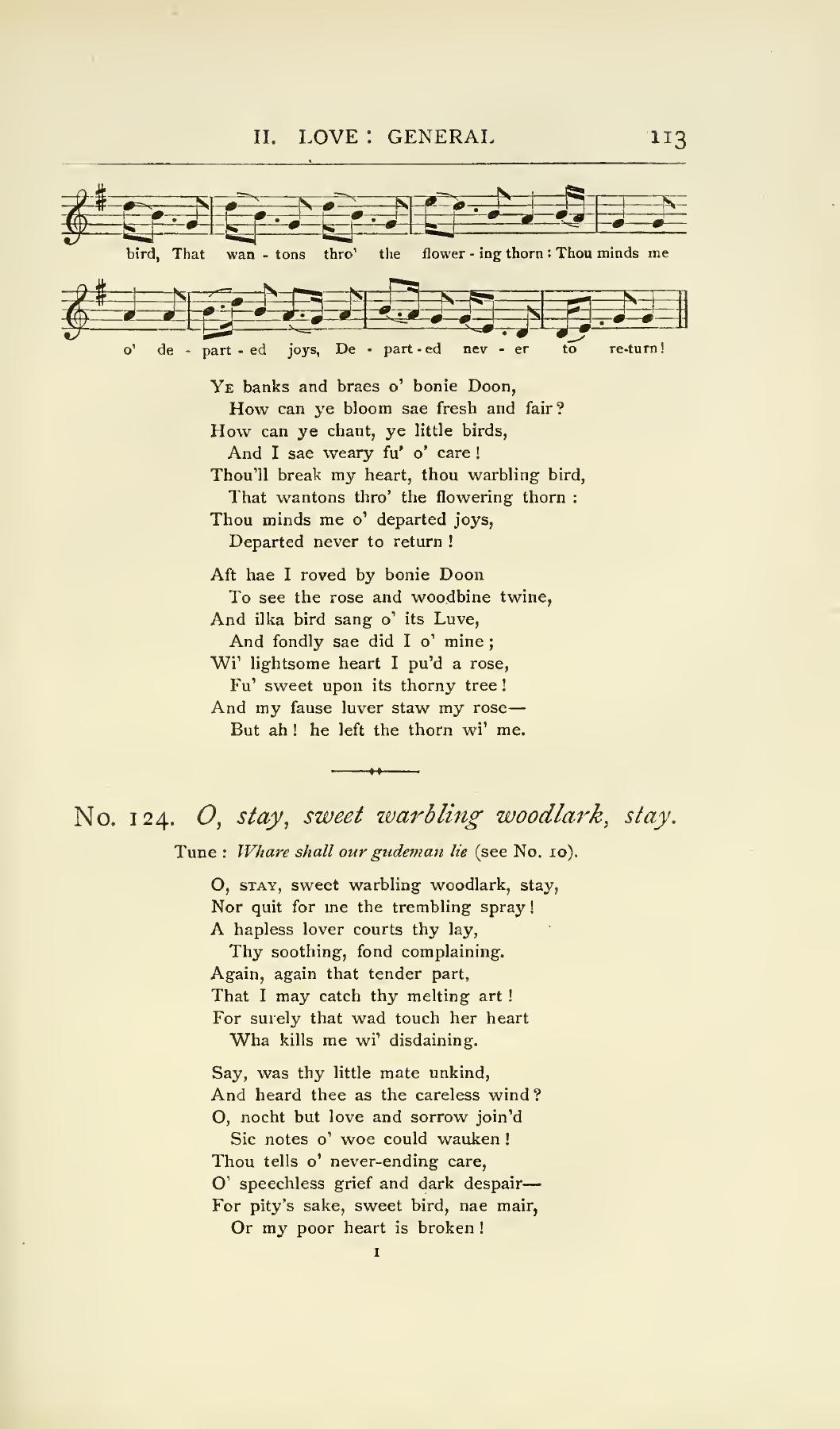
Dick prints this as the third version of the song. Its two eight-line stanzas allow the opening questions and the complaint to the bird to form one movement; the remembered walk and the stolen rose form the other. The “fause luver” appears only near the end, after the speaker has led us through the places and signs of that earlier happiness. [1]
Read the fuller story
The song sits within a group of related Doon texts. On the same page Dick prints the shorter-lined Ye flowery banks o’ bonie Doon as his second version, with a reference to Ballendalloch’s Reel or Cambdelmore. The present version has Caledonian Hunt’s delight printed with it. Keeping these forms distinct lets the changed line lengths and musical settings remain audible. [1][2]
Dick quotes Burns recommending the popular air to Thomson in November 1794 and relating a story of its formation by someone playing the black keys of a harpsichord. Dick then examines competing accounts of its origin. Cunningham repeats the black-key story in his introduction while preferring the simplicity of an earlier form of the song. Those are accounts and judgements preserved by the editors. [2][3]
Cunningham labels this text “Second Version”, where Dick calls it “Third Version”. Both give the same sixteen-line shape. Cunningham’s “stole my rose” and Dick’s Scots “staw my rose” make a small but noticeable difference at the moment of betrayal. The final thorn remains with the singer in both. [1][3]
Story references
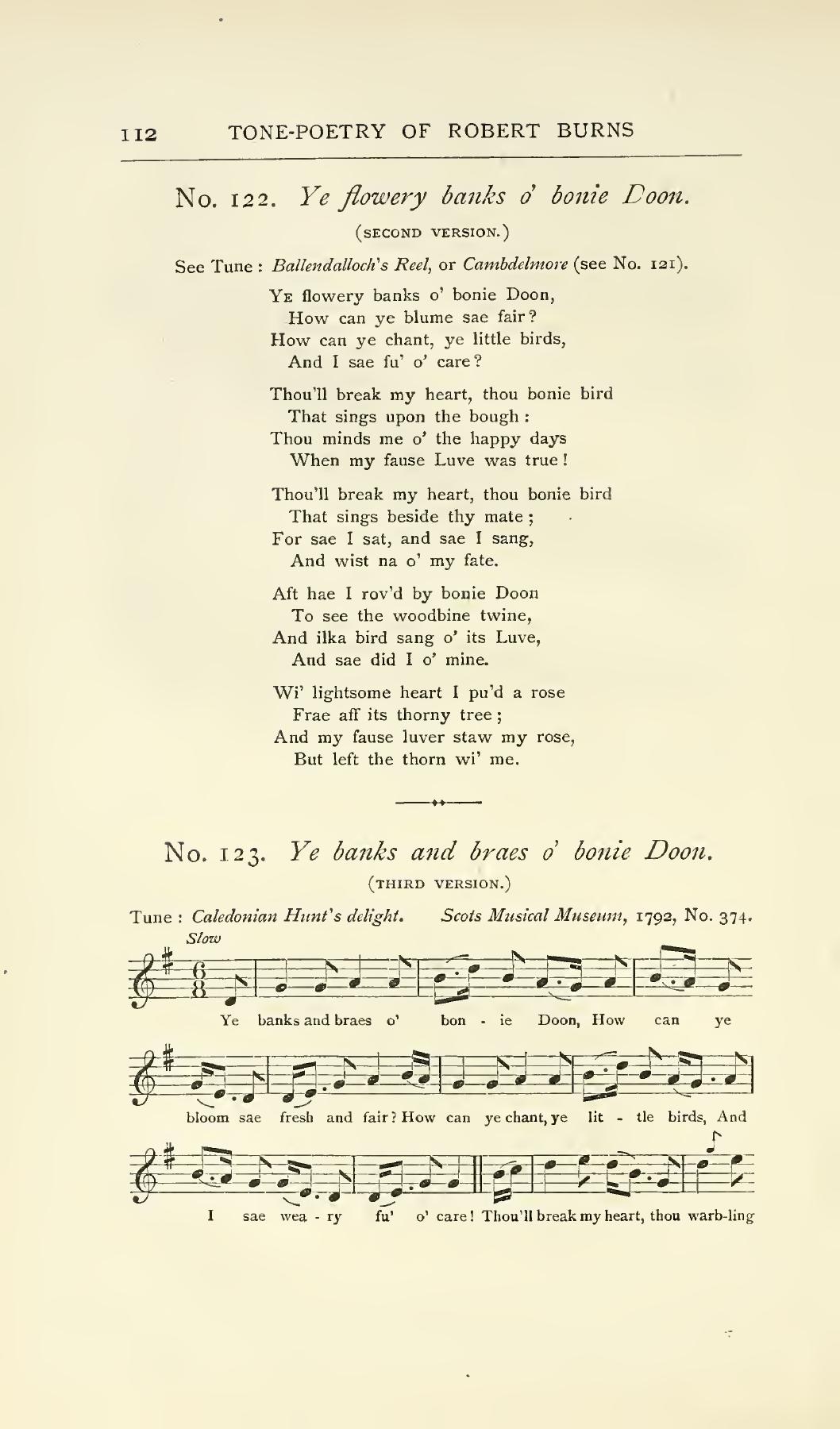 View score Dick’s Songs of Robert Burns (1903)
Lyrics
Choose an edition
Dick (1903) · no. 123
Ye banks and braes o’ bonie Doon,
    How can ye bloom sae fresh and fair?
How can ye chant, ye little birds,
    And I sae weary fu’ o’ care!
Thou’ll break my heart, thou warbling bird,
    That wantons thro’ the flowering thorn:
Thou minds me o’ departed joys,
    Departed never to return!

Aft hae I roved by bonie Doon
    To see the rose and woodbine twine,
And ilka bird sang o’ its Luve,
    And fondly sae did I o’ mine;
Wi’ lightsome heart I pu’d a rose,
    Fu’ sweet upon its thorny tree!
And my fause luver staw my rose—
    But ah! he left the thorn wi’ me.
View the source edition · no. 123; pp. 112–113
About this edition
Cunningham calls the sixteen-line text his Second Version; Dick calls it his Third Version. Dick prints “Thou’ll”, “roved” and “staw”; Cunningham has “Thou’lt”, “rov’d” and “stole”. Dick’s neighbouring no. 122 is a separate shorter-lined version with a different tune reference and remains separately identified.
Cunningham (1855)
Ye banks and braes o’ bonnie Doon,
  How can ye bloom sae fresh and fair;
How can ye chant, ye little birds,
  And I sae weary, fu’ o’ care!
Thou’lt break my heart, thou warbling bird,
  That wantons thro’ the flowering thorn:
Thou minds me o’ departed joys,
  Departed—never to return!

Aft hae I rov’d by bonnie Doon,
  To see the rose and woodbine twine;
And ilka bird sang o’ its luve,
  And fondly sae did I o’ mine.
Wi’ lightsome heart I pu’d a rose,
  Fu’ sweet upon its thorny tree;
And my fause luver stole my rose,
  But, ah! he left the thorn wi’ me.
Digital text from Project Gutenberg.
View the source edition · p. 257
About this edition
Cunningham calls the sixteen-line text his Second Version; Dick calls it his Third Version. Dick prints “Thou’ll”, “roved” and “staw”; Cunningham has “Thou’lt”, “rov’d” and “stole”. Dick’s neighbouring no. 122 is a separate shorter-lined version with a different tune reference and remains separately identified.
Scots Musical Museum, vol. IV (1792) · no. 374
View the source edition · Volume 4, no. 374; p. 387
Music
View historical scores
Dick’s Songs of Robert Burns (1903)
no. 123; pp. 112–113
View source · Download citation