Ye Jacobites by name
Behind the song
Ye Jacobites by Name calls its hearers to attention, then turns their political doctrines into questions. What makes right and wrong? The answer offered is a sword and the strength to draw it. What earns the name of heroic struggle? The next verse supplies an assassin's knife and a parent's life hunted by war. The repeated questions unsettle the proud vocabulary of political conflict. [1]
The last stanza tells the plotters to leave their schemes alone, adore the rising sun and abandon a ruined man to his fate. Its commands have a bitter edge after the violence of the preceding verse. That movement gives the song room for irony: a direct rebuke and a troubling account of how power decides allegiance can inhabit the same words. [1]
Read the fuller story
Dick calls the song a pithy, ironical satire and emphasises its equivocal language, which he believes either Whig or Tory could read in their own way. His judgement is a useful guide to the tension between the opening accusation and the questions that follow. The refrain's political name opens into a broader challenge to heroic violence. [1][2]
Cunningham's short introduction places the song's first appearance in the Scots Musical Museum and says that it was sent in Burns's handwriting. He prints four six-line stanzas. The familiar musical repetitions spread the first question across the verse before the answer arrives in its shorter lines. [3]
Dick arranges each stanza in five printed lines, joining the final short phrases that Cunningham separates. His tune heading names Ye Jacobites by name, as Cunningham's does. The words and the insistent musical calls work together, repeatedly asking a listening company to consider what its political language means. [1][3]
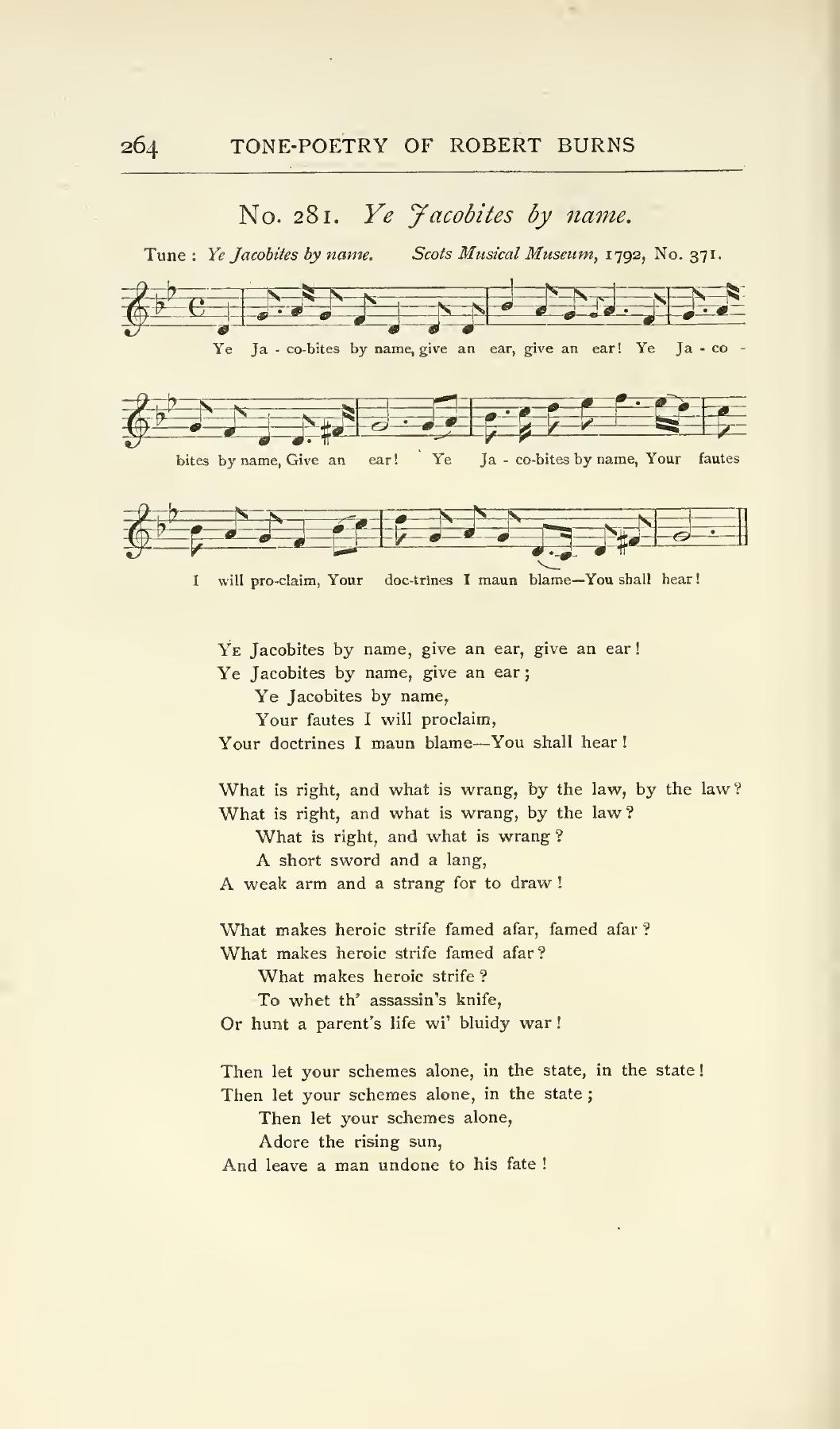 View score Dick’s Songs of Robert Burns (1903)
Lyrics
Choose an edition
Version notes
| Dick (1903) · no. 281 | Cunningham · 1855Ebook transcription |
|---|---|
| five printed lines per stanza | six printed lines per stanza |
| give an ear | give and ear |
| bluidy | bluidie |
Dick (1903) · no. 281
Ye Jacobites by name, give an ear, give an ear!
Ye Jacobites by name, give an ear;
Ye Jacobites by name,
Your fautes I will proclaim,
Your doctrines I maun blame—You shall hear!

What is right, and what is wrang, by the law, by the law?
What is right, and what is wrang, by the law?
What is right, and what is wrang?
A short sword and a lang,
A weak arm and a strang for to draw!

What makes heroic strife famed afar, famed afar?
What makes heroic strife famed afar?
What makes heroic strife?
To whet th' assassin's knife,
Or hunt a parent's life wi' bluidy war!

Then let your schemes alone, in the state, in the state!
Then let your schemes alone, in the state;
Then let your schemes alone,
Adore the rising sun,
And leave a man undone to his fate!
These are the words printed below the score.
View the source edition · no. 281; p. 264
About this edition
Dick prints four five-line stanzas; Cunningham separates each ending into six lines. Cunningham’s opening ebook has “give and ear”; Dick has “give an ear”. Dick prints “bluidy”; Cunningham “bluidie”.
Cunningham (1855)
Ye Jacobites by name, give and ear, give an ear;
  Ye Jacobites by name, give an ear;
    Ye Jacobites by name,
      Your fautes I will proclaim,
        Your doctrines I maun blame—
          You shall hear.

What is right, and what is wrang, by the law, by the law?
  What is right and what is wrang, by the law?
    What is right and what is wrang?
      A short sword, and a lang,
        A weak arm, and a strang
          For to draw.

What makes heroic strife, fam’d afar, fam’d afar?
  What makes heroic strife, fam’d afar?
    What makes heroic strife?
      To whet th’ assassin’s knife,
        Or hunt a parent’s life
          Wi’ bluidie war.

Then let your schemes alone, in the state, in the state;
  Then let your schemes alone in the state;
    Then let your schemes alone,
      Adore the rising sun,
        And leave a man undone
          To his fate.
Digital text from Project Gutenberg.
View the source edition · p. 256
About this edition
Dick prints four five-line stanzas; Cunningham separates each ending into six lines. Cunningham’s opening ebook has “give and ear”; Dick has “give an ear”. Dick prints “bluidy”; Cunningham “bluidie”.
Scots Musical Museum, vol. IV (1792) · no. 371
View the source edition · Volume 4, no. 371; p. 383
Music
View historical scores
Dick’s Songs of Robert Burns (1903)
no. 281; p. 264