The Country Lass
Behind the song
Bessie is determined to marry. An older woman urges her to choose a prosperous household, but Bessie values the affection in Robie’s glance more than Johnie’s land and livestock. [1]
Read the fuller story
The argument begins in a summer milking shiel, amid cut hay, green corn, clover and roses. The older adviser recommends patience and a comfortable home. Johnie of Buskie-glen has the water, byre and property to support one; in her practical account, plenty feeds the lover’s fire. [1]
Bessie sees a different economy. Johnie gives his love to crops and cattle, while Robie loves her. The older woman answers with the hardship of life and warns that Bessie must drink the ale she brews. Bessie has the last stanza: money can buy fields and animals, but affection brings a contentment she compares with a queen’s. Their exchange leaves the practical warning audible alongside her confident choice. [1]
Cunningham calls this a dramatic song and reports a manuscript in the poet’s handwriting with two or three variations he considers immaterial. That is his account of a manuscript witness. The heading names ‘The Country Lass’ as the tune. [1]
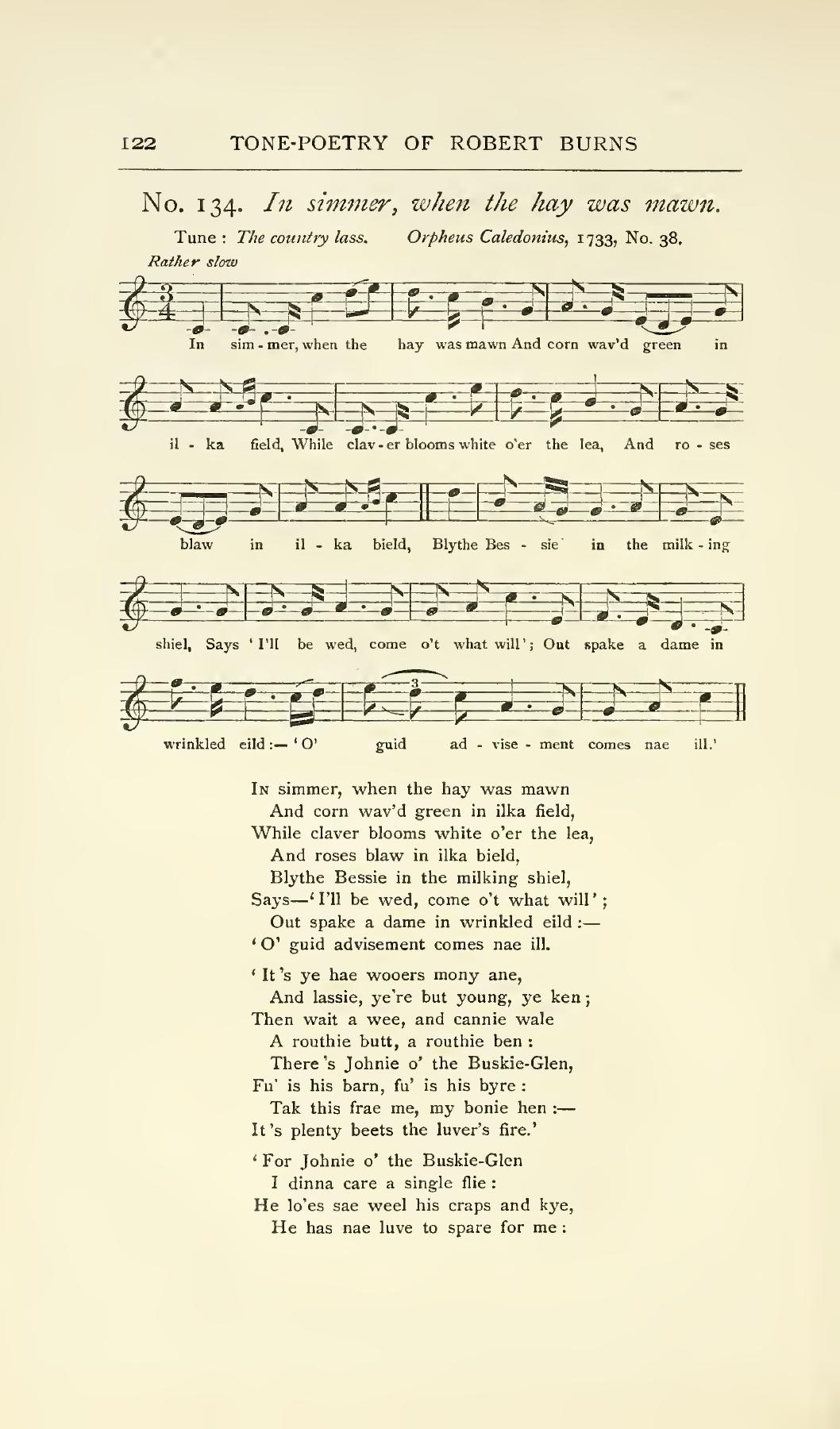 View score Dick’s Songs of Robert Burns (1903)
Lyrics
Choose an edition
Cunningham (1855)
In simmer, when the hay was mawn,
  And corn wav’d green in ilka field,
While claver blooms white o’er the lea,
  And roses blaw in ilka bield;
Blithe Bessie in the milking shiel,
  Says—I’ll be wed, come o’t what will;
Out spak a dame in wrinkled eild—
  O’ guid advisement comes nae ill.

It’s ye hae wooers mony ane,
  And, lassie, ye’re but young ye ken;
Then wait a wee, and cannie wale,
  A routhie butt, a routhie ben:
There’s Johnie o’ the Buskie-glen,
  Fu’ is his burn, fu’ is his byre;
Tak this frae me, my bonnie hen,
  It’s plenty beets the luver’s fire.

For Johnie o’ the Buskie-glen,
  I dinna care a single flie;
He lo’es sae weel his craps and kye,
  He has nae luve to spare for me:
But blithe’s the blink o’ Robie’s e’e,
  And weel I wat he lo’es me dear:
Ae blink o’ him I wad nae gie
  For Buskie-glen and a’ his gear.

O thoughtless lassie, life’s a faught;
  The canniest gate, the strife is sair;
But ay fu’ han’t is fechtin best,
  An hungry care’s an unco care:
But some will spend, and some will spare,
  An’ wilfu’ folk maun hae their will;
Syne as ye brew, my maiden fair,
  Keep mind that ye maun drink the yill.

O, gear will buy me rigs o’ land,
  And gear will buy me sheep and kye;
But the tender heart o’ leesome luve,
  The gowd and siller canna buy;
We may be poor—Robie and I,
  Light is the burden luve lays on;
Content and luve brings peace and joy—
  What mair hae queens upon a throne?
Digital text from Project Gutenberg.
View the source edition · p. 255
About this edition
Cunningham’s preface discusses several poems he left out of the collection.
Dick (1903) · no. 134
The words are on the score page.
View the source edition · no. 134; pp. 122–123
Scots Musical Museum, vol. IV (1792) · no. 366
View the source edition · Volume 4, no. 366; pp. 376–377
Music
View historical scores
Dick’s Songs of Robert Burns (1903)
no. 134; pp. 122–123