The Posie
Behind the song
A bird’s nest puts a limit on what the singer will take for May’s posie. He will gather the hawthorn and leave the nest in its bush. James C. Dick relates that Burns got the idea for the song from hearing his wife sing the street ballad There was a pretty May. [1][2]
He gathers the year’s first primrose, a pink for the finest of women, blue hyacinth for constancy, lily and daisy for purity and simplicity. By evening there is woodbine wet with dew for May’s eyes, and violet for modesty. He binds them with silk and promises her a lifetime of love. [1]
Read the fuller story
Dick says the song was suggested by hearing Mrs Burns sing a street ballad, There was a pretty May. He traces that account through Cromek and a letter to Thomson, and records the song's appearance in the Museum in 1792. The story gives the carefully assembled flowers a setting in remembered singing at home. [2]
Dick places the poem beside an English nosegay song printed in A Handefull of pleasant Delites in 1584, quoting two stanzas in which the flowers carry messages between lovers. He presents an older parallel for this way of writing. In Burns's lyric, the repeated address to “my ain dear May” gathers the separate emblems around one recipient. [1][2]
Dick sets the seven stanzas as four long lines each; Cunningham divides each into eight shorter lines. Cunningham's heading names The Posie, as does Dick's score. At the opening, Dick has “wisdom ance hath been”, where Cunningham has “wisdom ance has been”. The small verbal differences sit within the same sequence of gifts, ending with the binding promise. [1][3]
Story references
- James C. Dick, The Songs of Robert Burns (1903), No. 127; printed pp. 116–116; PDF pp. 172–172
- James C. Dick, The Songs of Robert Burns (1903), Dick historical note 127; printed 394,395; PDF 450,451
- Allan Cunningham, The Complete Works of Robert Burns (1855), printed 255; HTML #songsCXXVII. Project Gutenberg transcription.
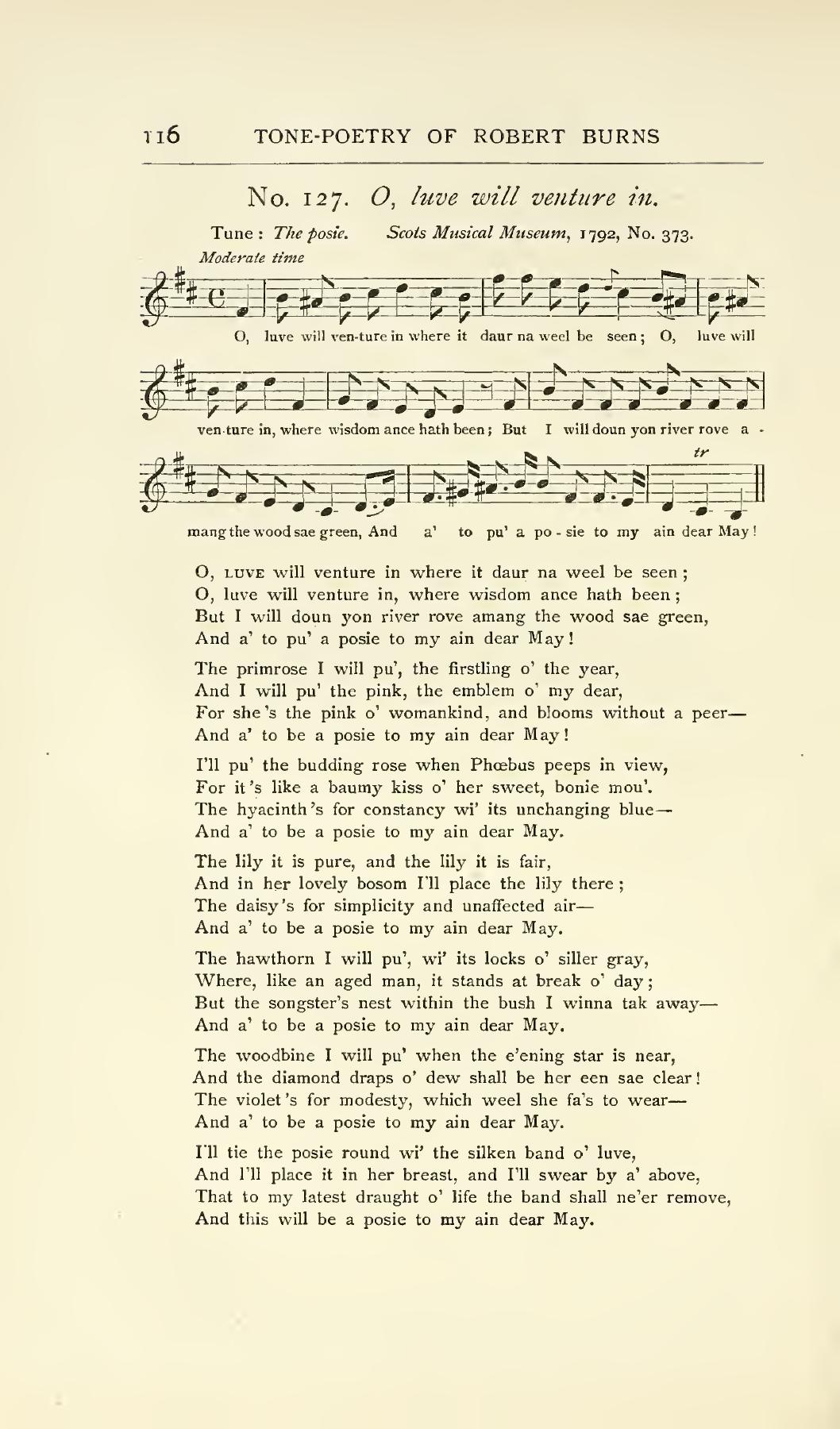 View score Dick’s Songs of Robert Burns (1903)
Lyrics
Choose an edition
Version notes
Dick prints seven four-line stanzas. The Cunningham transcription divides each stanza into eight lines. Dick gives “hath”, “doun” and “draps”. The corresponding words in the Cunningham transcription are “has”, “down” and “drops”. Dick (1903) · no. 127 · Cunningham · 1855
| Dick (1903) · no. 127 | Cunningham · 1855Ebook transcription |
|---|---|
| seven quatrains with long lines | seven eight-line stanzas |
| hath | has |
| doun | down |
| draps | drops |
Dick (1903) · no. 127
O, luve will venture in where it daur na weel be seen;
O, luve will venture in, where wisdom ance hath been;
But I will doun yon river rove amang the wood sae green,
And a' to pu' a posie to my ain dear May!

The primrose I will pu', the firstling o' the year,
And I will pu' the pink, the emblem o' my dear,
For she's the pink o' womankind, and blooms without a peer—
And a' to be a posie to my ain dear May!

I'll pu' the budding rose when Phœbus peeps in view,
For it's like a baumy kiss o' her sweet, bonie mou'.
The hyacinth's for constancy wi' its unchanging blue—
And a' to be a posie to my ain dear May.

The lily it is pure, and the lily it is fair,
And in her lovely bosom I'll place the lily there;
The daisy's for simplicity and unaffected air—
And a' to be a posie to my ain dear May.

The hawthorn I will pu', wi' its locks o' siller gray,
Where, like an aged man, it stands at break o' day;
But the songster's nest within the bush I winna tak away—
And a' to be a posie to my ain dear May.

The woodbine I will pu' when the e'ening star is near,
And the diamond draps o' dew shall be her een sae clear!
The violet's for modesty, which weel she fa's to wear—
And a' to be a posie to my ain dear May.

I'll tie the posie round wi' the silken band o' luve,
And I'll place it in her breast, and I'll swear by a' above,
That to my latest draught o' life the band shall ne'er remove,
And this will be a posie to my ain dear May.
These are the words printed below the score.
View the source edition · no. 127; p. 116
About this edition
Dick prints seven four-line stanzas; Cunningham divides each into eight lines. Dick has “hath”, “doun” and “draps”, against Cunningham’s “has”, “down” and “drops”. Dick’s note compares a separate 1584 nosegay lyric and discusses Roslin Castle; the comparison is not proof of direct borrowing.
Cunningham (1855)
O luve will venture in
  Where it daurna weel be seen;
O luve will venture in
  Where wisdom ance has been.
But I will down yon river rove,
  Among the wood sae green—
And a’ to pu’ a posie
  To my ain dear May.

The primrose I will pu’,
  The firstling o’ the year,
And I will pu’ the pink,
  The emblem o’ my dear,
For she’s the pink o’ womankind,
  And blooms without a peer—
And a’ to be a posie
  To my ain dear May.

I’ll pu’ the budding rose,
  When Phœbus peeps in view,
For it’s like a baumy kiss
  O’ her sweet bonnie mou’;
The hyacinth’s for constancy,
  Wi’ its unchanging blue—
And a’ to be a posie
  To my ain dear May.

The lily it is pure,
  And the lily it is fair,
And in her lovely bosom
  I’ll place the lily there;
The daisy’s for simplicity,
  And unaffected air—
And a’ to be a posie
  To my ain dear May.

The hawthorn I will pu’
  Wi’ its locks o’ siller gray,
Where, like an aged man,
  It stands at break of day.
But the songster’s nest within the bush
  I winna tak away—
And a’ to be a posie
  To my ain dear May.

The woodbine I will pu’
  When the e’ening star is near,
And the diamond drops o’ dew
  Shall be her e’en sae clear;
The violet’s for modesty,
  Which weel she fa’s to wear,
And a’ to be a posie
  To my ain dear May.

I’ll tie the posie round,
  Wi’ the silken band o’ luve,
And I’ll place it in her breast,
  And I’ll swear by a’ above,
That to my latest draught of life
  The band shall ne’er remove,
And this will be a posie
  To my ain dear May.
Digital text from Project Gutenberg.
View the source edition · p. 255
About this edition
Dick prints seven four-line stanzas; Cunningham divides each into eight lines. Dick has “hath”, “doun” and “draps”, against Cunningham’s “has”, “down” and “drops”. Dick’s note compares a separate 1584 nosegay lyric and discusses Roslin Castle; the comparison is not proof of direct borrowing.
Scots Musical Museum, vol. IV (1792) · no. 373
View the source edition · Volume 4, no. 373; p. 386
Music
View historical scores
Dick’s Songs of Robert Burns (1903)
no. 127; p. 116