Nithsdale’s Welcome Hame
Behind the song
The Maxwells are coming home across the border, and their towers need putting in order. James C. Dick connects the welcome with Lady Winifred Maxwell Constable, who he says rebuilt Terregles House in 1788. [1][2][3]
Robert Riddell of Glenriddell recalled composing the air and telling Burns what he meant to call it. Burns supplied the words. As night gives way to morning and the storms clear, the welcome reaches everyone who has looked for relief at the end of a weary day. [1][3]
Read the fuller story
Dick connects the song with Lady Winifred Maxwell Constable and says she rebuilt Terregles House in 1788. Cunningham likewise places the Maxwells at Terreagles and describes their descent from the Earls of Nithsdale. Dick’s account also preserves Scott’s much later judgement that Burns’s Jacobitism belonged to imagination rather than reason. That is Scott’s interpretation of the poet, expressed in 1828. [2][3]
The tune gives a more specific account of collaboration. Dick attributes it to Robert Riddell of Glenriddell and quotes a note in which Riddell says he composed the air, told Burns its intended name and received words written for it. The title and the welcome were thus linked in the transmitted account of their making. Dick prints the melody with a Joyous direction beside two eight-line stanzas. [3]
Story references
- James C. Dick, The Songs of Robert Burns (1903), No. 288; printed pp. 272–272; PDF pp. 328–328
- Allan Cunningham, The Complete Works of Robert Burns (1855), printed 254; HTML #songsCXXIV. Project Gutenberg transcription.
- James C. Dick, The Songs of Robert Burns (1903), Dick note 288; printed 467; PDF 523
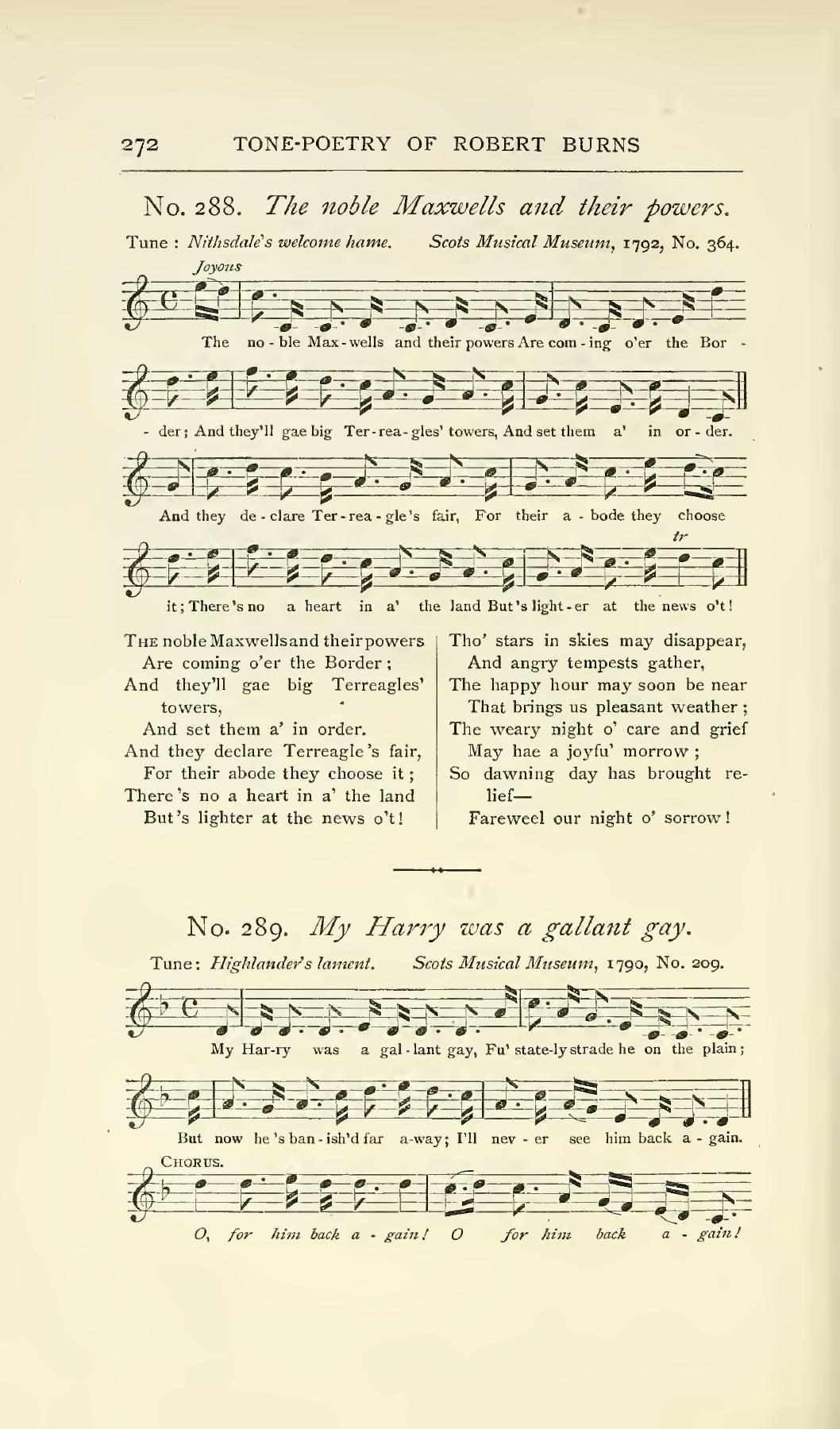 View score Dick’s Songs of Robert Burns (1903)
Lyrics
Choose an edition
Version notes
| Dick (1903) · no. 288 | Cunningham · 1855Ebook transcription |
|---|---|
| big | bigg |
| choose | chuse |
| Terreagles’ towers; Terreagle’s fair | Terreagle’s towers; Terreagles fair |
| And angry tempests gather, | And angry tempests gather; |
More differences between these editions
| Dick (1903) · no. 288 | Cunningham · 1855Ebook transcription |
|---|---|
| That brings us pleasant weather; | That brings us pleasant weather: |
Dick (1903) · no. 288
The noble Maxwells and their powers
Are coming o'er the Border;
And they'll gae big Terreagles' towers,
And set them a' in order.
And they declare Terreagle's fair,
For their abode they choose it;
There's no a heart in a' the land
But's lighter at the news o't!

Tho' stars in skies may disappear,
And angry tempests gather,
The happy hour may soon be near
That brings us pleasant weather;
The weary night o' care and grief
May hae a joyful morrow;
So dawning day has brought relief—
Fareweel our night o' sorrow!
View the source edition · no. 288; p. 272
About this edition
Both editions have two eight-line stanzas. Dick prints big and choose, Cunningham bigg and chuse. The place-name forms differ: Dick’s Terreagles’ towers / Terreagle’s fair against Cunningham’s Terreagle’s towers / Terreagles fair. These forms are retained within their editions.
Cunningham (1855)
The noble Maxwells and their powers
  Are coming o’er the border,
And they’ll gae bigg Terreagle’s towers,
  An’ set them a’ in order.
And they declare Terreagles fair,
  For their abode they chuse it;
There’s no a heart in a’ the land,
  But’s lighter at the news o’t.

Tho’ stars in skies may disappear,
  And angry tempests gather;
The happy hour may soon be near
  That brings us pleasant weather:
The weary night o’ care and grief
  May hae a joyful morrow;
So dawning day has brought relief—
  Fareweel our night o’ sorrow!
Digital text from Project Gutenberg.
View the source edition · p. 254
About this edition
Both editions have two eight-line stanzas. Dick prints big and choose, Cunningham bigg and chuse. The place-name forms differ: Dick’s Terreagles’ towers / Terreagle’s fair against Cunningham’s Terreagle’s towers / Terreagles fair. These forms are retained within their editions.
Scots Musical Museum, vol. IV (1792) · no. 364
View the source edition · Volume 4, no. 364; p. 375
Music
View historical scores
Dick’s Songs of Robert Burns (1903)
no. 288; p. 272