What can a young lassie do wi’ an auld man
Behind the song
Jenny’s mother has married her to an old man for his silver and land. He coughs, limps, finds fault and watches every younger man with suspicion. Jenny takes her grievances to Auntie Katie, who has a use in mind for the old man’s money. [1]
On her aunt’s advice Jenny means to plague him till his heart breaks, then buy a new pan with his brass. The whole marriage, from settlement to saucepan, comes down to what his money will fetch. [1]
Read the fuller story
Auntie Katie offers the plan that closes the song. Jenny will plague her husband until she breaks his heart, then turn his brass to the purchase of a new pan. The domestic object gives the threatened revenge a brisk finality. Money arranged the marriage and money returns in the imagined freedom beyond it. [1]
Cunningham compares this ending with an older strain in which a young wife threatens to make her husband a cuckold. Dick sets Burns's song beside a Herd fragment and a seventeenth-century English ballad on unequal marriage. These are the editors' comparisons within a broad song subject, with different plots and voices attached to it. [2][3]
Dick also quotes a practical instruction from Burns to the Museum's editor: he sends a better set of the tune and leaves the use of Dr Blacklock's ballad to the editor's judgement. It is a glimpse of Burns choosing words and music together. Dick's printed setting is headed What shall I do with an auld man? and marked “Merrily”. [1][2]
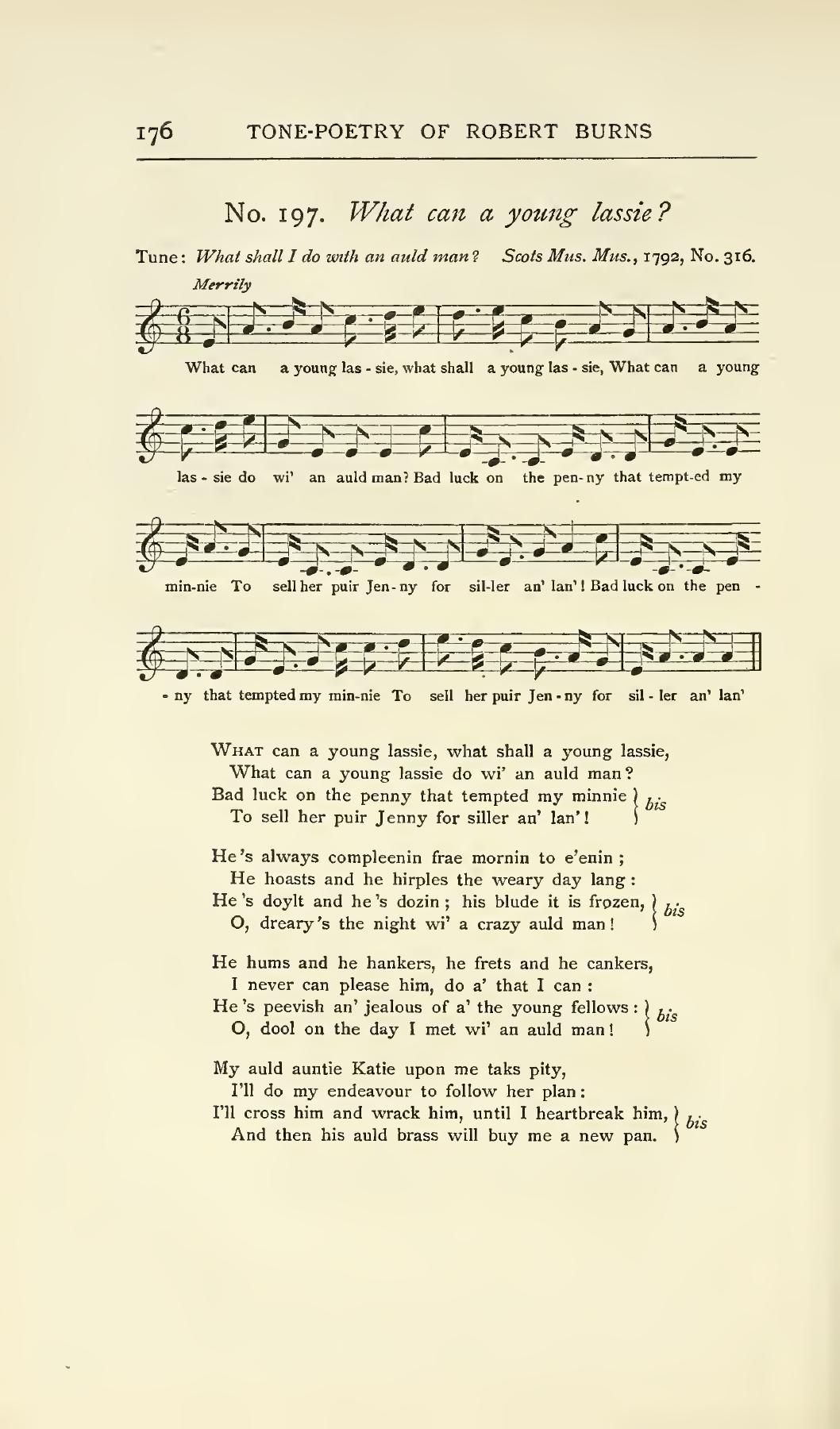 View score Dick’s Songs of Robert Burns (1903)
Lyrics
Choose an edition
Version notes
| Dick (1903) · no. 197 | Cunningham · 1855Ebook transcription |
|---|---|
| bis bracket after final two lines of each stanza | repeated lines printed in full |
| taks pity | takes pity |
| heartbreak | heart-break |
Dick (1903) · no. 197
What can a young lassie, what shall a young lassie,
What can a young lassie do wi' an auld man?
Bad luck on the penny that tempted my minnie
To sell her puir Jenny for siller an' lan'!
Bad luck on the penny that tempted my minnie
To sell her puir Jenny for siller an' lan'!

He's always compleenin frae mornin to e'enin;
He hoasts and he hirples the weary day lang:
He's doylt and he's dozin; his blude it is frozen,
O, dreary's the night wi' a crazy auld man!
He's doylt and he's dozin; his blude it is frozen,
O, dreary's the night wi' a crazy auld man!

He hums and he hankers, he frets and he cankers,
I never can please him, do a' that I can:
He's peevish an' jealous of a' the young fellows:
O, dool on the day I met wi' an auld man!
He's peevish an' jealous of a' the young fellows:
O, dool on the day I met wi' an auld man!

My auld auntie Katie upon me taks pity,
I'll do my endeavour to follow her plan:
I'll cross him and wrack him, until I heartbreak him,
And then his auld brass will buy me a new pan.
I'll cross him and wrack him, until I heartbreak him,
And then his auld brass will buy me a new pan.
These are the words printed below the score.
View the source edition · no. 197; p. 176
About this edition
Dick prints four quatrains with “bis” brackets repeating the last two lines of each. The reading expands each bracket in full. Cunningham prints those repeated lines in full. Dick has “taks pity” and “heartbreak”; Cunningham has “takes pity” and “heart-break”.
Cunningham (1855)
What can a young lassie, what shall a young lassie,
  What can a young lassie do wi’ an auld man?
Bad luck on the pennie that tempted my minnie
  To sell her poor Jenny for siller an’ lan’!
Bad luck on the pennie that tempted my minnie
  To sell her poor Jenny for siller an’ lan’!

He’s always compleenin’ frae mornin’ to e’enin’,
  He hosts and he hirples the weary day lang;
He’s doyl’t and he’s dozin’, his bluid it is frozen,
  O, dreary’s the night wi’ a crazy auld man!
He’s doyl’t and he’s dozin’, his bluid it is frozen,
  O, dreary’s the night wi’ a crazy auld man!

He hums and he hankers, he frets and he cankers,
  I never can please him, do a’ that I can;
He’s peevish and jealous of a’ the young fellows:
  O, dool on the day I met wi’ an auld man!
He’s peevish and jealous of a’ the young fellows:
  O, dool on the day I met wi’ an auld man!

My auld auntie Katie upon me takes pity,
  I’ll do my endeavour to follow her plan;
I’ll cross him, and wrack him, until I heart-break him,
  And then his auld brass will buy me a new pan.
I’ll cross him, and wrack him, until I heart-break him,
  And then his auld brass will buy me a new pan.
Digital text from Project Gutenberg.
View the source edition · p. 250
About this edition
Dick prints four quatrains with “bis” brackets repeating the last two lines of each. The reading expands each bracket in full. Cunningham prints those repeated lines in full. Dick has “taks pity” and “heartbreak”; Cunningham has “takes pity” and “heart-break”.
Scots Musical Museum, vol. IV (1792) · no. 316
View the source edition · Volume 4, no. 316; p. 327
Music
View historical scores
Dick’s Songs of Robert Burns (1903)
no. 197; p. 176