I do confess thou art sae fair
Behind the song
The speaker admits the beloved’s beauty, then reproaches her for granting favours too freely. Wind that kisses everything becomes the first image of that complaint. A rosebud taken from its briars supplies the second, as the song predicts that she too will be cast aside.
Read the fuller story
Each admission of sweetness turns towards accusation. The rose begins rich with dew, scent and colour; being plucked and worn makes it a common toy that quickly fades. The speaker transfers that imagined fate to the woman, ending with the harsh image of a discarded weed. The compliment of the title becomes the opening move in a warning about desire and reputation.
Cunningham attributes the original song to Sir Robert Aytoun. He quotes Burns saying that a Scottish dress had improved the simplicity of its sentiments. The selected version thus comes with an explicit account of adaptation and Burns’s own reported judgement of his changes.[1]
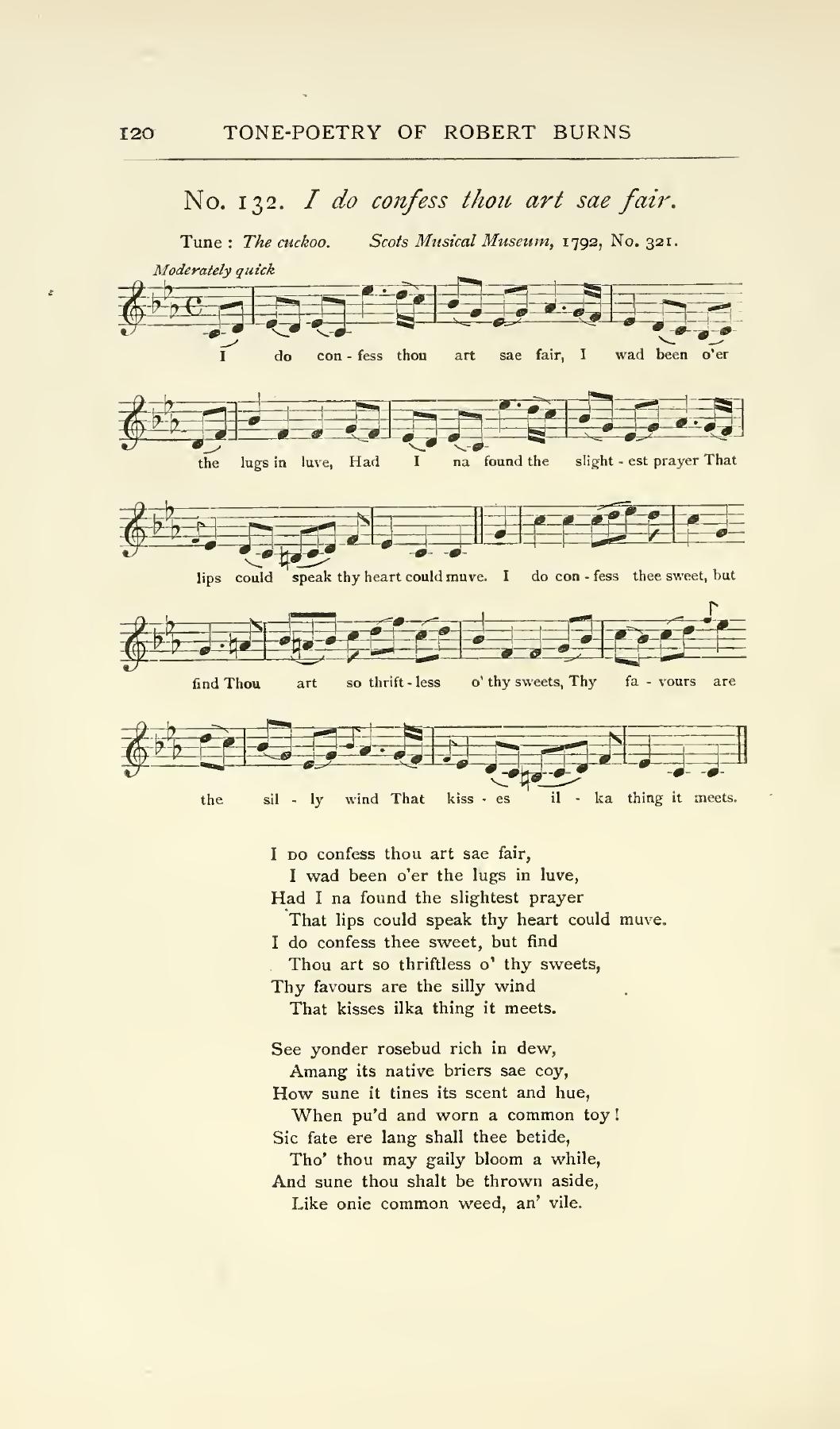 View score Dick’s Songs of Robert Burns (1903)
Lyrics
Choose an edition
Cunningham (1855)
I do confess thou art sae fair,
  I wad been o’er the lugs in love,
Had I na found the slightest prayer
  That lips could speak thy heart could muve.
I do confess thee sweet, but find
  Thou art sae thriftless o’ thy sweets,
Thy favours are the silly wind,
  That kisses ilka thing it meets.

See yonder rose-bud, rich in dew,
  Amang its native briers sae coy;
How sune it tines its scent and hue
  When pou’d and worn a common toy!
Sic fate, ere lang, shall thee betide,
  Tho’ thou may gaily bloom awhile;
Yet sune thou shalt be thrown aside
  Like ony common weed and vile.
Digital text from Project Gutenberg.
View the source edition · p. 245
About this edition
Cunningham’s preface discusses several poems he left out of the collection.
Dick (1903) · no. 132
The words are on the score page.
View the source edition · no. 132; p. 120
Scots Musical Museum, vol. IV (1792) · no. 321
View the source edition · Volume 4, no. 321; p. 332
Music
View historical scores
Dick’s Songs of Robert Burns (1903)
no. 132; p. 120
Adaptation attributed to Burns
Cunningham attributes the original to Sir Robert Aytoun and quotes Burns describing his Scottish adaptation.
Words Robert Burns, adapting a song attributed to Sir Robert Aytoun
Burns’s role Adaptation attributed to Burns