There’ll never be peace till Jamie comes hame
Behind the song
Seven sons took up the sword for Jamie. Beside a castle wall at dusk, their grey-haired father sings through his tears. All seven lie in their graves, and grief has broken his wife’s heart. Still he sings that there will never be peace till Jamie comes home. [1]
The old man sees a ruined church and a country at war. People know where the blame lies, he says, though few dare say it aloud. He counts the crown among his losses and expects to die with the same refrain on his lips. [1]
Read the fuller story
Dick quotes a letter to Alexander Cunningham dated 12 March 1791 in which Burns sent the song and discussed the use of political history by historians and poets. In Dick’s text, Burns asks his friend to lend the song the charm of his voice for a few companions who share that pleasure. The correspondence presents the lament as something to be sung among friends as well as read. [2]
Dick prints four quatrains across two pages, each closing with the separately quoted refrain. Cunningham groups the same sixteen lines into two numbered eight-line blocks and changes a number of words. The tune title names Jamie in Dick and Willie in Cunningham. Dick quotes an Interleaved Museum note in which Burns says that he knew only the title of an older song attached to the air. The selected setting is directed With pathos. [1][3][2]
Story references
- James C. Dick, The Songs of Robert Burns (1903), No. 302; printed pp. 283–284; PDF pp. 339–340
- James C. Dick, The Songs of Robert Burns (1903), Dick note 302; printed 472; PDF 528
- Allan Cunningham, The Complete Works of Robert Burns (1855), printed 245; HTML #songsXCIX. Project Gutenberg transcription.
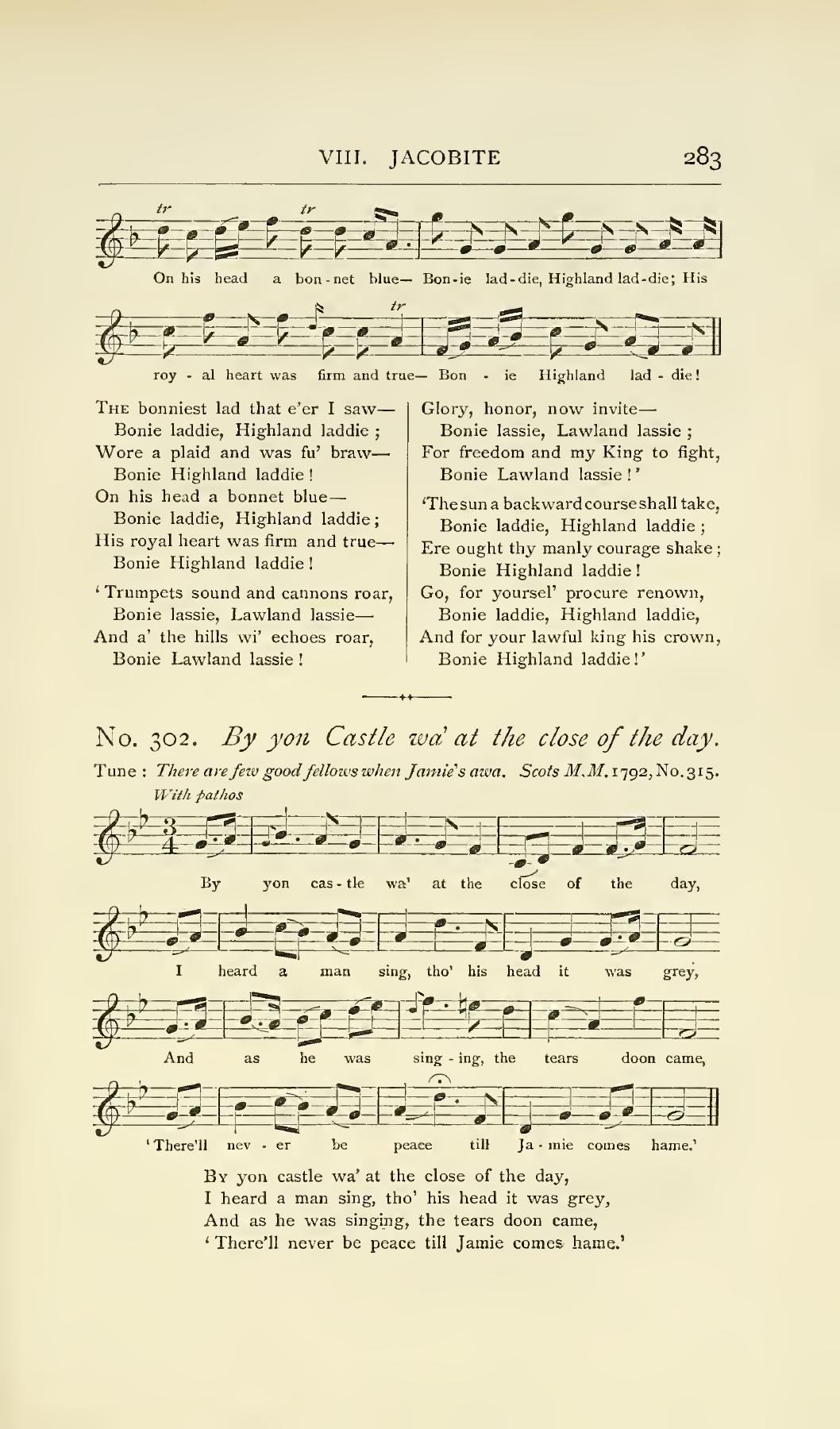 View score Dick’s Songs of Robert Burns (1903)
Lyrics
Choose an edition
Version notes
| Dick (1903) · no. 302 | Cunningham · 1855Ebook transcription |
|---|---|
| four unnumbered quatrains with quoted refrain | two numbered eight-line blocks without speech quotes |
| doon | down |
| but we ken | though we ken |
| But now I greet | And now I greet |
More differences between these editions
| Dick (1903) · no. 302 | Cunningham · 1855Ebook transcription |
|---|---|
| burden | burthen |
| Sin I tint | Since I tint |
| There are few good fellows when Jamie’s awa | There art few gude fellows when Willie’s awa |
Dick (1903) · no. 302
By yon castle wa' at the close of the day,
I heard a man sing, tho' his head it was grey,
And as he was singing, the tears doon came,
'There'll never be peace till Jamie comes hame.'

The Church is in ruins, the State is in jars;
Delusions, oppressions, and murderous wars,
We darena weel say't, but we ken wha's to blame—
'There'll never be peace till Jamie comes hame.'

My seven braw sons for Jamie drew sword,
But now I greet round their green beds in the yerd;
It brak the sweet heart o' my faithfu' auld dame—
'There'll never be peace till Jamie comes hame.'

Now life is a burden that bows me down,
Sin I tint my bairns, and he tint his crown;
But till my last moments my words are the same—
'There'll never be peace till Jamie comes hame.'
View the source edition · no. 302; pp. 283–284
About this edition
Dick prints four quatrains and puts quotation marks around each closing refrain. Cunningham groups the lines into two numbered eight-line blocks. Dick reads doon, but we ken, But now I greet, burden and Sin I tint against Cunningham’s down, though we ken, And now I greet, burthen and Since I tint. The tune headings differ in both wording and Jamie/Willie.
Cunningham (1855)
By yon castle wa’, at the close of the day,
I heard a man sing, though his head it was gray;
And as he was singing the tears down came,
There’ll never be peace till Jamie comes hame.
The church is in ruins, the state is in jars;
Delusions, oppressions, and murderous wars:
We darena weel say’t, though we ken wha’s to blame,
There’ll never be peace till Jamie comes hame!

My seven braw sons for Jamie drew sword,
And now I greet round their green beds in the yerd.
It brak the sweet heart of my faithfu’ auld dame—
There’ll never be peace till Jamie comes hame.
Now life is a burthen that bows me down,
Since I tint my bairns, and he tint his crown;
But till my last moments my words are the same—
There’ll never be peace till Jamie comes hame!
Digital text from Project Gutenberg.
View the source edition · p. 245
About this edition
Dick prints four quatrains and puts quotation marks around each closing refrain. Cunningham groups the lines into two numbered eight-line blocks. Dick reads doon, but we ken, But now I greet, burden and Sin I tint against Cunningham’s down, though we ken, And now I greet, burthen and Since I tint. The tune headings differ in both wording and Jamie/Willie.
Scots Musical Museum, vol. IV (1792) · no. 315
View the source edition · Volume 4, no. 315; p. 326
Music
View historical scores
Dick’s Songs of Robert Burns (1903)
no. 302; pp. 283–284