O meikle thinks my luve o’ my beauty
Behind the song
Her suitor praises her looks and her family. She knows what draws him to the tree for its apples, and to her for her dowry. She tells him to seek his fortune elsewhere. Allan Cunningham credits Burns with writing the verses for the Scots Musical Museum. [1]
Read the fuller story
The first stanza turns compliments into evidence of self-interest. The lover tends the tree for its apple and the bee for its honey: the images reduce his care to the profit he expects. His affection is so occupied by money that the speaker sees little left for herself.[1]
The second stanza makes courtship a bargain. His offer of love is compared to an earnest payment, with the dowry as the purchase he hopes to secure. She declares herself a match for his cunning, refuses the transaction and predicts damage to his credit. The song’s energy comes from a speaker who can name the deception and dismiss its author.[1]
The heading names “My tocher’s the jewel” as tune. Cunningham says Burns wrote the words for an air by Oswald but wished them sung to “Lord Elcho’s favourite”. That distinction places the lyric within a choice of musical settings, while its two stanzas remain centred on the woman’s refusal to mistake a financial bargain for affection.[1]
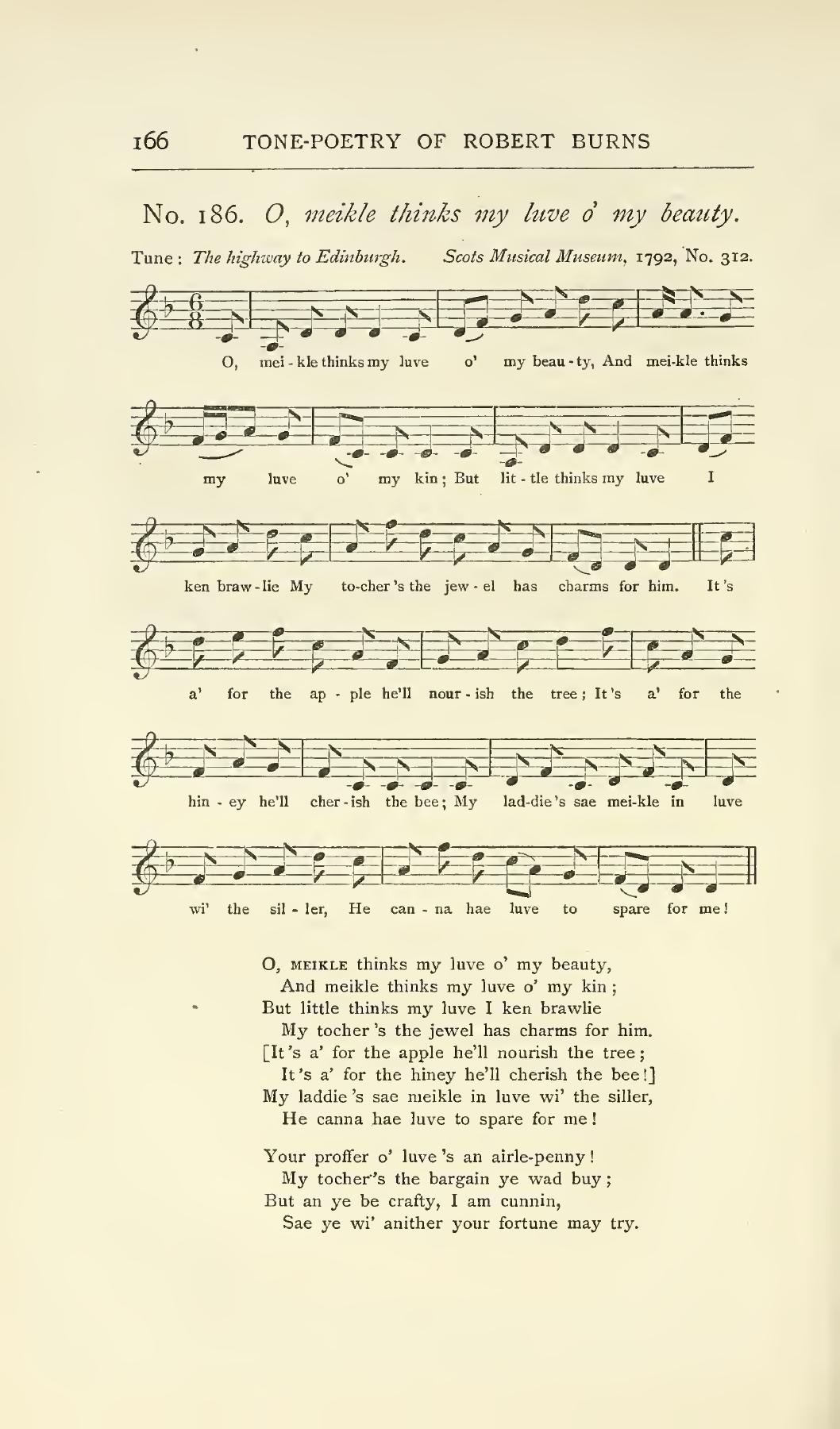 View score Dick’s Songs of Robert Burns (1903)
Lyrics
Choose an edition
Cunningham (1855)
O Meikle thinks my luve o’ my beauty,
  And meikle thinks my luve o’ my kin;
But little thinks my luve I ken brawlie
  My tocher’s the jewel has charms for him.
It’s a’ for the apple he’ll nourish the tree;
  It’s a’ for the hiney he’ll cherish the bee;
My laddie’s sae meikle in luve wi’ the siller,
  He canna hae lure to spare for me.

Your proffer o’ luve’s an airl-penny,
  My tocher’s the bargain ye wad buy;
But an ye be crafty, I am cunnin’,
  Sae ye wi’ anither your fortune maun try.
Ye’re like to the timmer o’ yon rotten tree,
  Ye’ll slip frae me like a knotless thread,
And ye’ll crack your credit wi’ mae nor me.
Digital text from Project Gutenberg.
View the source edition · p. 244
About this edition
Cunningham’s preface discusses several poems he left out of the collection.
Dick (1903) · no. 186
The words are on the score page.
View the source edition · no. 186; p. 166
Scots Musical Museum, vol. IV (1792) · no. 312
View the source edition · Volume 4, no. 312; p. 322
Music
View historical scores
Dick’s Songs of Robert Burns (1903)
no. 186; p. 166