Cock up your Beaver
Behind the song
Johnnie arrives with a blue bonnet whose crown is missing. A hat and feather give him a new appearance, and the song urges him to cock his beaver proudly. Its second verse turns that display into a boast about crossing the border and teaching somebody better behaviour.
Read the fuller story
The repeated address to “brave Johnnie lad” makes the change of headgear a shared celebration. The hat becomes part of the swagger: “fu’ sprush” leads straight into the promise to give the people over the border a brush. The short song ends by returning to Johnnie and his hat.
Cunningham describes an older song enlarged and amended by Burns. He assigns Burns the last verse apart from its final line, together with amendments to several lines of the first. The same headnote quotes Sir Harris Nicolas saying that the Museum printed the song without Burns’s name. Cunningham’s account places Burns’s contribution within words already in circulation.[1]
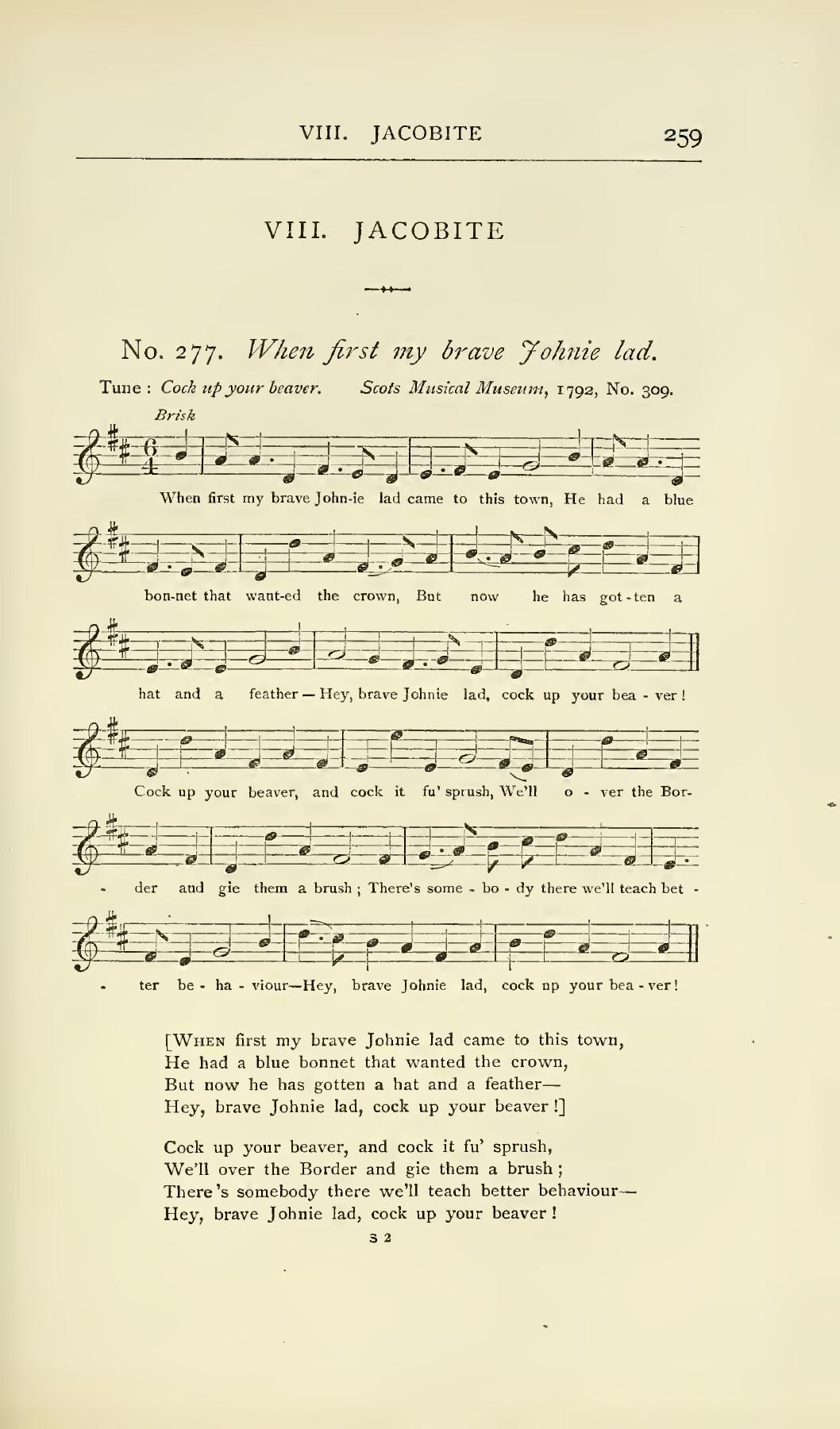 View score Dick’s Songs of Robert Burns (1903)
Lyrics
Choose an edition
Cunningham (1855)
When first my brave Johnnie lad
  Came to this town,
He had a blue bonnet
  That wanted the crown;
But now he has gotten
  A hat and a feather,—
Hey, brave Johnnie lad,
  Cock up your beaver!

Cock up your beaver,
  And cock it fu’ sprush,
We’ll over the border
  And gie them a brush;
There’s somebody there
  We’ll teach better behaviour—
Hey, brave Johnnie lad,
  Cock up your beaver!
Digital text from Project Gutenberg.
View the source edition · p. 244
About this edition
Cunningham’s preface discusses several poems he left out of the collection.
Dick (1903) · no. 277
The words are on the score page.
View the source edition · no. 277; p. 259
Scots Musical Museum, vol. IV (1792) · no. 309
View the source edition · Volume 4, no. 309; p. 319
Music
View historical scores
Dick’s Songs of Robert Burns (1903)
no. 277; p. 259
Reworking attributed to Burns
Cunningham credits Burns with most of the last verse and amendments within the first verse of an older song.
Words Robert Burns and the earlier song tradition
Burns’s role Reworking attributed to Burns