Frae the friends and land I love
Behind the song
Exile spoils every pleasure the singer can remember. Even the brightest foreign shore looks dark. Labour and care lie ahead, and the singer longs for friends, homeland and the person most dear. [1]
Then the solitary voice speaks for a company of banished people. Revenge wears a laurel crown, and the loyal men may yet cross the sea and recover their own. Burns said he added the last four lines to give the poem this turn. [1][2][3]
Read the fuller story
Both editors quote Burns saying that he added the last four lines to give the poem’s theme a turn. Cunningham conjectures that the remainder may also be his, while Dick reports failing to find an earlier song. [2][3]
Dick places the lyric within a series of Jacobite songs in the Museum. His own setting is headed Carron side and marked Plaintive; Cunningham gives the same air as Carron Side. Dick says he has used an earlier copy of the melody in place of the Museum’s setting. [2][1][3]
Story references
- James C. Dick, The Songs of Robert Burns (1903), No. 305; printed pp. 286–286; PDF pp. 342–342
- James C. Dick, The Songs of Robert Burns (1903), Dick note 305; printed 473; PDF 529
- Allan Cunningham, The Complete Works of Robert Burns (1855), printed 243; HTML #songsXCIV. Project Gutenberg transcription.
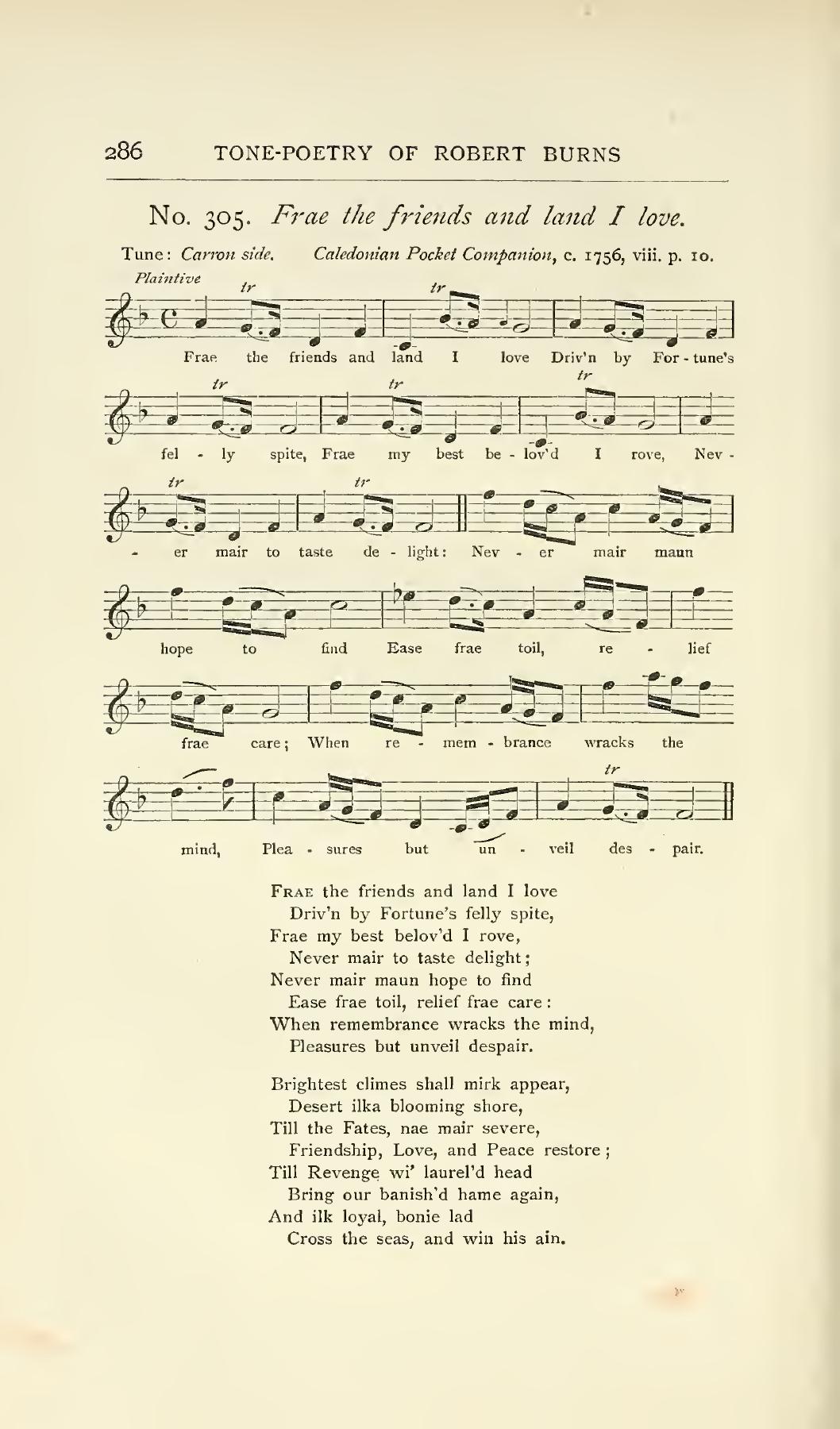 View score Dick’s Songs of Robert Burns (1903)
Lyrics
Choose an edition
Version notes
| Dick (1903) · no. 305 | Cunningham · 1855Ebook transcription |
|---|---|
| laurel’d / ilk loyal, bonie | laurell’d / ilka loyal bonnie |
| Fortune / Love / Peace | fortune / love / peace |
Dick (1903) · no. 305
Frae the friends and land I love
Driv'n by Fortune's felly spite,
Frae my best belov'd I rove,
Never mair to taste delight;
Never mair maun hope to find
Ease frae toil, relief frae care:
When remembrance wracks the mind,
Pleasures but unveil despair.

Brightest climes shall mirk appear,
Desert ilka blooming shore,
Till the Fates, nae mair severe,
Friendship, Love, and Peace restore;
Till Revenge wi' laurel'd head
Bring our banish'd hame again,
And ilk loyal, bonie lad
Cross the seas, and win his ain.
View the source edition · no. 305; p. 286
About this edition
Both editions print two eight-line stanzas. Dick has laurel’d and ilk loyal, bonie; Cunningham has laurell’d and ilka loyal bonnie. Dick capitalises Fortune, Love and Peace. Cunningham adds commas after love and find in the opening stanza and around the Revenge phrase, with a semicolon after again where Dick has a comma.
Cunningham (1855)
Frae the friends and land I love,
  Driv’n by fortune’s felly spite,
Frae my best belov’d I rove,
  Never mair to taste delight;
Never mair maun hope to find,
  Ease frae toil, relief frae care:
When remembrance wracks the mind,
  Pleasures but unveil despair.

Brightest climes shall mirk appear,
  Desert ilka blooming shore,
Till the Fates, nae mair severe,
  Friendship, love, and peace restore;
Till Revenge, wi’ laurell’d head,
  Bring our banish’d hame again;
And ilka loyal bonnie lad
  Cross the seas and win his ain.
Digital text from Project Gutenberg.
View the source edition · p. 243
About this edition
Both editions print two eight-line stanzas. Dick has laurel’d and ilk loyal, bonie; Cunningham has laurell’d and ilka loyal bonnie. Dick capitalises Fortune, Love and Peace. Cunningham adds commas after love and find in the opening stanza and around the Revenge phrase, with a semicolon after again where Dick has a comma.
Scots Musical Museum, vol. IV (1792) · no. 302
View the source edition · Volume 4, no. 302; p. 312
Music
View historical scores
Dick’s Songs of Robert Burns (1903)
no. 305; p. 286