The Banks of Nith
Behind the song
The Thames can keep its royal cities. The singer would rather be by the winding Nith, and asks why Fortune is keeping him from the valleys and friends among whom he would like to spend his last days. [1]
Read the fuller story
The first stanza sets public grandeur beside personal attachment. The Nith matters through a winding stream and an honoured land the speaker longs to see again. Repeated questions blame adverse Fortune for keeping him away, giving the comparison its homesick urgency. [1]
The second stanza brings the river country closer through blooming hawthorns, sloping dales and lambs playing among the broom. The hope at its close is modest and intimate: after wandering, to end beside the river among friends of early days. Cunningham’s headnote adds an account of changing family power along the Nith, naming the Comyns, Douglasses, Charterises, Maxwells, Johnstones and Scots. That historical outline is the editor’s perspective on the land named in the song. [1]
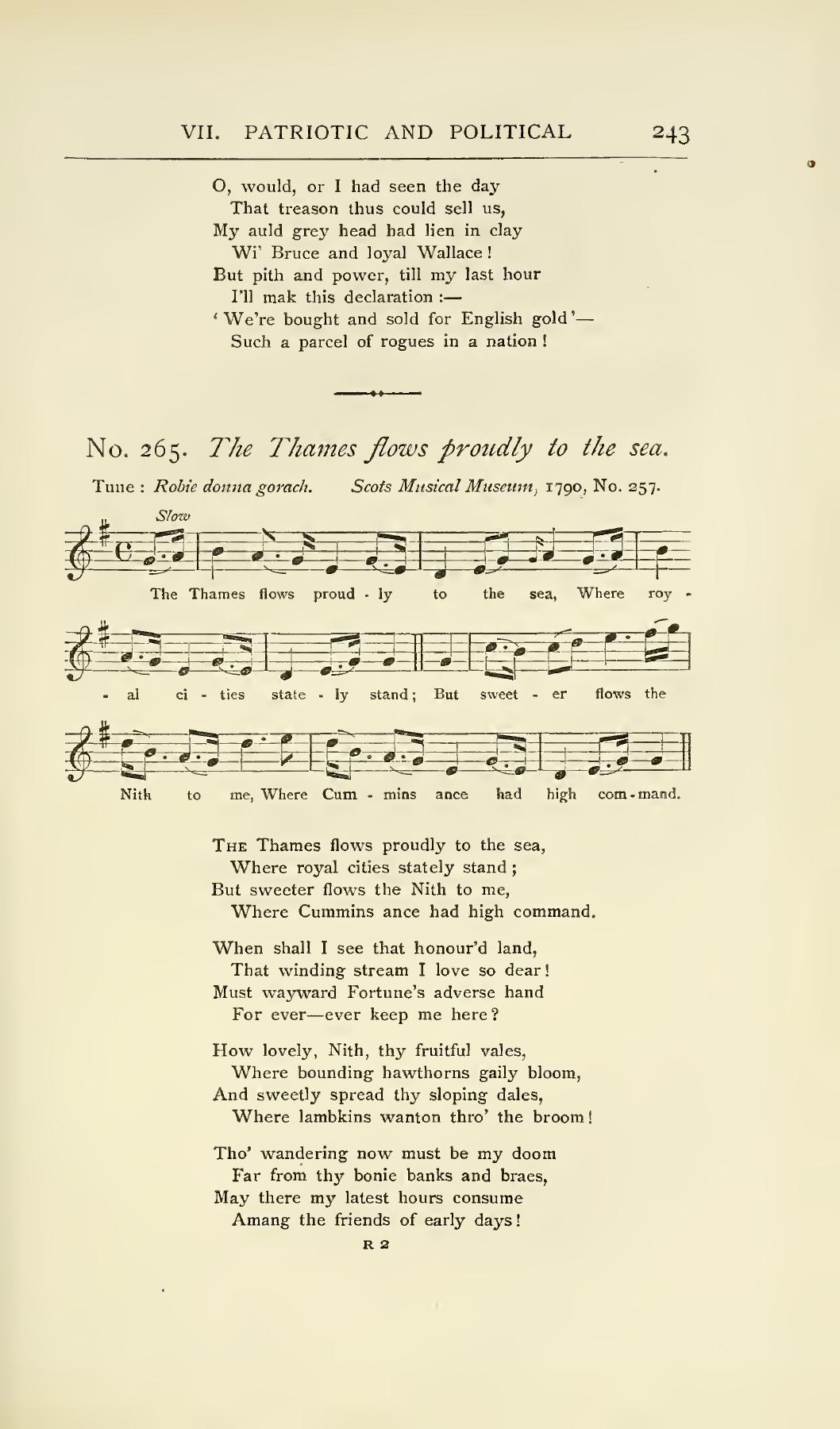 View score Dick’s Songs of Robert Burns (1903)
Lyrics
Choose an edition
Cunningham (1855)
The Thames flows proudly to the sea,
  Where royal cities stately stand;
But sweeter flows the Nith, to me,
  Where Comyns ance had high command:
When shall I see that honour’d land,
  That winding stream I love so dear!
Must wayward Fortune’s adverse hand
  For ever, ever keep me here?

How lovely, Nith, thy fruitful vales,
  Where spreading hawthorns gaily bloom!
How sweetly wind thy sloping dales,
  Where lambkins wanton thro’ the broom!
Tho’ wandering now, must be my doom,
  Far from thy bonnie banks and braes,
May there my latest hours consume,
  Amang the friends of early days!
Digital text from Project Gutenberg.
View the source edition · p. 242
About this edition
Cunningham’s preface discusses several poems he left out of the collection.
Dick (1903) · no. 265
The words are on the score page.
View the source edition · no. 265; p. 243
Scots Musical Museum, vol. III (1790) · no. 295
View the source edition · Volume 3, no. 295; p. 305
Music
View historical scores
Dick’s Songs of Robert Burns (1903)
no. 265; p. 243