The braes o’ Killiecrankie, O
Behind the song
A smartly dressed lad is asked if he came by Killiecrankie. Anyone who had seen what he saw, the refrain replies, would look a good deal less cheerful. [1]
The lad has fought on land and sea and even battled his aunt. Now he remembers the devil and Dundee. Dick identifies the Clavers of the last verse as John Claverhouse, who died at Killiecrankie in 1689. The lad imagines an Atholl kite feeding on him if he had stayed there. [1][3]
Read the fuller story
Cunningham assigns the song to Burns and says he sent it to Johnson in his own handwriting. Dick finds the direct connection less secure, while transmitting Stenhouse’s statement that the chorus was old and Burns wrote the remaining verses in 1789. [2][3]
Dick places the battle in 1689 and identifies Clavers with John Claverhouse, killed there. His tune heading is An ye had been where I hae been, while Cunningham names Killiecrankie. Dick distinguishes this melody from the different Killiecrankie air used at no256. [3][1][2]
Story references
- James C. Dick, The Songs of Robert Burns (1903), No. 300; printed pp. 282–282; PDF pp. 338–338
- Allan Cunningham, The Complete Works of Robert Burns (1855), printed 241; HTML #songsXC. Project Gutenberg transcription.
- James C. Dick, The Songs of Robert Burns (1903), Dick note 300; printed 471,472; PDF 527,528
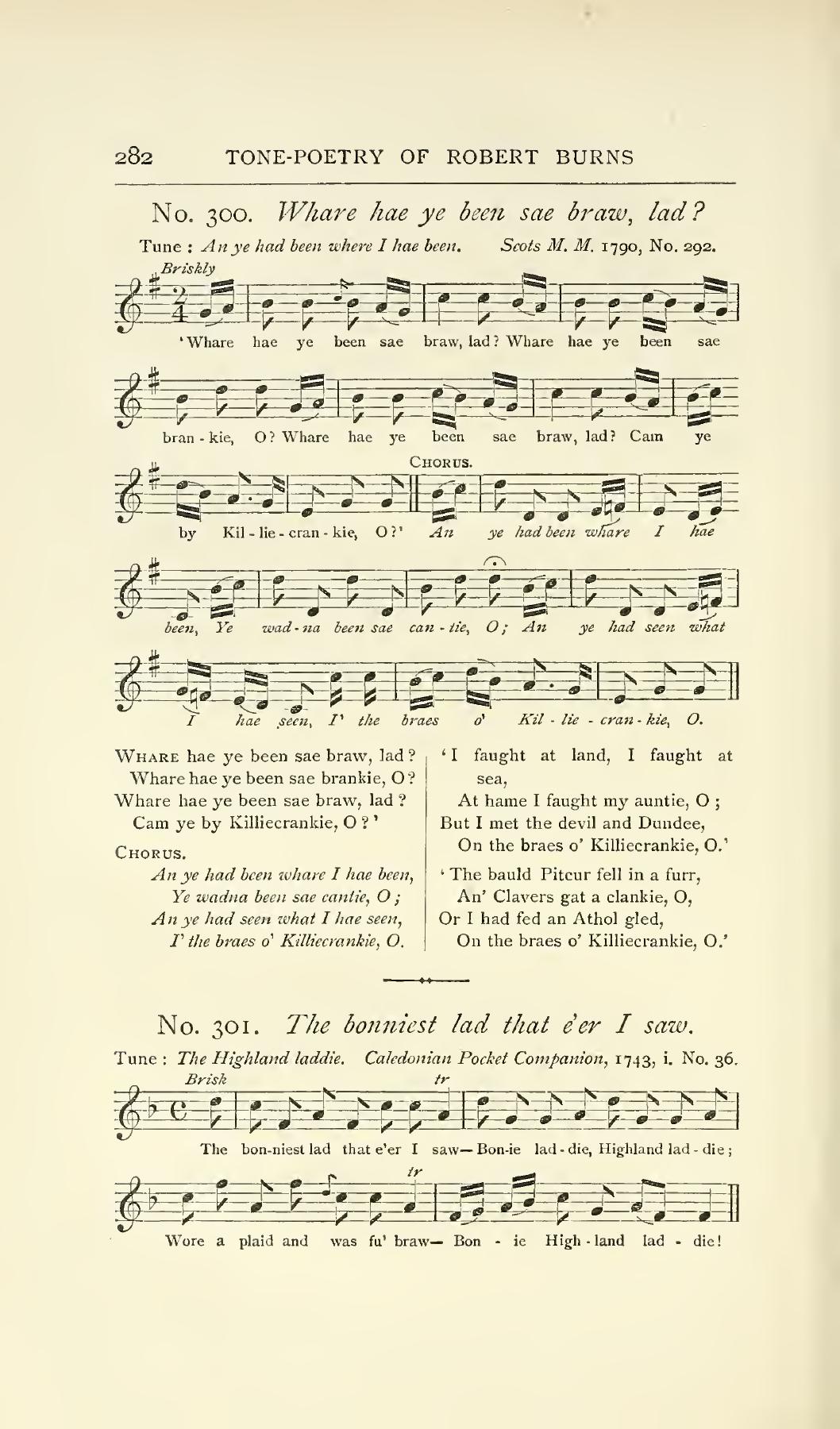 View score Dick’s Songs of Robert Burns (1903)
Lyrics
Choose an edition
Version notes
| Dick (1903) · no. 300 | Cunningham · 1855Ebook transcription |
|---|---|
| An ye / wadna / sae / I’ the braes | An’ ye / wad na / so / On the braes |
| faught / devil and | fought / Devil an’ |
| Clavers gat | Claver’se got |
| fed an Athol gled | fed on Athole gled |
More differences between these editions
| Dick (1903) · no. 300 | Cunningham · 1855Ebook transcription |
|---|---|
| opening question, separate chorus, two further quatrains | two numbered eight-line stanzas |
| Dundee quatrain ends O.’; Pitcur quatrain begins ‘The bauld | No speech quotation marks in Cunningham’s answering stanza |
Dick (1903) · no. 300
Whare hae ye been sae braw, lad?
Whare hae ye been sae brankie, O?
Whare hae ye been sae braw, lad?
Cam ye by Killiecrankie, O?'

Chorus. An ye had been whare I hae been,
Ye wadna been sae cantie, O;
An ye had seen what I hae seen,
I' the braes o' Killiecrankie, O.

'I faught at land, I faught at sea,
At hame I faught my auntie, O;
But I met the devil and Dundee,
On the braes o' Killiecrankie, O.'

'The bauld Pitcur fell in a furr,
An' Clavers gat a clankie, O,
Or I had fed an Athol gled,
On the braes o' Killiecrankie, O.'
View the source edition · no. 300; p. 282
About this edition
Dick separates the question, chorus and two answering quatrains; Cunningham groups the sixteen lines into two eight-line stanzas. Dick has faught, Clavers gat and fed an Athol gled; Cunningham has fought, Claver’se got and fed on Athole gled. Dick’s chorus has An ye, wadna, sae and I’ the braes, against Cunningham’s An’ ye, wad na, so and On the braes. Cunningham supplies an additional O before the third opening question. Dick closes the Dundee answering quatrain with a quotation mark and begins the Pitcur quatrain with a fresh one; Cunningham prints these passages without speech quotation marks.
Cunningham (1855)
Whare hae ye been sae braw, lad?
  Whare hae ye been sae brankie, O?
O, whare hae ye been sae braw, lad?
  Cam ye by Killiecrankie, O?
An’ ye had been whare I hae been,
  Ye wad na been so cantie, O;
An’ ye had seen what I hae seen,
  On the braes o’ Killiecrankie, O.

I fought at land, I fought at sea;
  At hame I fought my auntie, O;
But I met the Devil an’ Dundee,
  On the braes o’ Killiecrankie, O.
The bauld Pitcur fell in a furr,
  An’ Claver'se got a clankie, O;
Or I had fed on Athole gled,
  On the braes o’ Killiecrankie, O.
Digital text from Project Gutenberg.
View the source edition · p. 241
About this edition
Dick separates the question, chorus and two answering quatrains; Cunningham groups the sixteen lines into two eight-line stanzas. Dick has faught, Clavers gat and fed an Athol gled; Cunningham has fought, Claver’se got and fed on Athole gled. Dick’s chorus has An ye, wadna, sae and I’ the braes, against Cunningham’s An’ ye, wad na, so and On the braes. Cunningham supplies an additional O before the third opening question. Dick closes the Dundee answering quatrain with a quotation mark and begins the Pitcur quatrain with a fresh one; Cunningham prints these passages without speech quotation marks.
Scots Musical Museum, vol. III (1790) · no. 292
View the source edition · Volume 3, no. 292; p. 302
Music
View historical scores
Dick’s Songs of Robert Burns (1903)
no. 300; p. 282