O Willie brewed a peck o’ maut
Behind the song
Willie has made the drink, and Rob and Allan have come to help him finish it. The three insist they are only a little drunk. Let the cock crow and the daylight come. They mean to stay where they are and try the barley bree, the liquor brewed from the grain. [1]
Dick’s account names the friends as William Nicol, Burns and Allan Masterton. In the song even the moon has to wait for them. The first man to leave is a coward and the first man to fall beside his chair earns a crown. [1][2]
Read the fuller story
Dick prints Burns's account of a visit to William Nicol at Moffat during the autumn vacation. Allan Masterton, then visiting Dalswinton, went with Burns. The meeting was so joyous that poet and musician agreed to celebrate it, each in his own way. Dick dates the occasion to autumn 1789 and attributes the air to Masterton through Burns's quoted note. [2]
Cunningham names the same three men but locates the scene at Nicol's small estate of Laggan, in Nithsdale, and calls it a house-heating. He repeats the joyous-meeting quotation. The two editorial accounts share that reported testimony while differing over the setting and occasion. [2][3]
The printed texts differ at the climax. Dick makes the man who falls “first” beside his chair the king; Cunningham has “last”. Dick's tune heading repeats Willie brew'd a peck o' maut, with the direction “Blythely” above a setting in common time. [1][3]
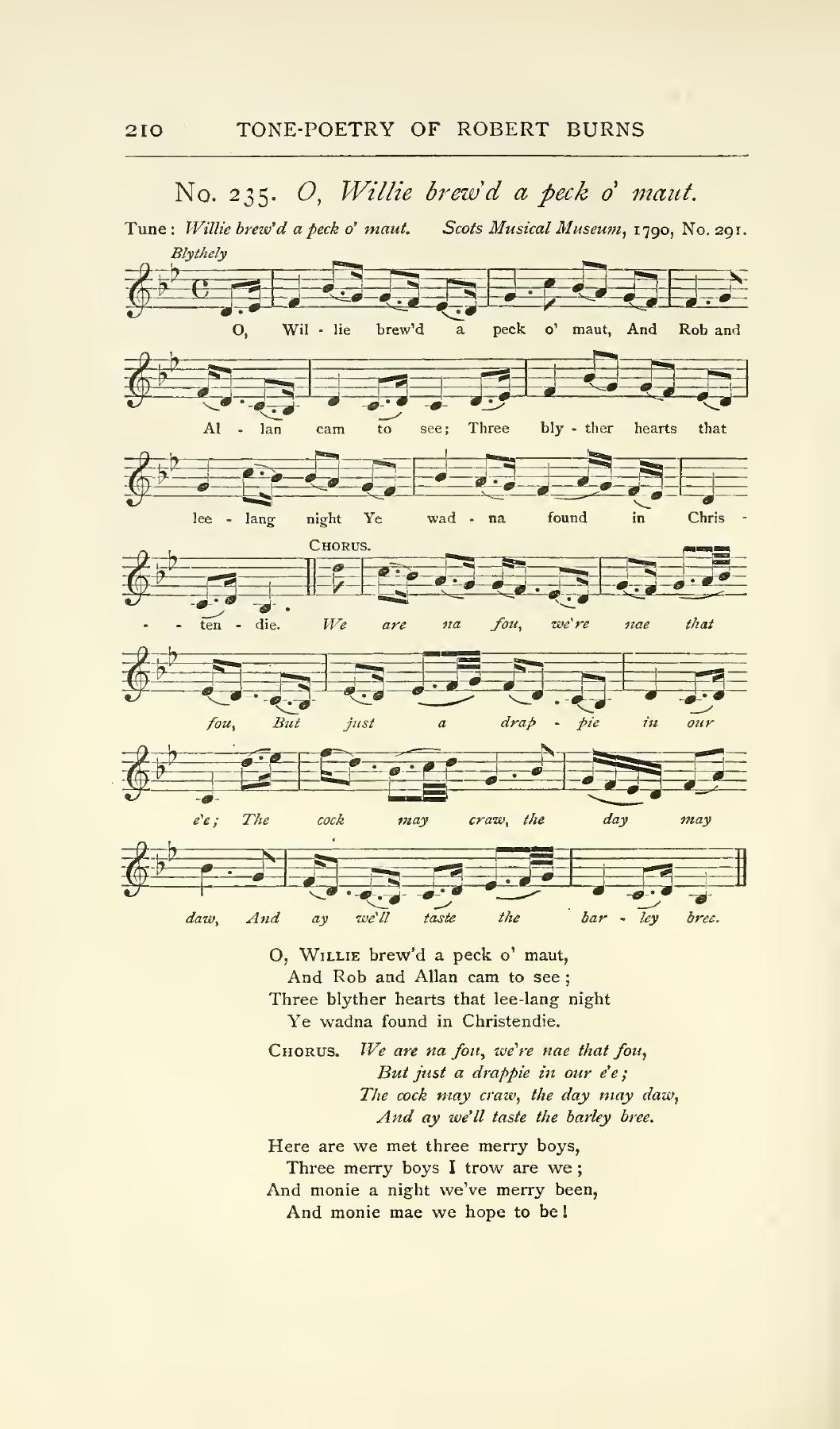 View score Dick’s Songs of Robert Burns (1903)
Lyrics
Choose an edition
Version notes
| Dick (1903) · no. 235 | Cunningham · 1855Ebook transcription |
|---|---|
| Wha first beside his chair shall fa’ | Wha last beside his chair shall fa’ |
| we’re nae that fou | we’re no that fou |
| chorus printed after stanzaI | chorus printed after stanzaI and stanzaIV |
Dick (1903) · no. 235
O, Willie brew'd a peck o' maut,
And Rob and Allan cam to see;
Three blyther hearts that lee-lang night
Ye wadna found in Christendie.

Chorus. We are na fou, we're nae that fou,
But just a drappie in our e'e;
The cock may craw, the day may daw,
And ay we'll taste the barley bree.

Here are we met three merry boys,
Three merry boys I trow are we;
And monie a night we've merry been,
And monie mae we hope to be!

It is the moon, I ken her horn,
That's blinkin in the lift sae hie:
She shines sae bright to wyle us hame,
But, by my sooth, she'll wait a wee!

Wha first shall rise to gang awa,
A cuckold, coward loun is he!
Wha first beside his chair shall fa',
He is the king amang us three!
These are the words printed below the score.
View the source edition · no. 235; pp. 210–211
About this edition
Four quatrains and a chorus in both editions; Cunningham repeats the chorus at the end. Dick’s final stanza prints “Wha first beside his chair shall fa’”; Cunningham has “Wha last”. This consequential edition difference is retained without silent correction.
Cunningham (1855)
O, Willie brew’d a peck o’ maut,
  And Rob and Allan came to see:
Three blither hearts, that lee-lang night
  Ye wad na find in Christendie.
    We are na fou, we’re no that fou,
      But just a drappie in our e’e;
    The cock may craw, the day may daw,
      And aye we’ll taste the barley bree.

Here are we met, three merry boys,
  Three merry boys, I trow, are we;
And mony a night we’ve merry been,
  And mony mae we hope to be!

It is the moon—I ken her horn,
  That’s blinkin in the lift sae hie;
She shines sae bright to wyle us hame,
  But, by my sooth, she’ll wait a wee!

Wha first shall rise to gang awa’,
  A cuckold, coward loon is he!
Wha last beside his chair shall fa’,
  He is the king amang us three!
    We are na fou, we’re no that fou,
      But just a drappie in our e’e;
    The cock may craw, the day may daw,
      And aye we’ll taste the barley bree.
Digital text from Project Gutenberg.
View the source edition · p. 241
About this edition
Four quatrains and a chorus in both editions; Cunningham repeats the chorus at the end. Dick’s final stanza prints “Wha first beside his chair shall fa’”; Cunningham has “Wha last”. This consequential edition difference is retained without silent correction.
Scots Musical Museum, vol. III (1790) · no. 291
View the source edition · Volume 3, no. 291; p. 301
Music
View historical scores
Dick’s Songs of Robert Burns (1903)
no. 235; pp. 210–211