Young Jockey was the blithest lad
Behind the song
Jockey whistles at work and dances lightly in the hall. The speaker remembers his private compliments, then watches eagerly for the oxen that signal his return from the plain. Work in wind, wet, frost and snow gives way to the embrace and promise renewed at night.
Read the fuller story
The two stanzas join a cheerful public figure to an intimate relationship. Praise of blue eyes and a small waist brings the speaker’s heart to her mouth. The second stanza settles into repeated returns: Jockey comes home, night comes round, and his vow lasts as long as he can draw breath.
Cunningham says all but three or four lines are Burns’s work, although the Museum marks it as an old song with additions. He suggests that Burns sometimes found making new verses easier than modifying old ones. For this song, his account leaves a small inherited element within a largely Burns-attributed text.[1]
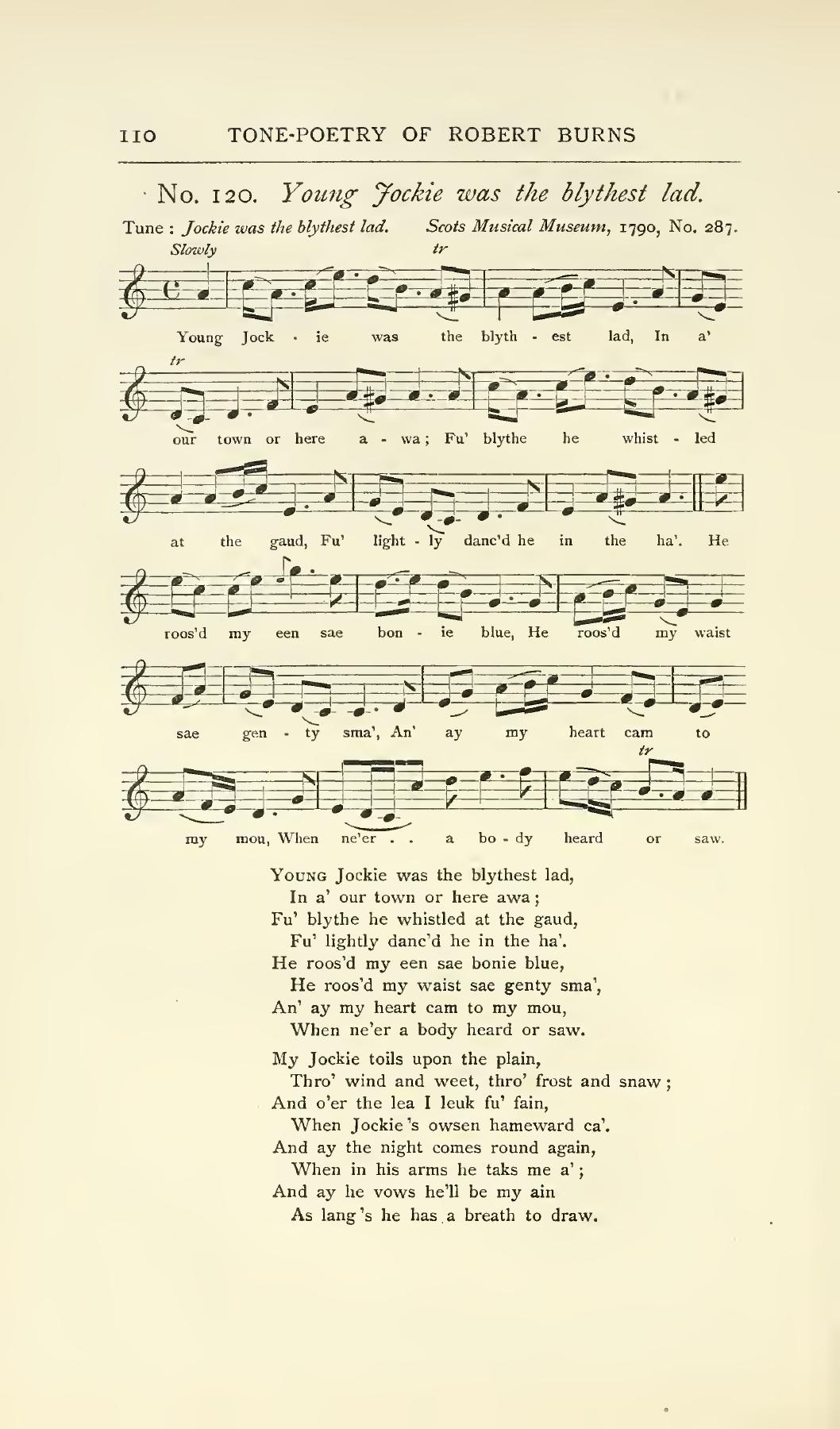 View score Dick’s Songs of Robert Burns (1903)
Lyrics
Choose an edition
Cunningham (1855)
Young Jockey was the blythest lad
  In a’ our town or here awa:
Fu’ blythe he whistled at the gaud,
  Fu’ lightly danced he in the ha’.
He roosed my een, sae bonnie blue,
  He roos’d my waist sae genty sma’,
And ay my heart came to my mou’
  When ne’er a body heard or saw.

My Jockey toils upon the plain,
  Thro’ wind and weet, thro’ frost and snaw;
And o’er the lea I leuk fu’ fain,
  When Jockey’s owsen hameward ca’.
An’ ay the night comes round again,
  When in his arms he takes me a’,
An’ ay he vows he’ll be my ain,
  As lang’s he has a breath to draw.
Digital text from Project Gutenberg.
View the source edition · p. 241
About this edition
Cunningham’s preface discusses several poems he left out of the collection.
Dick (1903) · no. 120
The words are on the score page.
View the source edition · no. 120; p. 110
Scots Musical Museum, vol. III (1790) · no. 287
View the source edition · Volume 3, no. 287; p. 297
Music
View historical scores
Dick’s Songs of Robert Burns (1903)
no. 120; p. 110
Reworking attributed to Burns
Cunningham credits Burns with all but three or four lines and reports an old-song-with-additions Museum label.
Words Robert Burns with three or four older lines, according to Cunningham
Burns’s role Reworking attributed to Burns