The Battle of Sherriff-muir
Behind the song
Two men argue over the battle at Sheriffmuir, fought in 1715. Did you come to fight, one asks, or to get out of the way? The other remembers blood, noise and the Highland clans bearing down. Each man’s account seems to send a different army running. [1][2]
The redcoats charge, swords clash, and then somebody interrupts to question who was chasing whom. Sister Kate supplies yet another account. By the end it sounds like two battles, with Tory and Whig dead lying together. [1]
Read the fuller story
Dick connects the song with the battle fought in 1715 and describes Burns’s model as a dialogue by the Rev John Barclay. Cunningham also presents the lyric as Burns’s reshaping of Barclay’s dialogue, explaining the revision through dissatisfaction with its handling of the Highland clans. [2][3]
The editions preserve substantially different passages in the last two stanzas. Dick ends Kate’s report with men fleeing home, while Cunningham ends it with “And so it goes, you see, man”; Cunningham’s final stanza also expands the account of weapons and dying cries. Both name Cameronian Rant as the air; Dick marks his score Brisk, matching the rush of internal rhymes in the fighting lines. [1][3]
Story references
- James C. Dick, The Songs of Robert Burns (1903), No. 280; printed pp. 262–263; PDF pp. 318–319
- James C. Dick, The Songs of Robert Burns (1903), Dick note 280; printed 462,463,464; PDF 518,519,520
- Allan Cunningham, The Complete Works of Robert Burns (1855), printed 240; HTML #songsLXXXVII. Project Gutenberg transcription.
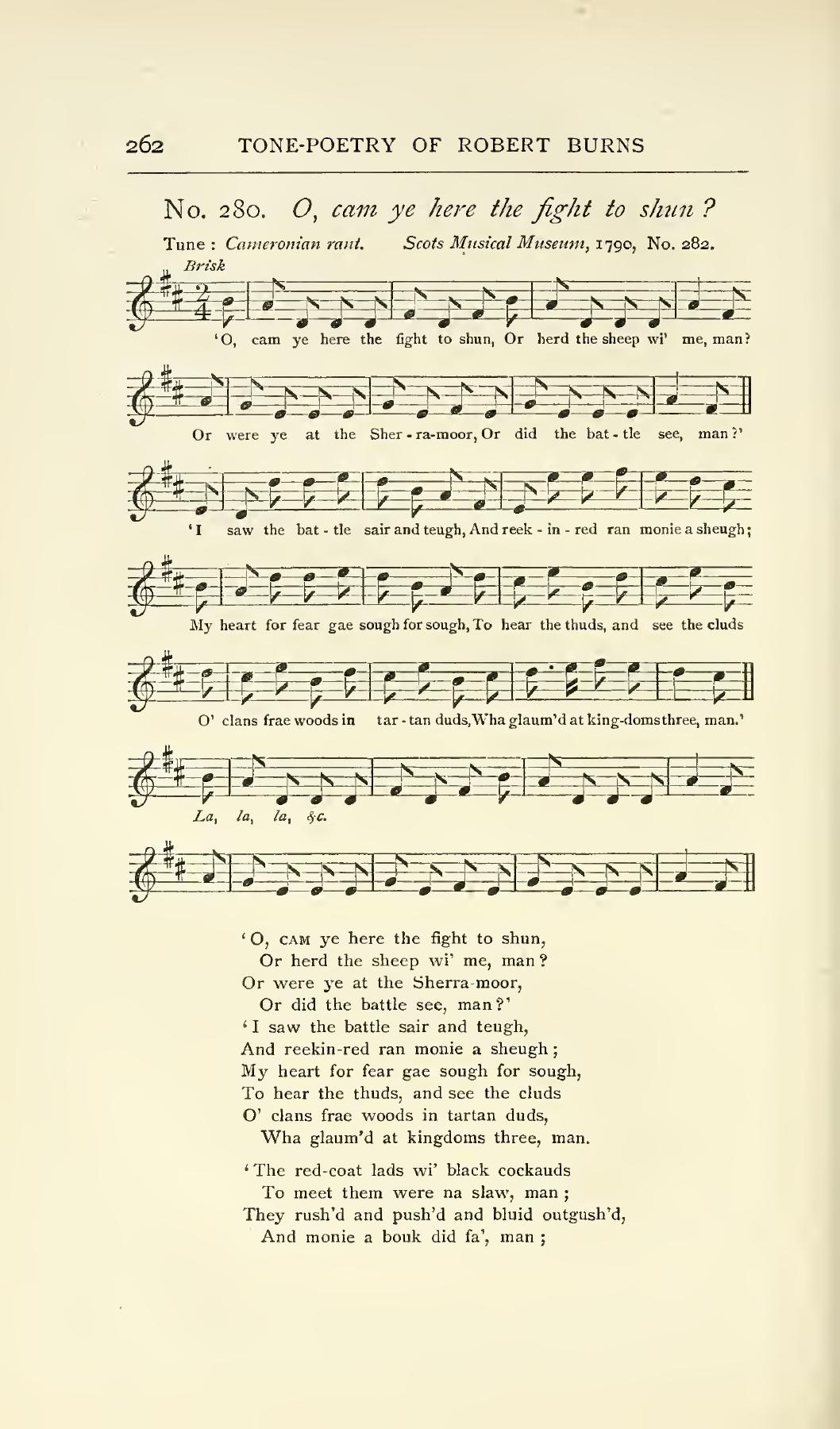 View score Dick’s Songs of Robert Burns (1903)
Lyrics
Choose an edition
Version notes
| Dick (1903) · no. 280 | Cunningham · 1855Ebook transcription |
|---|---|
| cam / Sherra-moor / Or did | cam / Sherra-muir / And did |
| teugh / monie / gae / cockauds / bluid / Argyle | tough / mony / gaed / cockades / blude / Argyll |
| braid-swords / snash’d / philabegs / daur’d / dows | broad-swords / smash’d / philibegs / dar’d / doos |
| When baignets overpower’d the targe | When bayonets opposed the targe |
More differences between these editions
| Dick (1903) · no. 280 | Cunningham · 1855Ebook transcription |
|---|---|
| mysel / horseman / Dunblane / wing’d | myself / horsemen / Dumblane / winged |
| To Perth and to Dundee | Frae Perth unto Dundee |
| Their cogs o’ brose, they scar’d at blows, / And hameward fast did flee, man. | Their cogs o’ brose—they scar’d at blows. / And so it goes, you see, man. |
| Or in his en’mies’ hands | Or fallen in Whiggish hands |
| She swoor she saw | She swore she saw |
| Or in his en’mies’ hands, man: | Or fallen in Whiggish hands, man: |
Dick (1903) · no. 280
'O, cam ye here the fight to shun,
Or herd the sheep wi' me, man?
Or were ye at the Sherra-moor,
Or did the battle see, man?'
'I saw the battle sair and teugh,
And reekin-red ran monie a sheugh;
My heart for fear gae sough for sough,
To hear the thuds, and see the cluds
O' clans frae woods in tartan duds,
Wha glaum'd at kingdoms three, man.

'The red-coat lads wi' black cockauds
To meet them were na slaw, man;
They rush'd and push'd and bluid outgush'd,
And monie a bouk did fa', man;
The great Argyle led on his files,
I wat they glanc'd for twenty miles;
They hough'd the clans like nine-pin kyles,
They hack'd and hash'd, while braid-swords clash'd,
And thro' they dash'd, and hew'd and snash'd,
'Till fey men died awa', man.

'But had ye seen the philabegs
And skyrin tartan trews, man,
When in the teeth they daur'd our Whigs
And covenant True-blues, man!
In lines extended lang and large,
When baignets overpower'd the targe,
And thousands hasten'd to the charge,
Wi' Highland wrath they frae the sheath
Drew blades o' death, till out o' breath
They fled like frighted dows, man.'

'Oh, how deil, Tam, can that be true?
The chase gaed frae the North, man;
I saw mysel, they did pursue
The horseman back to Forth, man;
And at Dunblane, in my ain sight,
They took the brig wi' a' their might,
And straught to Stirling wing'd their flight;
But, cursed lot! the gates were shut;
And monie a huntit poor red-coat
For fear amaist did swarf, man!'

'My sister Kate cam up the gate
Wi' crowdie unto me, man:
She swoor she saw some rebels run
To Perth and to Dundee, man!
Their left-hand general had nae skill;
The Angus lads had nae good-will
That day their neibor's blude to spill;
For fear by foes that they should lose
Their cogs o' brose, they scar'd at blows,
And hameward fast did flee, man.

'They've lost some gallant gentlemen,
Amang the Highland clans, man;
I fear my Lord Panmure is slain,
Or in his en'mies' hands, man:
Now wad ye sing this double fight,
Some fell for wrang, and some for right,
But monie bade the world gude-night;
Say, pell and mell, wi' muskets' knell,
How Tories fell, and Whigs to hell
Flew off in frighted bands, man!'
View the source edition · no. 280; pp. 262–263
About this edition
Dick prints six ten-line stanzas; Cunningham’s last stanza has eleven lines. Dick has Or did the battle see, teugh, cockauds, bluid, Argyle, snash’d, daur’d, dows and baignets overpower’d; Cunningham has And did, tough, cockades, blude, Argyll, smash’d, dar’d, doos and bayonets opposed. Their Kate stanzas and final four/five lines differ materially. Dick’s speaker turns are preserved as printed, including quotes carried across stanzas. Dick prints swoor in Kate’s report, where Cunningham has swore, and a colon after en’mies’ hands, man.
Cunningham (1855)
“O cam ye here the fight to shun,
  Or herd the sheep wi’ me, man?
Or were ye at the Sherra-muir,
  And did the battle see, man?”
I saw the battle, sair and tough,
And reekin’ red ran mony a sheugh.
My heart, for fear, gaed sough for sough,
To hear the thuds, and see the cluds,
O’ clans frae woods, in tartan duds,
  Wha glaum’d at kingdoms three, man.

The red-coat lads, wi’ black cockades,
  To meet them were na slaw, man;
They rush’d and push’d, and blude outgush’d,
  And mony a bouk did fa’, man:
The great Argyll led on his files,
I wat they glanc’d for twenty miles:
They hough’d the clans like nine-pin kyles,
They hack’d and hash’d, while broad-swords clash’d,
And thro’ they dash’d, and hew’d, and smash’d,
  ’Till fey men died awa, man.

But had you seen the philibegs,
  And skyrin tartan trews, man;
When in the teeth they dar’d our Whigs
  And covenant true blues, man;
In lines extended lang and large,
When bayonets opposed the targe,
And thousands hasten’d to the charge,
Wi’ Highland wrath they frae the sheath,
Drew blades o’ death, ’till, out o’ breath,
  They fled like frighted doos, man.

“O how deil, Tam, can that be true?
  The chase gaed frae the north, man;
I saw myself, they did pursue
  The horsemen back to Forth, man;
And at Dumblane, in my ain sight,
They took the brig wi’ a’ their might,
And straught to Stirling winged their flight;
But, cursed lot! the gates were shut;
And mony a huntit, poor red-coat,
  For fear amaist did swarf, man!”

My sister Kate cam up the gate
  Wi’ crowdie unto me, man;
She swore she saw some rebels run
  Frae Perth unto Dundee, man:
Their left-hand general had nae skill,
The Angus lads had nae good-will
That day their neebors’ blood to spill;
For fear, by foes, that they should lose
Their cogs o’ brose—they scar’d at blows.
  And so it goes, you see, man.

They’ve lost some gallant gentlemen,
  Amang the Highland clans, man!
I fear my Lord Panmure is slain,
  Or fallen in Whiggish hands, man:
Now wad ye sing this double fight,
Some fell for wrang, and some for right;
And mony bade the world guid-night;
Then ye may tell, how pell and mell,
By red claymores, and muskets’ knell,
Wi’ dying yell, the Tories fell,
  And Whigs to hell did flee, man.
Digital text from Project Gutenberg.
View the source edition · p. 240
About this edition
Dick prints six ten-line stanzas; Cunningham’s last stanza has eleven lines. Dick has Or did the battle see, teugh, cockauds, bluid, Argyle, snash’d, daur’d, dows and baignets overpower’d; Cunningham has And did, tough, cockades, blude, Argyll, smash’d, dar’d, doos and bayonets opposed. Their Kate stanzas and final four/five lines differ materially. Dick’s speaker turns are preserved as printed, including quotes carried across stanzas. Dick prints swoor in Kate’s report, where Cunningham has swore, and a colon after en’mies’ hands, man.
Scots Musical Museum, vol. III (1790) · no. 282
View the source edition · Volume 3, no. 282; pp. 290–291
Music
View historical scores
Dick’s Songs of Robert Burns (1903)
no. 280; pp. 262–263