John Anderson, my Jo
Behind the song
John Anderson and the woman who loves him have climbed the hill together and had many a happy day on the way up. Now they will go hand in hand down the other side. [1]
She remembers his smooth forehead and raven-black hair when they first knew each other. “My jo” means “my sweetheart”. She blesses his white hair in old age and looks ahead to the time when they will sleep together at the bottom of the hill. [1]
Read the fuller story
Dick identifies the song in the Scots Musical Museum of 1790. In his account Burns took the name or opening line from older material and made a new subject of it. He quotes an older comic and bawdy song with very different circumstances. The traditional title and air thus connect works whose speakers and concerns differ sharply. [2]
Later editions also expanded Burns’s short song. Dick describes additional stanzas printed by Brash and Reid and carried into Thomson’s collection; Cunningham prints a sample in his editorial introduction and questions its attribution. Keeping those additions apart from the two-stanza lyric preserves the close relation between the remembered face and the hill of life. [2][3]
Dick’s score names John Anderson my jo, John, and marks the air “Slow”. Cunningham’s text has “When we were first acquent”, where Dick prints “When we first acquent”. The shared address returns at the end of each stanza, giving both memory and the final promise the same tender point of arrival. [1][3]
Story references
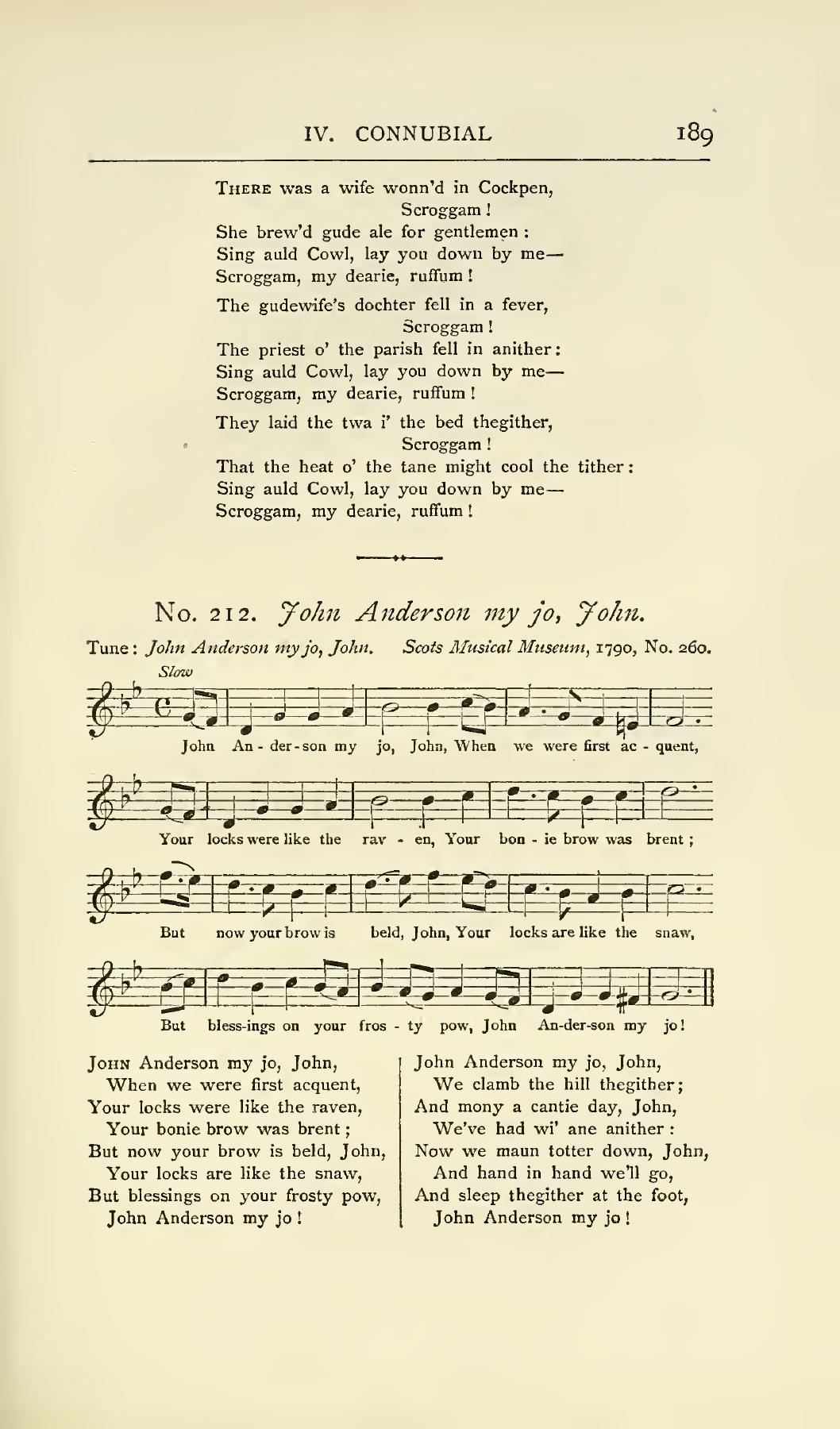 View score Dick’s Songs of Robert Burns (1903)
Lyrics
Choose an edition
Version notes
| Dick (1903) · no. 212 | Cunningham · 1855Ebook transcription |
|---|---|
| Your bonie brow was brent; | Your bonnie brow was brent; |
| Your locks are like the snaw, | Your locks are like the snaw; |
| And mony a cantie day, John, | And mony a canty day, John, |
| And hand in hand we’ll go, | But hand in hand we’ll go; |
More differences between these editions
| Dick (1903) · no. 212 | Cunningham · 1855Ebook transcription |
|---|---|
| John Anderson my jo! | John Anderson, my jo. |
Dick (1903) · no. 212
John Anderson my jo, John,
    When we first acquent,
Your locks were like the raven,
    Your bonie brow was brent;
But now your brow is beld, John,
    Your locks are like the snaw,
But blessings on your frosty pow,
    John Anderson my jo!

John Anderson my jo, John,
    We clamb the hill thegither;
And mony a cantie day, John,
    We’ve had wi’ ane anither:
Now we maun totter down, John,
    And hand in hand we’ll go,
And sleep thegither at the foot,
    John Anderson my jo!
View the source edition · no. 212; p. 189
About this edition
Dick prints two eight-line stanzas. Cunningham’s first line of recollection includes “we were first acquent”; Dick has “we first acquent”. Cunningham gives “But hand in hand we’ll go”, where Dick prints “And hand in hand we’ll go”. Cunningham’s introductory quoted extra stanza belongs to his discussion of later additions, rather than to the two-stanza reading.
Cunningham (1855)
“John Anderson, my jo, John,
  When nature first began
To try her cannie hand, John,
  Her master-piece was man;
And you amang them a’, John,
  Sae trig frae tap to toe,
She proved to be nae journey-work,
  John Anderson, my jo.”]

“John Anderson, my jo, John,
  When we were first acquent,
Your locks were like the raven,
  Your bonnie brow was brent;
But now your brow is beld, John,
  Your locks are like the snaw;
But blessings on your frosty pow,
  John Anderson, my jo.

John Anderson, my jo, John,
  We clamb the hill thegither;
And mony a canty day, John,
  We’ve had wi’ ane anither:
Now we maun totter down, John,
  But hand in hand we’ll go;
And sleep thegither at the foot,
  John Anderson, my jo.
Digital text from Project Gutenberg.
View the source edition · p. 237
About this edition
Dick prints two eight-line stanzas. Cunningham’s first line of recollection includes “we were first acquent”; Dick has “we first acquent”. Cunningham gives “But hand in hand we’ll go”, where Dick prints “And hand in hand we’ll go”. Cunningham’s introductory quoted extra stanza belongs to his discussion of later additions, rather than to the two-stanza reading.
Scots Musical Museum, vol. III (1790) · no. 260
View the source edition · Volume 3, no. 260; p. 269
Music
View historical scores
Dick’s Songs of Robert Burns (1903)
no. 212; p. 189
Burns’s own writing
Dick describes Burns’s lyric as a new subject, retaining the title or first line from older material.
Words Robert Burns, using an older title or opening
Burns’s role New words on an inherited title