My Heart’s in the Highlands
Behind the song
The singer has left the Highlands, but his heart is still there chasing deer. Wherever he wanders, he carries the country and its people with him. [1]
His farewell names the snow on the mountains, the valleys and woods and the noise of the rushing water. He calls the North “the birthplace of valour, the country of worth”. Each return of the chorus carries him there again in thought. [1]
Read the fuller story
Dick quotes Burns’s note that the first half-stanza was old and the rest his own. Cunningham repeats that account. Dick also discusses a longer ballad called The strong walls of Derry, whose fifth stanza contains related chorus words, and quotes a further verse ending with the heart in the Highlands. His account places Burns’s lyric among earlier refrains and songs. [2][3]
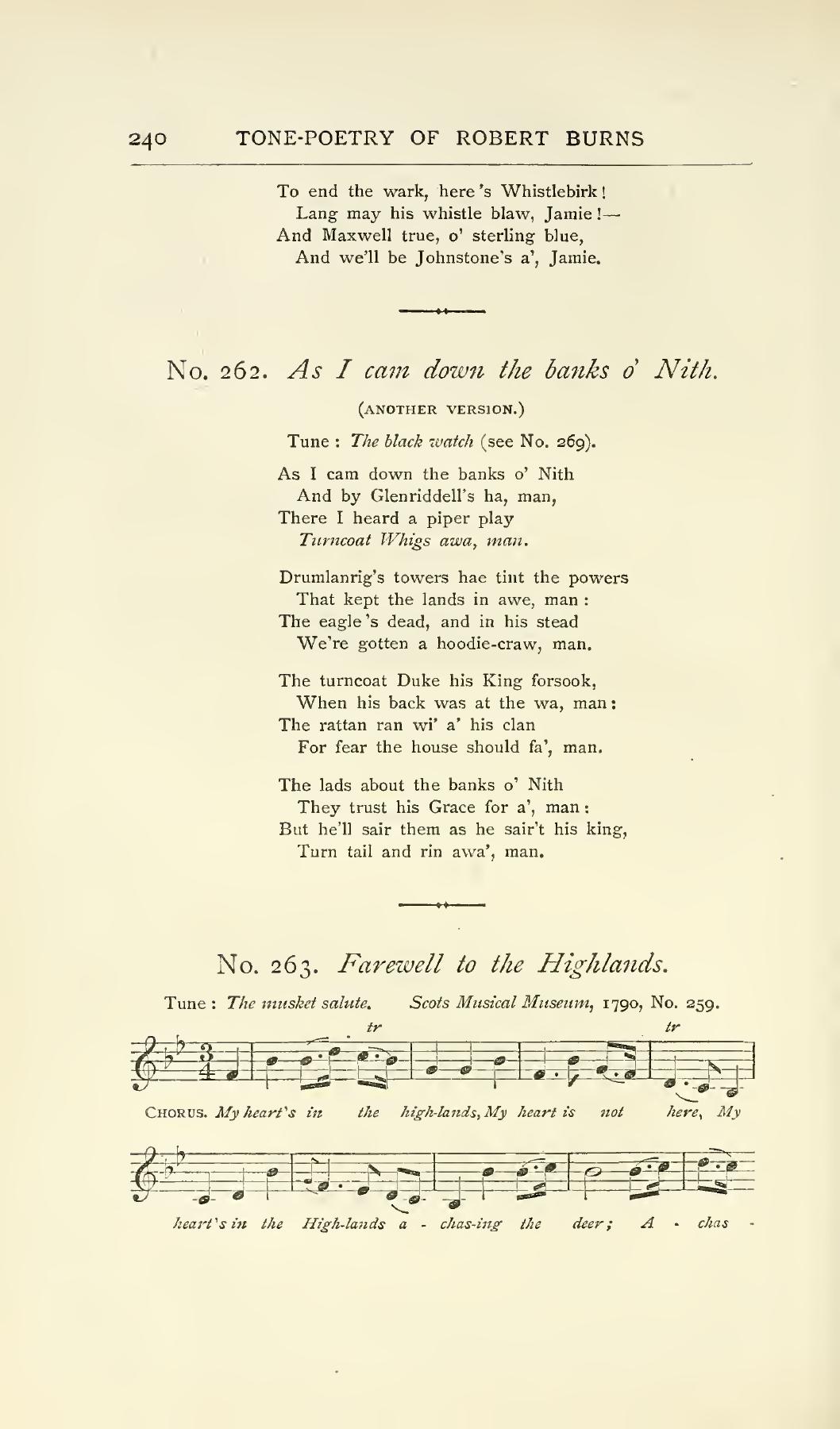
Dick heads the entry Farewell to the Highlands and prints the chorus before two quatrains. Cunningham calls it My Heart’s in the Highlands and combines chorus and verses into two longer stanzas, repeating the chorus at the end. These page arrangements give different visual emphasis to the words that a performance can bring back again. [1][3]
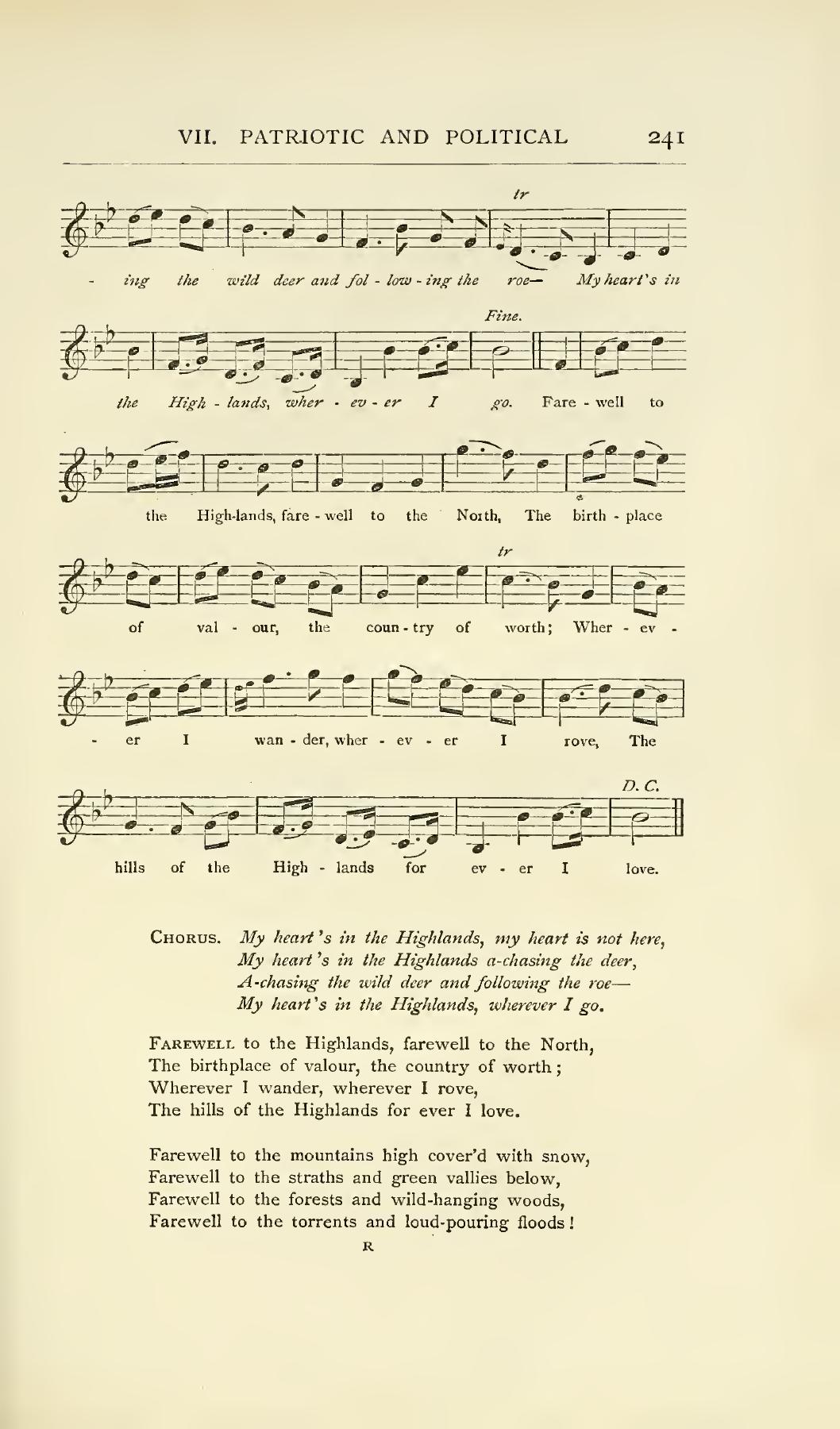
The tune in Dick is The musket salute, with Scots Musical Museum 1790, no. 259 cited above the score. His commentary gives Failte na miosg as another name; Cunningham uses that name as his heading. Dick’s notation spans two pages and separates the musical phrases for chorus and verse. [1][2][3]
Story references
 View score Dick’s Songs of Robert Burns (1903)
Lyrics
Choose an edition
Version notes
| Dick (1903) · no. 263 | Cunningham · 1855Ebook transcription |
|---|---|
| The birthplace of valour, the country of worth; | The birth-place of valour, the country of worth; |
Dick (1903) · no. 263
Chorus. My heart’s in the Highlands, my heart is not here,
    My heart’s in the Highlands a-chasing the deer,
    A-chasing the wild deer and following the roe—
    My heart’s in the Highlands, wherever I go.

Farewell to the Highlands, farewell to the North,
The birthplace of valour, the country of worth;
Wherever I wander, wherever I rove,
The hills of the Highlands for ever I love.

Farewell to the mountains high cover’d with snow,
Farewell to the straths and green vallies below,
Farewell to the forests and wild-hanging woods,
Farewell to the torrents and loud-pouring floods!
View the source edition · no. 263; pp. 240–241
About this edition
Dick prints a chorus and two farewell quatrains. Cunningham combines these into two eight-line stanzas and repeats the chorus at the end, with “Chasing” in the final repeat where the opening has “A-chasing”. Cunningham’s tune heading is Failte na Miosg; Dick’s is The musket salute.
Cunningham (1855)
My heart’s in the Highlands, my heart is not here;
My heart’s in the Highlands a-chasing the deer;
A-chasing the wild deer, and following the roe—
My heart’s in the Highlands wherever I go.
Farewell to the Highlands, farewell to the North,
The birth-place of valour, the country of worth;
Wherever I wander, wherever I rove,
The hills of the Highlands for ever I love.

Farewell to the mountains high cover’d with snow;
Farewell to the straths and green valleys below:
Farewell to the forests and wild-hanging woods;
Farewell to the torrents and loud-pouring floods.
My heart’s in the Highlands, my heart is not here,
My heart’s in the Highlands a-chasing the deer;
Chasing the wild deer, and following the roe—
My heart’s in the Highlands wherever I go.
Digital text from Project Gutenberg.
View the source edition · p. 237
About this edition
Dick prints a chorus and two farewell quatrains. Cunningham combines these into two eight-line stanzas and repeats the chorus at the end, with “Chasing” in the final repeat where the opening has “A-chasing”. Cunningham’s tune heading is Failte na Miosg; Dick’s is The musket salute.
Scots Musical Museum, vol. III (1790) · no. 259
View the source edition · Volume 3, no. 259; p. 268
Music
View historical scores
Dick’s Songs of Robert Burns (1903)
no. 263; pp. 240–241
View source · Download citation