There’s a youth in this city
Behind the song
The spruce young man in blue has curled hair, gleaming silver buckles and an eye for a good match. Meg has a farm, Susie’s father was a laird, and Nancy has a sizeable dowry. The last line names the person he loves best.
Read the fuller story
The first stanza builds the handsome figure piece by piece, lingering over colours and shining buckles. The second examines what catches his eye. Meg has her farm, Susie a father who was laird, and Nancy a substantial dowry. The catalogue of possible matches ends by exposing the self-interest beneath his attractive surface.
Cunningham quotes Burns describing the first half-stanza as old and claiming the rest as his own. In the same passage, Burns is said to report Neil Gow’s claim to the air under the name “Lament for his Brother”. The headnote places song and air in the Museum, while keeping the old opening distinct from Burns’s added portrait and satire.[1]
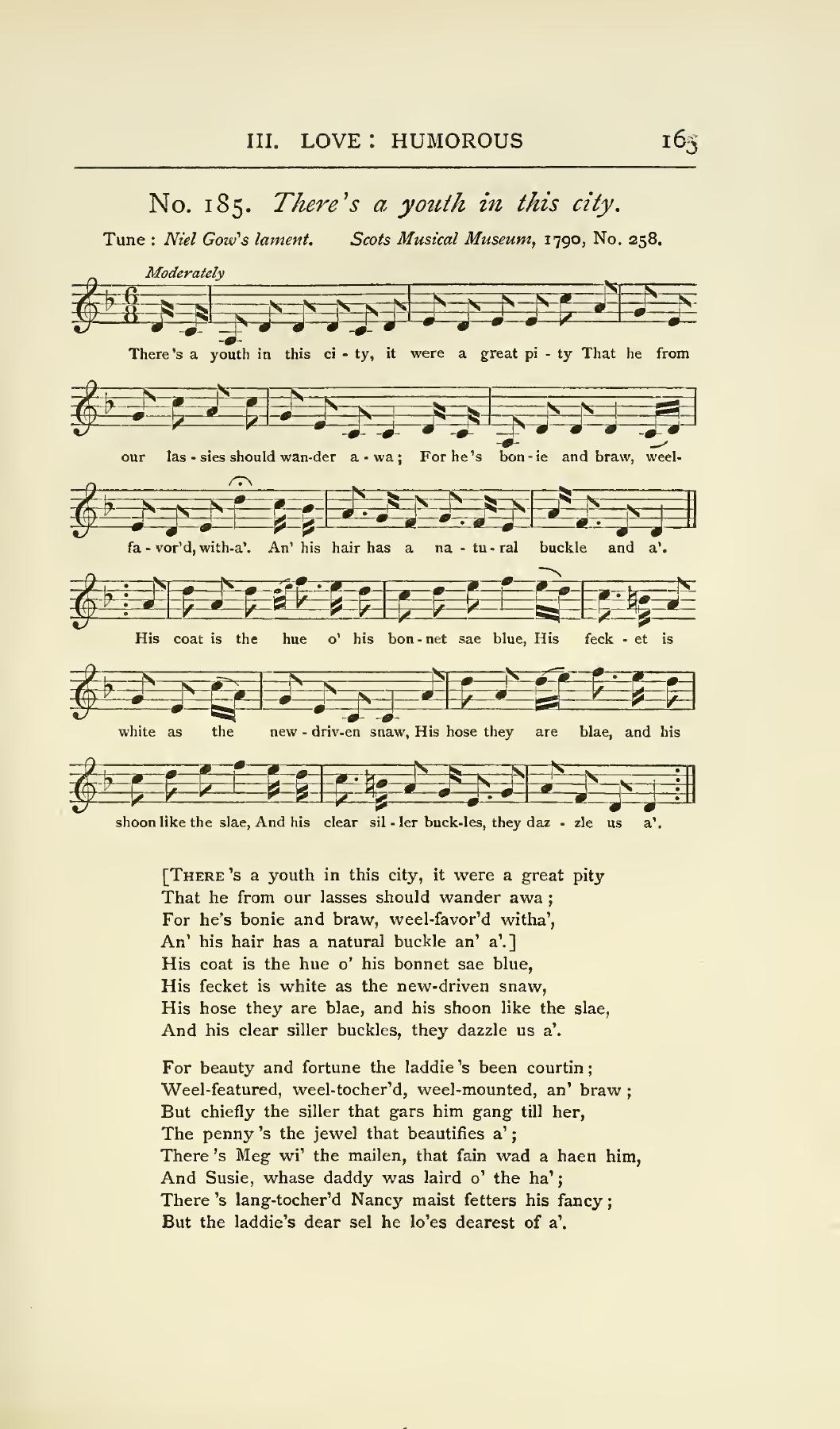 View score Dick’s Songs of Robert Burns (1903)
Lyrics
Choose an edition
Cunningham (1855)
    There’s a youth in this city,
    It were a great pity
That he frae our lasses shou’d wander awa:
    For he’s bonnie an’ braw,
    Weel-favour’d an’ a’,
And his hair has a natural buckle an’ a’.
    His coat is the hue
    Of his bonnet sae blue;
His feck it is white as the new-driven snaw;
    His hose they are blae,
    And his shoon like the slae.
And his clear siller buckles they dazzle us a’.

    For beauty and fortune
    The laddie’s been courtin’;
Weel-featured, weel-tocher’d, weel-mounted and braw;
    But chiefly the siller,
    That gars him gang till her,
The pennie’s the jewel that beautifies a’.
    There’s Meg wi’ the mailen
    That fain wad a haen him;
And Susie, whose daddy was laird o’ the ha’;
    There’s lang-tocher’d Nancy
    Maist fetters his fancy—
But the laddie’s dear sel’ he lo’es dearest of a’.
Digital text from Project Gutenberg.
View the source edition · p. 237
About this edition
Cunningham’s preface discusses several poems he left out of the collection.
Dick (1903) · no. 185
The words are on the score page.
View the source edition · no. 185; p. 165
Scots Musical Museum, vol. III (1790) · no. 258
View the source edition · Volume 3, no. 258; pp. 266–267
Music
View historical scores
Dick’s Songs of Robert Burns (1903)
no. 185; p. 165
Extension attributed to Burns
Cunningham quotes Burns claiming all but the older first half-stanza.
Words Robert Burns with an older first half-stanza
Burns’s role Extension attributed to Burns