The Lazy Mist
Behind the song
Bare trees and a stream lost in mist give the singer a place to walk and think alone. Summer’s colour has gone, and time is going just as fast. Cunningham quotes Burns’s claim to the words and attributes the air to Oswald.[1]
Read the fuller story
The first stanza watches autumn surrender to winter. The mist obscures the water’s course, and the scene seems drained of its former energy. The speaker chooses to wander alone and reflect. The closing line introduces Time and Fate as forces moving rapidly and pursuing closely, giving the seasonal change a personal urgency.[1]
The second stanza asks how much of life has been wasted and how little may remain. Its questions bring together changing circumstances and broken attachments. Life then appears as an ascent followed by a painful descent: striving for the summit gives way to weakness, darkness and suffering.[1]
The final couplet makes a bleak judgement on what life can offer, then reaches towards something beyond it. That turn gives the song a speculative ending after its inventory of loss. In the headnote, Cunningham quotes Burns saying “This song is mine” and places words and air in the Musical Museum. The lyric’s two eight-line stanzas compress the movement from an autumn walk to a question about the purpose of existence.[1]
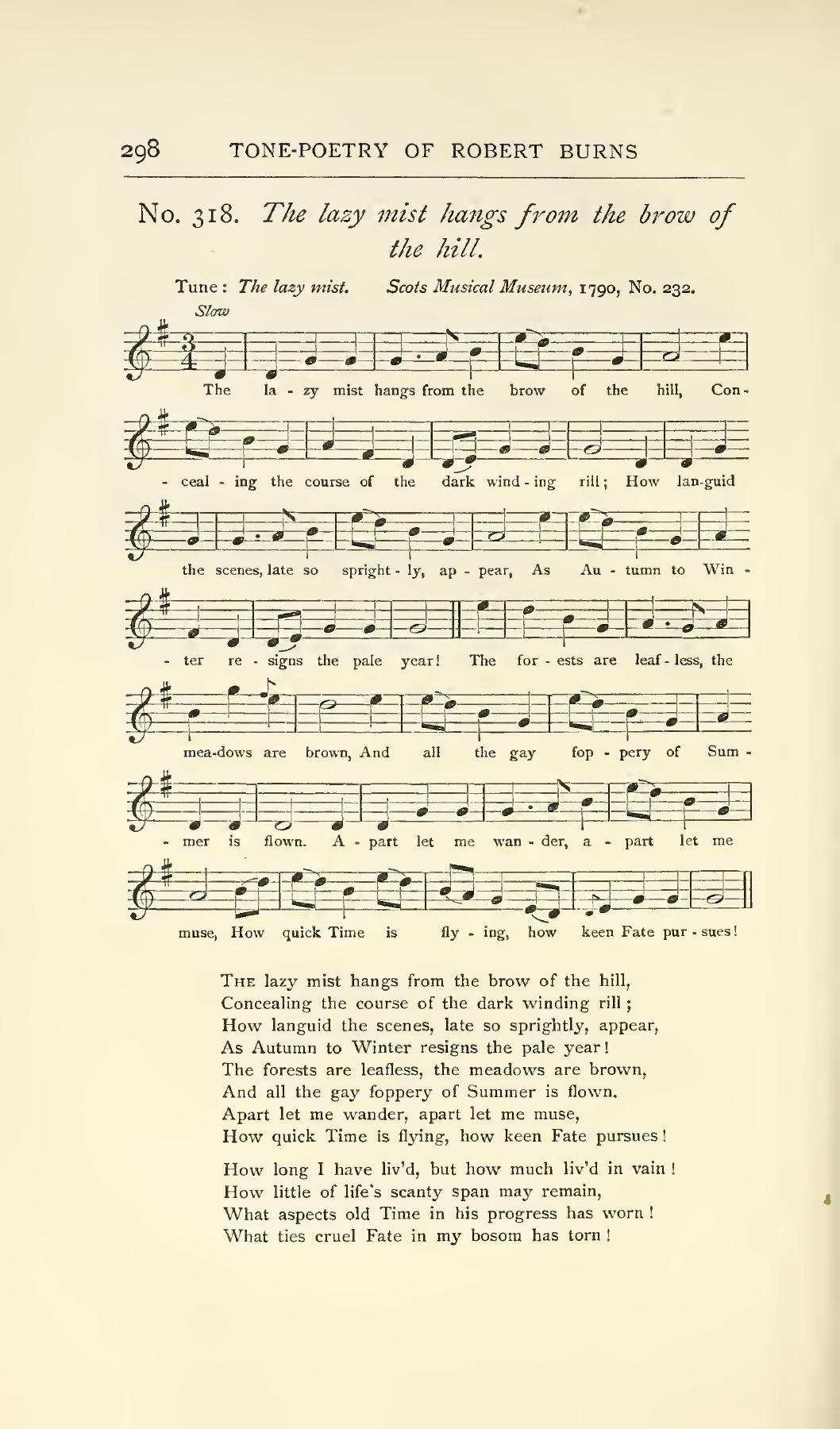 View score Dick’s Songs of Robert Burns (1903)
Lyrics
Choose an edition
Cunningham (1855)
The lazy mist hangs from the brow of the hill,
Concealing the course of the dark winding rill;
How languid the scenes, late so sprightly, appear!
As Autumn to Winter resigns the pale year.
The forests are leafless, the meadows are brown,
And all the gay foppery of summer is flown:
Apart let me wander, apart let me muse,
How quick Time is flying, how keen Fate pursues!

How long have I liv’d, but how much liv’d in vain!
How little of life’s scanty span may remain!
What aspects, old Time, in his progress, has worn!
What ties cruel Fate in my bosom has torn!
How foolish, or worse, till our summit is gain’d!
And downward, how weaken’d, how darken’d, how pain’d!
Life is not worth having with all it can give—
For something beyond it poor man sure must live.
Digital text from Project Gutenberg.
View the source edition · p. 235
About this edition
Cunningham’s preface discusses several poems he left out of the collection.
Dick (1903) · no. 318
The words are on the score page.
View the source edition · no. 318; p. 298
Scots Musical Museum, vol. III (1790) · no. 232
View the source edition · Volume 3, no. 232; p. 241
Music
View historical scores
Dick’s Songs of Robert Burns (1903)
no. 318; p. 298