Go fetch to me a Pint O’ Wine
Behind the song
Bring wine in a silver cup so the singer can drink to Mary. The wind is blowing from the ferry, a boat rocks at Leith and a ship waits by Berwick-law. [1]
The next sounds are trumpets on a battlefield. Banners and spears give way to a bloody fight. Amid the army and its noise, leaving Mary is the reason the singer wishes he could stay. [1]
Read the fuller story
Dick reproduces Burns’s statement that the first stanza was old and the rest his own. Cunningham instead quotes the first half-stanza as old, then expresses doubt that even this much was inherited. Their different accounts matter because they assign different extents to Burns’s contribution. Dick also reports a letter to Mrs Dunlop dated 17 December 1788 which introduced the words as two old stanzas. [2][3]
The musical history is equally varied in Dick’s account. He identifies James Oswald’s tune under the titles The stolen Kiss and The secret Kiss, then reports Burns suggesting Waes my heart that we should sunder to Thomson in 1793. Thomson, he says, used The old highland laddie. Dick prints The secret kiss with the song, marked Gracefully; Cunningham uses the opening Go fetch to me a pint o’ wine as the tune heading. [2][1][3]
Story references
- James C. Dick, The Songs of Robert Burns (1903), No. 148; printed pp. 134–134; PDF pp. 190–190
- James C. Dick, The Songs of Robert Burns (1903), Dick note 148; printed 402; PDF 458
- Allan Cunningham, The Complete Works of Robert Burns (1855), printed 235; HTML #songsLXXII. Project Gutenberg transcription.
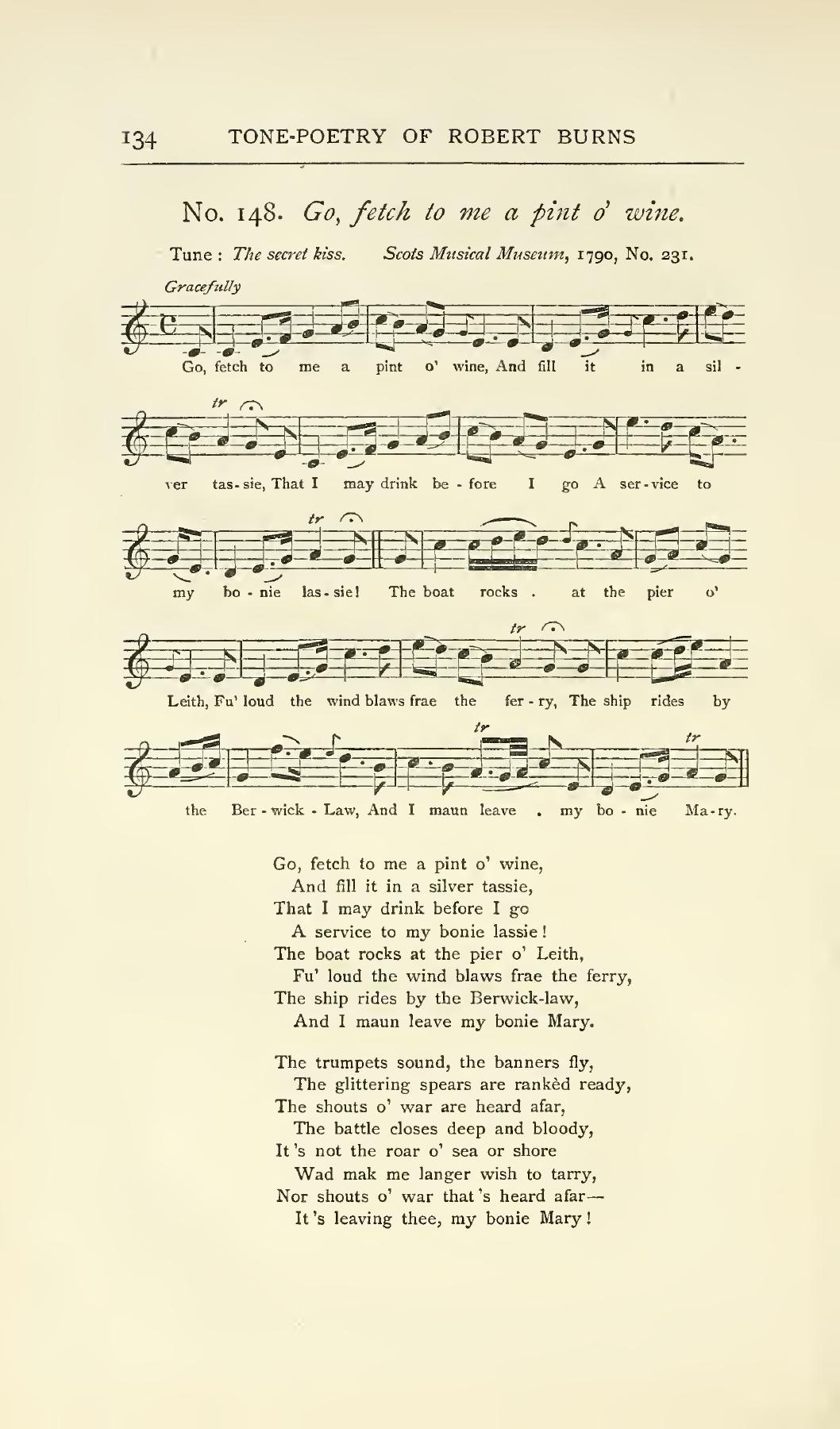 View score Dick’s Songs of Robert Burns (1903)
Lyrics
Choose an edition
Version notes
| Dick (1903) · no. 148 | Cunningham · 1855Ebook transcription |
|---|---|
| Go, fetch to me a pint o’ wine | My Bonnie Mary |
| And fill / bonie | An’ fill / bonnie |
| deep and bloody | thick and bloody |
| Leith, | Leith; |
More differences between these editions
| Dick (1903) · no. 148 | Cunningham · 1855Ebook transcription |
|---|---|
| The secret kiss | Go fetch to me a pint o’ wine |
Dick (1903) · no. 148
Go, fetch to me a pint o' wine,
And fill it in a silver tassie,
That I may drink before I go
A service to my bonie lassie!
The boat rocks at the pier o' Leith,
Fu' loud the wind blaws frae the ferry,
The ship rides by the Berwick-law,
And I maun leave my bonie Mary.

The trumpets sound, the banners fly,
The glittering spears are ranked ready,
The shouts o' war are heard afar,
The battle closes deep and bloody,
It's not the roar o' sea or shore
Wad make me langer wish to tarry,
Nor shouts o' war that's heard afar—
It's leaving thee, my bonie Mary!
These are the words printed below the score.
View the source edition · no. 148; p. 134
About this edition
Both versions have two octaves. Dick has “And fill”, “bonie”, “The battle closes deep and bloody” and a comma after “Leith”; Cunningham has “An’ fill”, “bonnie”, “thick and bloody” and a semicolon. Dick’s note transmits “first stanza ... old”, while Cunningham’s introduction transmits “first half-stanza ... old” and questions the extent. Cunningham titles the song My Bonnie Mary; Dick uses the first line.
Cunningham (1855)
Go fetch to me a pint o’ wine,
  An’ fill it in a silver tassie;
That I may drink, before I go,
  A service to my bonnie lassie;
The boat rocks at the pier o’ Leith;
  Fu’ loud the wind blaws frae the ferry;
The ship rides by the Berwick-law,
  And I maun leave my bonnie Mary.

The trumpets sound, the banners fly,
  The glittering spears are ranked ready;
The shouts o’ war are heard afar,
  The battle closes thick and bloody;
It’s not the roar o’ sea or shore
  Wad make me langer wish to tarry;
Nor shouts o’ war that’s heard afar—
  It’s leaving thee, my bonnie Mary.
Digital text from Project Gutenberg.
View the source edition · p. 235
About this edition
Both versions have two octaves. Dick has “And fill”, “bonie”, “The battle closes deep and bloody” and a comma after “Leith”; Cunningham has “An’ fill”, “bonnie”, “thick and bloody” and a semicolon. Dick’s note transmits “first stanza ... old”, while Cunningham’s introduction transmits “first half-stanza ... old” and questions the extent. Cunningham titles the song My Bonnie Mary; Dick uses the first line.
Scots Musical Museum, vol. III (1790) · no. 231
View the source edition · Volume 3, no. 231; p. 240
Music
View historical scores
Dick’s Songs of Robert Burns (1903)
no. 148; p. 134