Jamie, come try me
Behind the song
Jamie is invited to come and see whether he can win the singer’s love. The person doing the asking is already wondering how such a request could be refused. [1]
The second verse imagines a kiss and asks who could see it stolen. The refrain calls Jamie back to the invitation while the meeting is still in prospect. [1]
Read the fuller story
Cunningham describes Burns taking up the opening words of an older song. Dick similarly presents the lyric as written from a single line or title, and connects the work with the revival of James Oswald’s melody. He records its appearance in the Scots Musical Museum of 1790 under the title Jamie, come try me. [2][3]
Dick heads his entry If thou should ask my love and prints the air Jamie, come try me, marked Slowly. His note traces the melody through Oswald’s Curious Scots Tunes and the Caledonian Pocket Companion, while judging its compass demanding for ordinary voices. Cunningham writes the chorus again at the end of his final stanza; Dick prints it once before the two verses. [1][3][2]
Story references
- James C. Dick, The Songs of Robert Burns (1903), No. 117; printed pp. 108–108; PDF pp. 164–164
- Allan Cunningham, The Complete Works of Robert Burns (1855), printed 234; HTML #songsLXXI. Project Gutenberg transcription.
- James C. Dick, The Songs of Robert Burns (1903), Dick note 117; printed 390; PDF 446
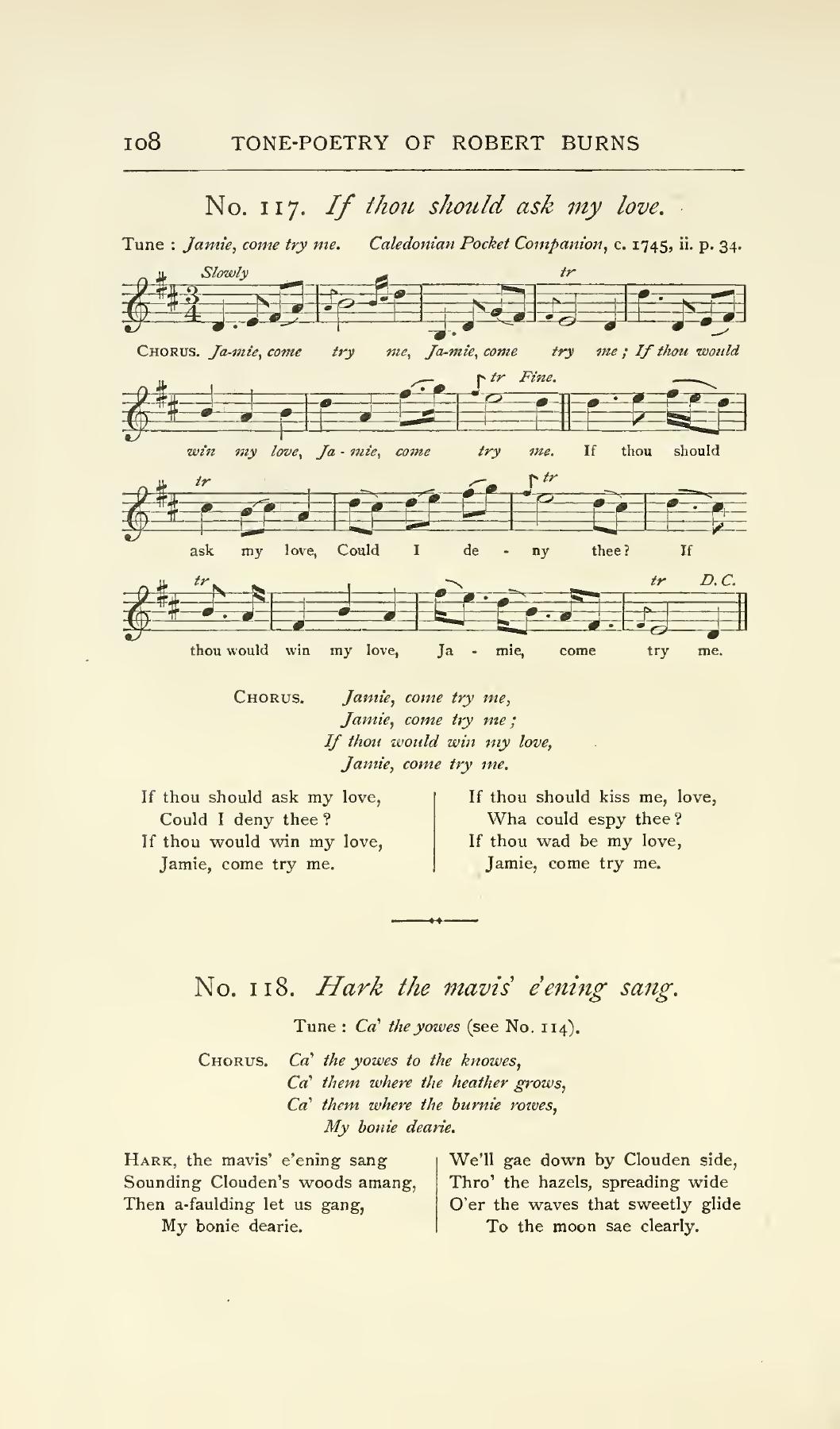 View score Dick’s Songs of Robert Burns (1903)
Lyrics
Choose an edition
Version notes
| Dick (1903) · no. 117 | Cunningham · 1855Ebook transcription |
|---|---|
| chorus once before two quatrains | chorus before verses and written again after final quatrain |
| Jamie, come try me | Jamy, come try me |
Dick (1903) · no. 117
CHORUS.
Jamie, come try me,
Jamie, come try me;
If thou would win my love,
Jamie, come try me.

If thou should ask my love,
Could I deny thee?
If thou would win my love,
Jamie, come try me.

If thou should kiss me, love,
Wha could espy thee?
If thou wad be my love,
Jamie, come try me.
View the source edition · no. 117; p. 108
About this edition
Dick prints a labelled four-line chorus followed by two quatrains, set side by side on the page and read in that order. Cunningham prints the opening chorus and repeats its four lines after the last verse. The tune title is Jamie in Dick and Jamy in Cunningham.
Cunningham (1855)
    Jamie, come try me,
    Jamie, come try me;
    If thou would win my love,
    Jamie, come try me.

If thou should ask my love,
  Could I deny thee?
If thou would win my love,
  Jamie, come try me.

If thou should kiss me, love,
  Wha could espy thee?
If thou wad be my love,
  Jamie, come try me.
    Jamie, come try me,
    Jamie, come try me;
    If thou would win my love,
    Jamie, come try me.
Digital text from Project Gutenberg.
View the source edition · p. 234
About this edition
Dick prints a labelled four-line chorus followed by two quatrains, set side by side on the page and read in that order. Cunningham prints the opening chorus and repeats its four lines after the last verse. The tune title is Jamie in Dick and Jamy in Cunningham.
Scots Musical Museum, vol. III (1790) · no. 229
View the source edition · Volume 3, no. 229; p. 238
Music
View historical scores
Dick’s Songs of Robert Burns (1903)
no. 117; p. 108