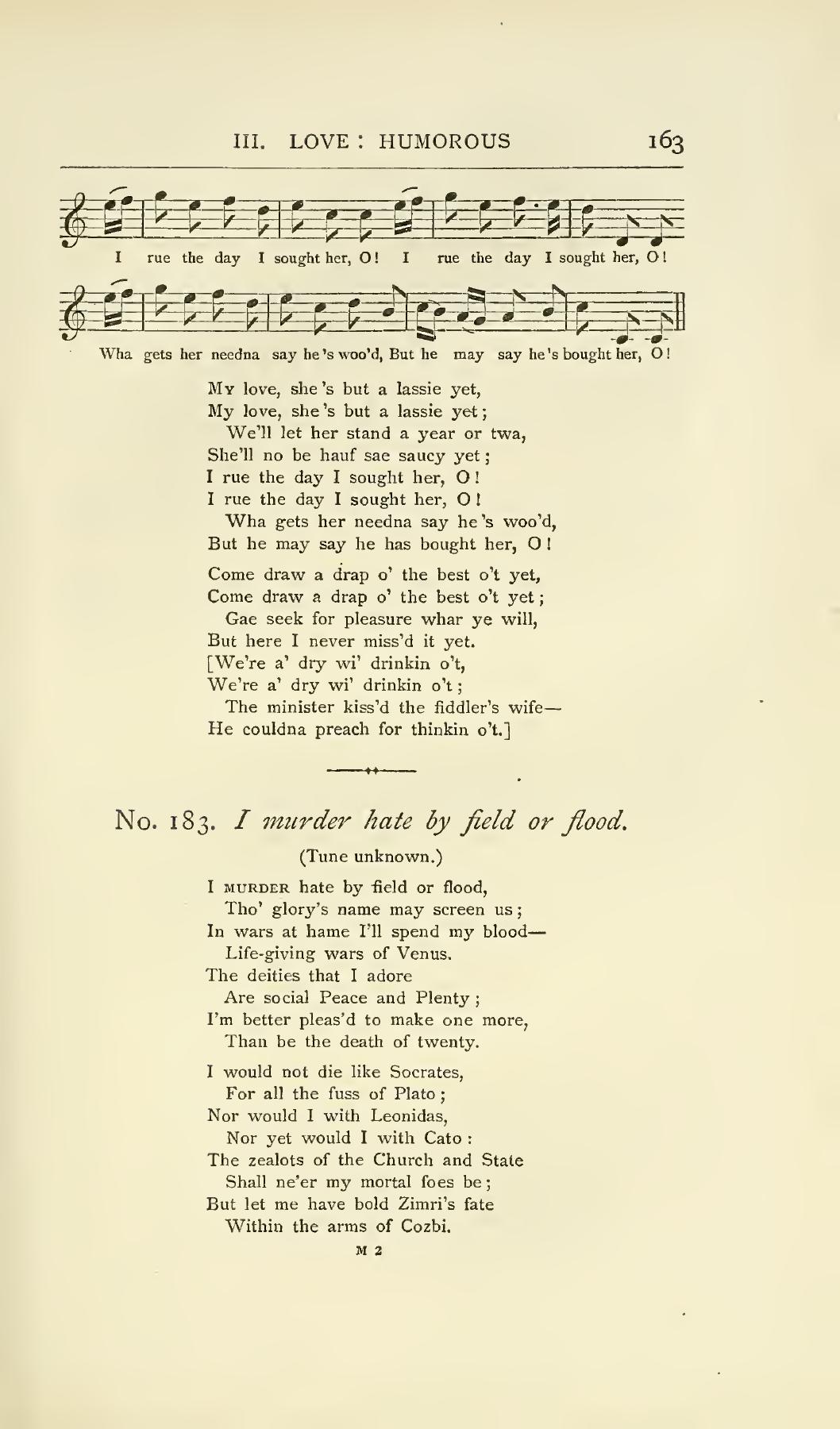
My Love she’s but a lassie yet
Behind the song
The first stanza complains of a saucy beloved and costly courtship. The next turns to drink and ends with a minister distracted from preaching by a kiss. The song’s repetitions carry both scenes with the same lively insistence. [1]
Read the fuller story
Each eight-line stanza begins with repeated lines and then changes the direction of its joke. The first proposes waiting a year or two before pursuing the lass, then voices regret and compares winning her with buying her. The second invites another draught, praises the pleasure found in drinking and closes with the minister and the fiddler’s wife. [1]
Cunningham describes an older strain behind these verses, saying that some old lines and the old title remain. He calls that earlier material equally lively and less delicate, and places the selected version in the Musical Museum. The headnote supplies a partial account of inheritance, with no line-by-line allocation or named adapter. [1]
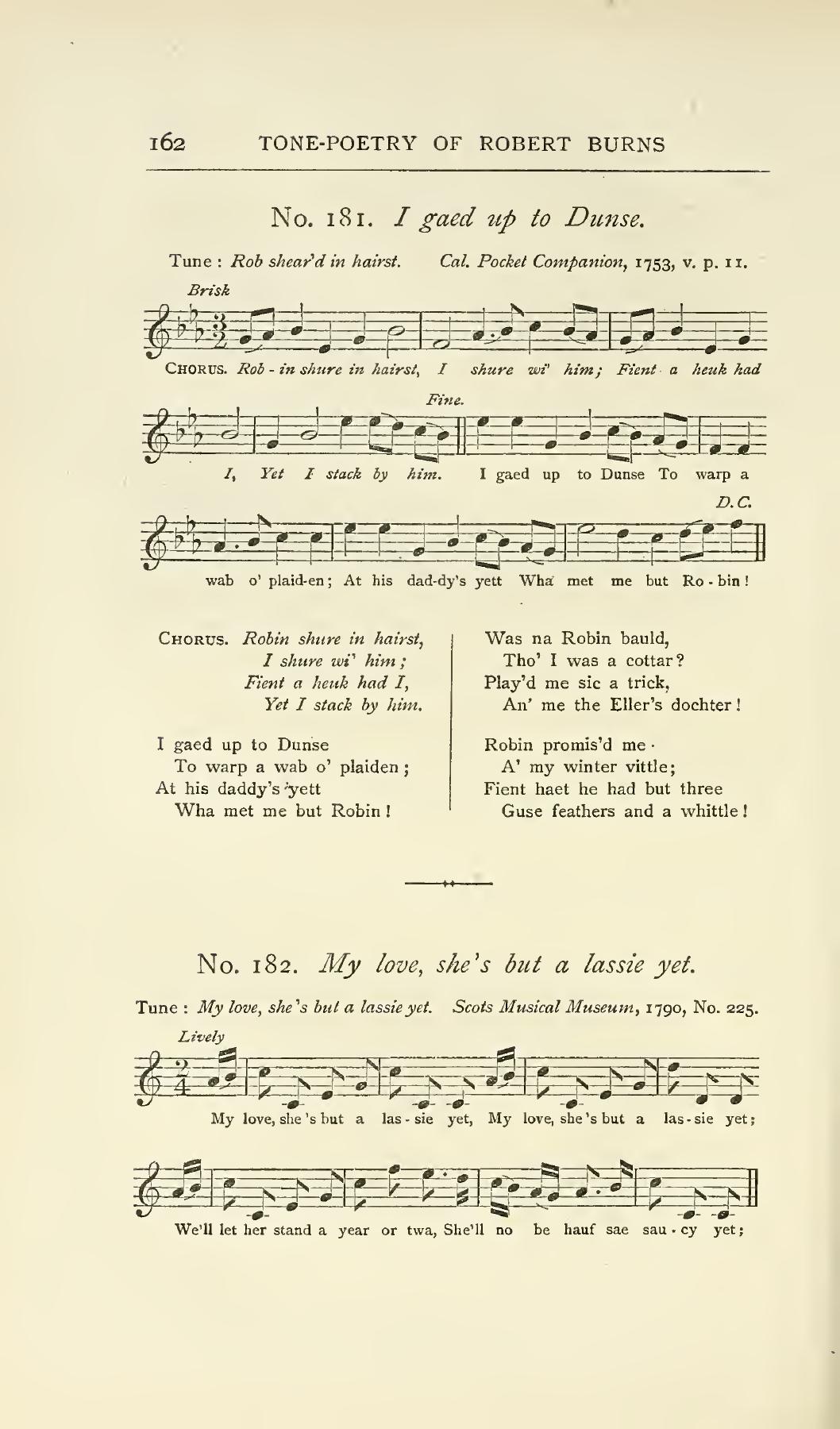 View score Dick’s Songs of Robert Burns (1903)
Lyrics
Choose an edition
Cunningham (1855)
My love she’s but a lassie yet,
  My love she’s but a lassie yet,
We’ll let her stand a year or twa,
  Shell no be half so saucy yet.
I rue the day I sought her, O;
  I rue the day I sought her, O;
Wha gets her needs na say he’s woo’d,
  But he may say he’s bought her, O!

Come, draw a drap o’ the best o’t yet;
  Come, draw a drap o’ the best o’t yet;
Gae seek for pleasure where ye will,
  But here I never miss’d it yet.
We’re a’ dry wi’ drinking o’t;
  We’re a’ dry wi’ drinking o’t;
The minister kiss’d the fiddler’s wife,
  An’ could na preach for thinkin’ o’t.
Digital text from Project Gutenberg.
View the source edition · p. 234
About this edition
Cunningham’s preface discusses several poems he left out of the collection.
Dick (1903) · no. 182
The words are on the score page.
View the source edition · no. 182; pp. 162–163
Scots Musical Museum, vol. III (1790) · no. 225
View the source edition · Volume 3, no. 225; p. 234
Music
View historical scores
Dick’s Songs of Robert Burns (1903)
no. 182; pp. 162–163
View source · Download citation