Blooming Nelly
Behind the song
Nelly wakes to find Willie kissing her and springs away like a startled partridge. He has been watching her sleep among the flowers. He follows, catches up and pleads with her. The narrator says she forgives him. Cunningham attributes the song to Burns and suggests a lyric in Allan Ramsay’s collection may have been in his mind.[1]
Read the fuller story
The opening places Nelly within the warmth and colour of summer. Willie, who has already sought her favour, stands watching. Four repeated actions—gazing, wishing, fearing and blushing—hold him between desire and uncertainty, returning at the end of each of the first three stanzas.[1]
The description follows his attention to her closed eyes, breathing lips and lightly moving clothes. Flowers become part of that admiring language. The kiss breaks the pattern of watching: Nelly wakes and springs away like a startled partridge. Her alarm makes the encounter briefly move as quickly as the earlier stanzas had lingered.[1]
In the last stanza Willie follows, overtakes her and pleads. The narrator supplies the ending by describing her as forgiving, giving the pursuit a resolved conclusion without a reply in Nelly’s own words. Cunningham prints “On a bank of flowers” as the tune; his proposed Ramsay connection remains an editorial suggestion beside this four-stanza telling.[1]
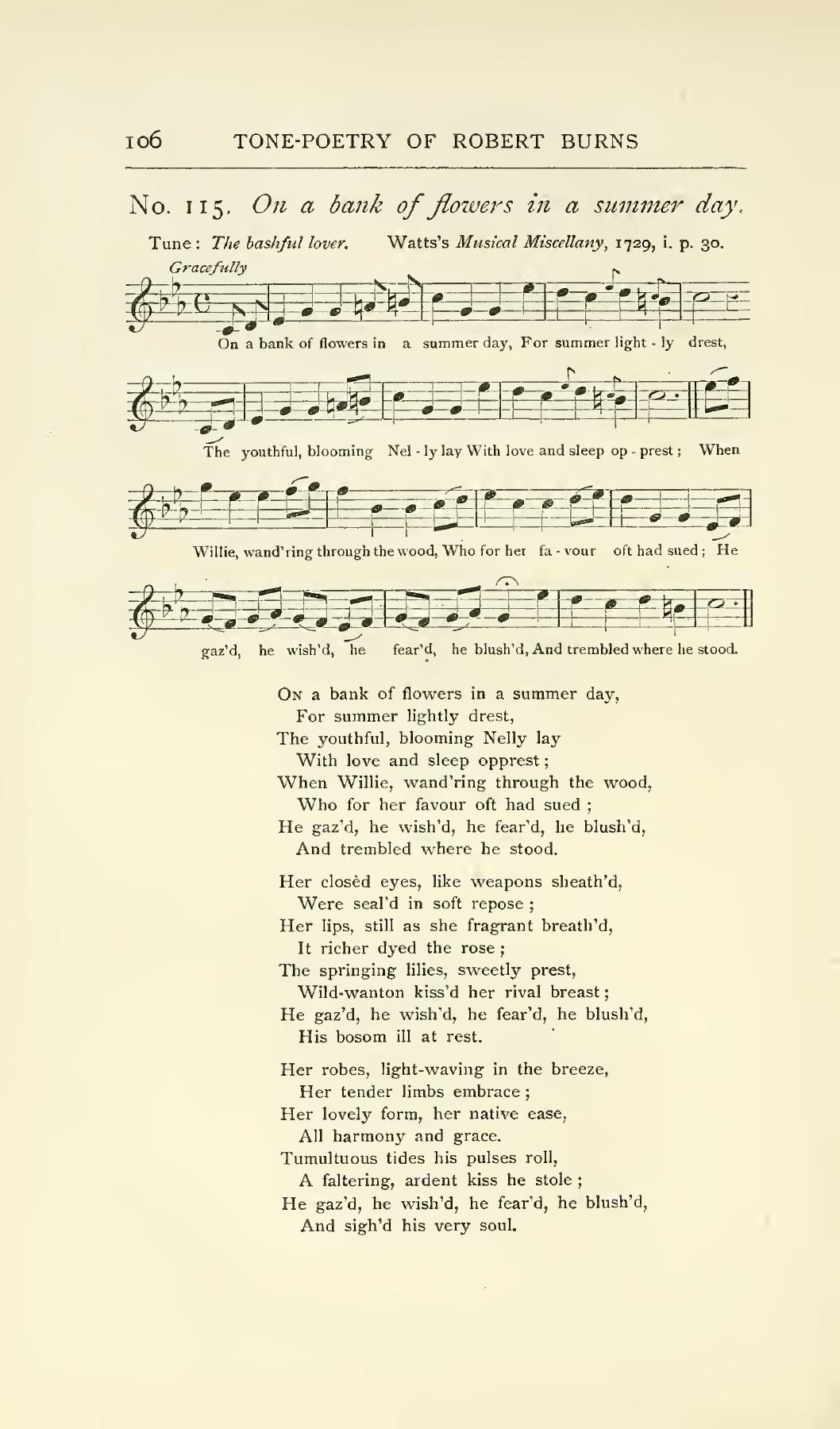 View score Dick’s Songs of Robert Burns (1903)
Lyrics
Choose an edition
Cunningham (1855)
On a bank of flowers, in a summer day,
  For summer lightly drest,
The youthful blooming Nelly lay,
  With love and sleep opprest;
When Willie wand’ring thro’ the wood,
  Who for her favour oft had sued,
He gaz’d, he wish’d, he fear’d, he blush’d,
  And trembled where he stood.

Her closed eyes like weapons sheath’d,
  Were seal’d in soft repose;
Her lips still as she fragrant breath’d,
  It richer dy’d the rose.
The springing lilies sweetly prest,
  Wild—wanton, kiss’d her rival breast;
He gaz’d, he wish’d, he fear’d, he blush’d—
  His bosom ill at rest.

Her robes light waving in the breeze
  Her tender limbs embrace;
Her lovely form, her native ease,
  All harmony and grace:
Tumultuous tides his pulses roll,
  A faltering, ardent kiss he stole;
He gaz’d, he wish’d, he fear’d, he blush’d,
  And sigh’d his very soul.

As flies the partridge from the brake,
  On fear-inspired wings,
So Nelly, starting, half awake,
  Away affrighted springs:
But Willie follow’d, as he should,
  He overtook her in a wood;
He vow’d, he pray’d, he found the maid
  Forgiving all and good.
Digital text from Project Gutenberg.
View the source edition · p. 233
About this edition
Cunningham’s preface discusses several poems he left out of the collection.
Dick (1903) · no. 115
The words are on the score page.
View the source edition · no. 115; pp. 106–107
Scots Musical Museum, vol. III (1790) · no. 223
View the source edition · Volume 3, no. 223; p. 232
Music
View historical scores
Dick’s Songs of Robert Burns (1903)
no. 115; pp. 106–107
Words attributed to Burns
Cunningham attributes the song to Burns while suggesting a lyric in Allan Ramsay’s collection was in his mind; the earlier text has not been independently compared.
Words Robert Burns
Burns’s role Wrote the words