The Gardener wi’ his paidle
Behind the song
In May the gardener works among running water, flowers and singing birds with his paidle, a small spade. At evening he goes home to the woman he loves. Cunningham describes the title as older material and attributes the rest to Burns, connecting the air with the Gardeners’ annual procession.[1]
Read the fuller story
The first stanza places labour within the pleasures of spring. Running water, scented breezes and birds described as lovers surround the recurring figure of the gardener with his paidle. His repeated name and tool keep the working man at the centre of a richly flowering scene.[1]
The second stanza gives the day its two edges. Purple morning finds the hare abroad and the gardener going through the dew. At sunset, nature draws its curtain and he hurries to his beloved’s arms. Work and affection share the same daily rhythm.[1]
The tune heading preserves “The gardener wi’ his paidle”, while the printed lyric begins “When rosy May”. Cunningham’s distinction between the inherited title and Burns’s words gives the familiar refrain a place within the song’s history. The two stanzas make it a repeated point of return as the day passes from spring activity into rest and companionship.[1]
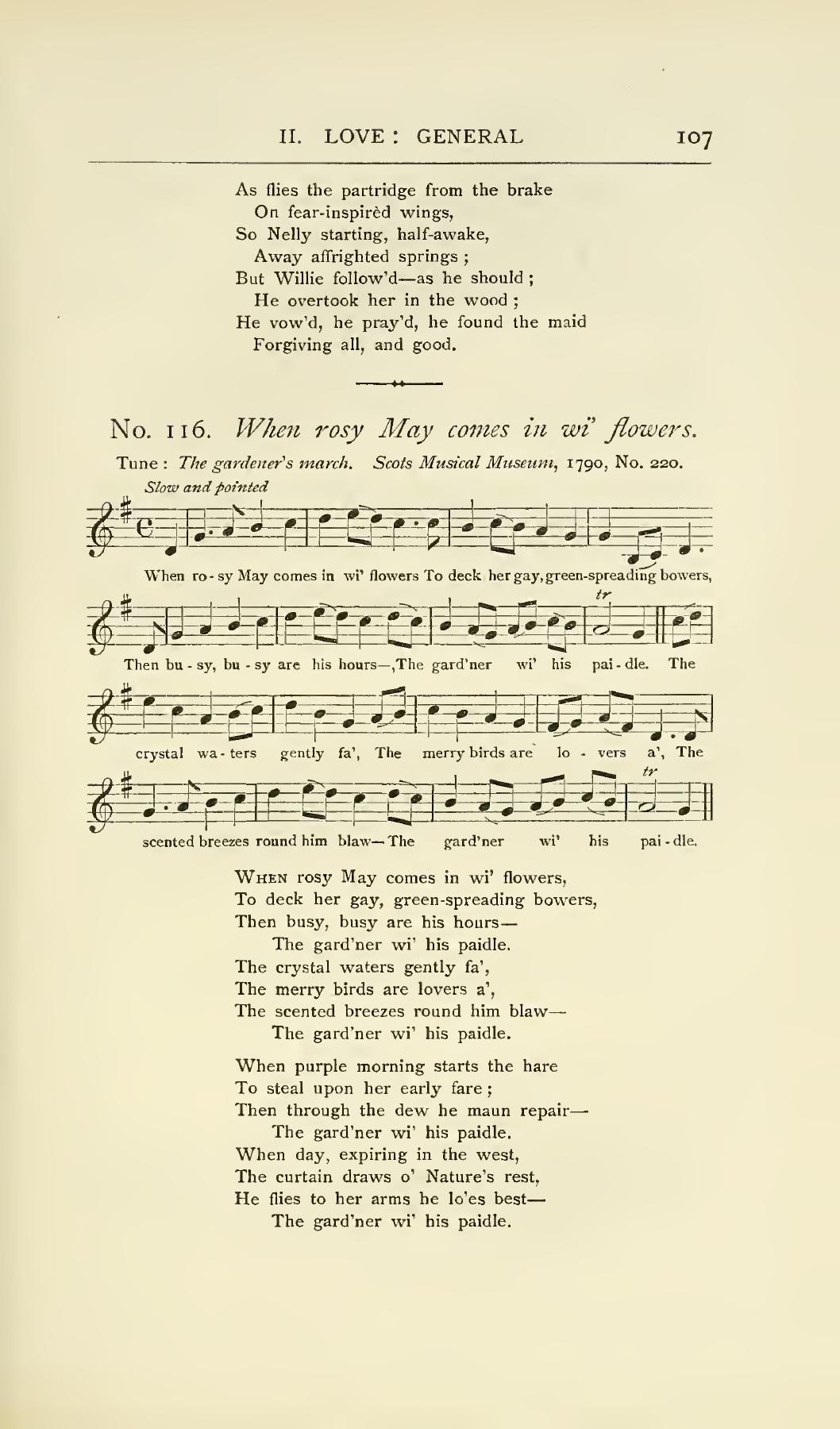 View score Dick’s Songs of Robert Burns (1903)
Lyrics
Choose an edition
Cunningham (1855)
When rosy May comes in wi’ flowers,
To deck her gay green-spreading bowers,
Then busy, busy are his hours—
  The gard’ner wi’ his paidle
The crystal waters gently fa’;
The merry birds are lovers a’;
The scented breezes round him blaw—
  The gard’ner wi’ his paidle.

When purple morning starts the hare
To steal upon her early fare,
Then thro’ the dews he maun repair—
  The gard’ner wi’ his paidle.
When day, expiring in the west,
The curtain draws of nature’s rest,
He flies to her arms he lo’es best—
  The gard’ner wi’ his paidle.
Digital text from Project Gutenberg.
View the source edition · p. 233
About this edition
Cunningham’s preface discusses several poems he left out of the collection.
Dick (1903) · no. 116
The words are on the score page.
View the source edition · no. 116; p. 107
Scots Musical Museum, vol. III (1790) · no. 220
View the source edition · Volume 3, no. 220; p. 229
Music
View historical scores
Dick’s Songs of Robert Burns (1903)
no. 116; p. 107