The Tailor fell through the bed, thimbles an’ a’
Behind the song
The tailor falls through the bed with his thimbles, thin blankets and small sheets around him. A sleepy lassie has expected no harm from him. By the close, the song imagines somebody tired of lying alone and eager to see the little tailor skipping back.
Read the fuller story
Repeated lines hold each of the four verses together. The opening mishap gives way to the lassie’s confidence, a demand for the groat again, and the prospect of another visit. The tailor’s tools stay attached to the bedroom joke from the first line, bringing his trade into the song’s sexual comedy.
Cunningham assigns the second and fourth verses to Burns and calls the rest very old. He also describes an old air played at trade festivals and processions by the Corporation of Tailors. His division of the words places the added sleeping-lassie verse and the closing wish for a return around inherited material.[1]
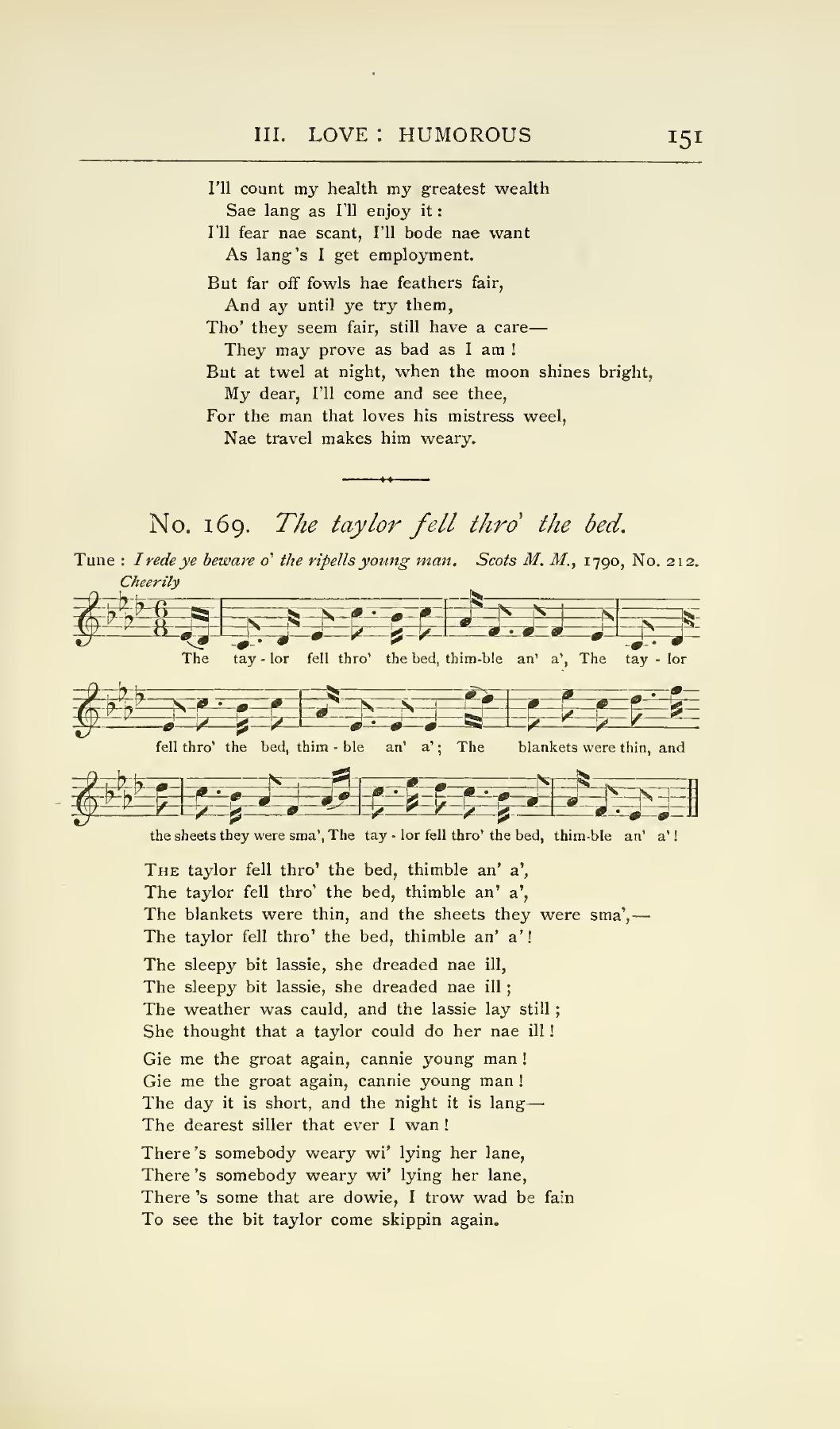 View score Dick’s Songs of Robert Burns (1903)
Lyrics
Choose an edition
Cunningham (1855)
The Tailor fell thro’ the bed, thimbles an’ a’,
The Tailor fell thro’ the bed, thimbles an’ a’;
The blankets were thin, and the sheets they were sma’,
The Tailor fell thro’ the bed, thimbles an’ a’.

The sleepy bit lassie, she dreaded nae ill,
The sleepy bit lassie, she dreaded nae ill;
The weather was cauld, and the lassie lay still,
She thought that a tailor could do her nae ill.

Gie me the groat again, canny young man;
Gie me the groat again, canny young man;
The day it is short, and the night it is lang,
The dearest siller that ever I wan!

There’s somebody weary wi’ lying her lane;
There’s somebody weary wi’ lying her lane;
There’s some that are dowie, I trow would be fain
To see the bit tailor come skippin’ again.
Digital text from Project Gutenberg.
View the source edition · p. 232
About this edition
Cunningham’s preface discusses several poems he left out of the collection.
Dick (1903) · no. 169
The words are on the score page.
View the source edition · no. 169; p. 151
Scots Musical Museum, vol. III (1790) · no. 212
View the source edition · Volume 3, no. 212; p. 221
Music
View historical scores
Dick’s Songs of Robert Burns (1903)
no. 169; p. 151
Burns’s added verses — qualified attribution
Cunningham credits Burns with the second and fourth verses and calls the remainder very old.
Words Robert Burns (verses2and4) and earlier song tradition
Burns’s role Burns’s added verses — qualified attribution