Rattlin’, Roarin’ Willie
Behind the song
Willie takes his fiddle to the fair to sell it. Thinking about the days they have spent together brings him to tears, and the prospect of wine is little compensation. [1]
The final stanza finds a Willie among friends at the end of the table at Crochallan. Burns said he added this verse as a compliment to William Dunbar of the Edinburgh club. [1][2]
Read the fuller story
Dick quotes Burns assigning the final stanza to himself and identifying its compliment to William Dunbar, an Edinburgh Writer to the Signet and “Colonel” of the Crochallan club. Cunningham also prints that identification. The traditional Willie and the club’s Willie occupy different parts of the song’s making. [2][3]
Dick describes the preceding material as an old unprinted song corrected and extended, and encloses it in square brackets in his lyric. His own historical judgement of its merit is cool; the printed verses retain the moment in which Willie chooses the fiddle over the proposed pint. The bracket closes before Burns’s Crochallan stanza begins. [1][2]
The tune is Rattlin, roarin Willie, marked “Lively”, in 9/8. Dick cites Museum 1788, no. 194. Cunningham groups the exchanges into three eight-line stanzas; Dick gives the dialogue its own short blocks. His final “gude companie” is Cunningham’s “good companie”, a small edition difference within the same welcome. [1][3]
Story references
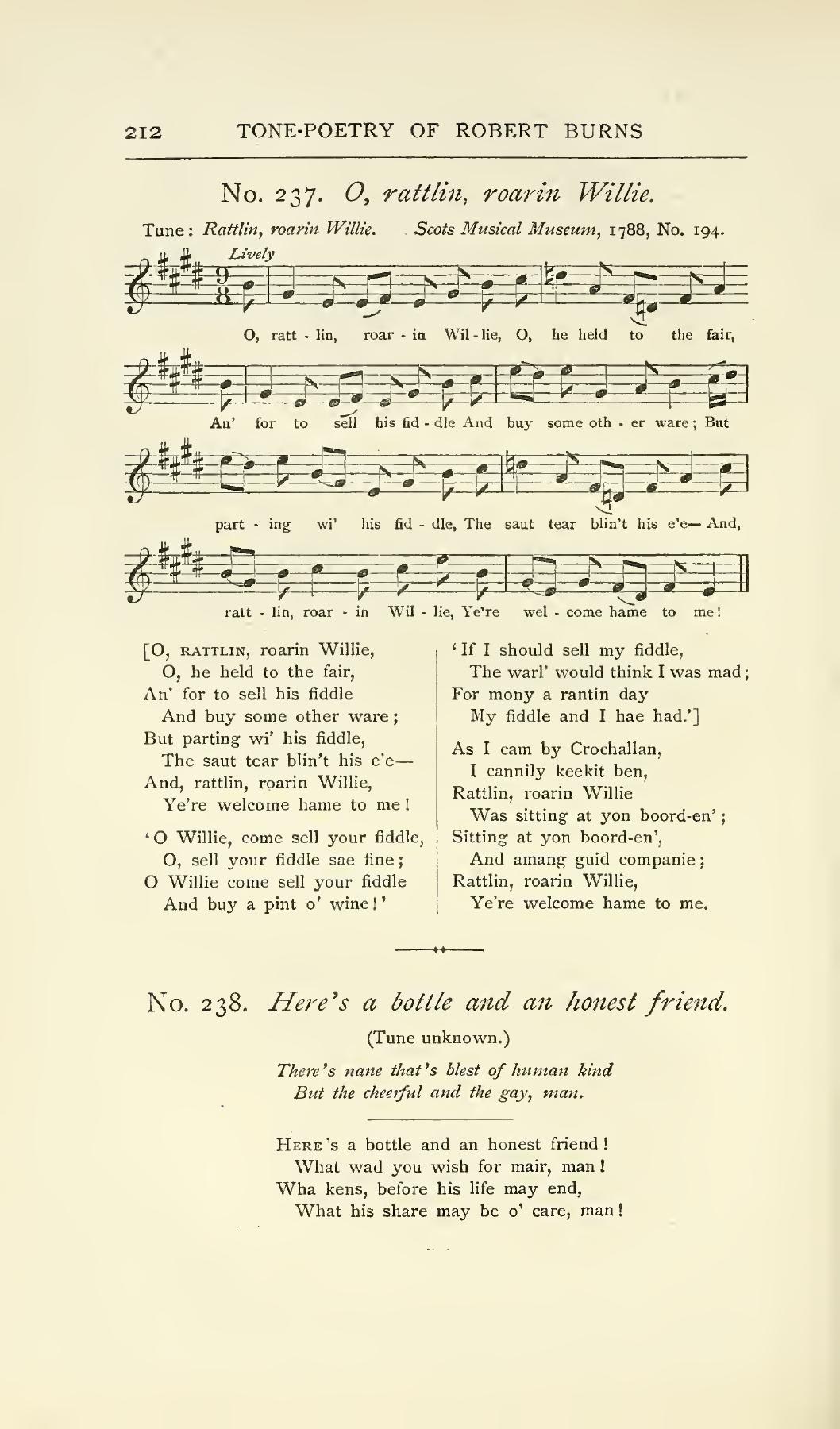 View score Dick’s Songs of Robert Burns (1903)
Lyrics
Choose an edition
Dick (1903) · no. 237
[O, rattlin, roarin Willie,
    O, he held to the fair,
An’ for to sell his fiddle
    And buy some other ware;
But parting wi’ his fiddle,
    The saut tear blin’t his e’e—
And, rattlin, roarin Willie,
    Ye’re welcome hame to me!

‘O Willie, come sell your fiddle,
    O, sell your fiddle sae fine;
O Willie, come sell your fiddle
    And buy a pint o’ wine!’

‘If I should sell my fiddle,
    The warl’ would think I was mad;
For mony a rantin day
    My fiddle and I hae had.’]

As I cam by Crochallan,
    I cannily keekit ben,
Rattlin, roarin Willie
    Was sitting at yon boord-en’;
Sitting at yon boord-en’,
    And amang gude companie;
Rattlin, roarin Willie,
    Ye’re welcome hame to me.
View the source edition · no. 237; p. 212
About this edition
Dick brackets the first sixteen lines and separates the four-line offer and reply. Cunningham prints three eight-line stanzas. Dick’s “boord-en’” and “gude companie” are Cunningham’s “board en’” and “good companie”. The ebook ends “me I”, where Dick’s final line ends “me.”; the ebook anomaly remains for printed-page proof.
Cunningham (1855)
O rattlin’, roarin’ Willie,
  O, he held to the fair,
An’ for to sell his fiddle,
  An’ buy some other ware;
But parting wi’ his fiddle,
  The saut tear blint his ee;
And rattlin’, roarin’ Willie,
  Ye’re welcome hame to me!

O Willie, come sell your fiddle,
  O sell your fiddle sae fine;
O Willie, come sell your fiddle,
  And buy a pint o’ wine!
If I should sell my fiddle,
  The warl’ would think I was mad;
For mony a rantin’ day
  My fiddle and I hae had.

As I cam by Crochallan,
  I cannily keekit ben—
Rattlin’, roarin’ Willie
  Was sittin’ at yon board en’;
Sitting at yon board en’,
  And amang good companie;
Rattlin’, roarin’ Willie,
  Ye’re welcome hame to me I
Digital text from Project Gutenberg.
View the source edition · p. 230
About this edition
Dick brackets the first sixteen lines and separates the four-line offer and reply. Cunningham prints three eight-line stanzas. Dick’s “boord-en’” and “gude companie” are Cunningham’s “board en’” and “good companie”. The ebook ends “me I”, where Dick’s final line ends “me.”; the ebook anomaly remains for printed-page proof.
Scots Musical Museum, vol. II (1788) · no. 194
View the source edition · Volume 2, no. 194; p. 202
Music
View historical scores
Dick’s Songs of Robert Burns (1903)
no. 237; p. 212