O’er the Water to Charlie
Behind the song
The singer offers John Ross an extra bawbee, a halfpenny, to row him over to Charlie. In the chorus one man’s request becomes a Jacobite pledge of allegiance to Charles Edward Stuart. They will cross the water together and spend their lives in his cause. [1][3]
The singer calls on the moon, stars and early sun to witness the oath. If he had twenty thousand lives, he would give every one to Charlie. His enemies can go before the Devil. [1]
Read the fuller story
Cunningham assigns the second stanza and nearly all the third to Burns, while describing other songs on the same subject and air. Dick cites Stenhouse’s description of the version as revised and corrected by Burns. He associates a slightly varied refrain with the Jacobite events of 1745, placing inherited words behind the version Burns worked on. [2][3]
Dick prints Over the water to Charlie, marked Brisk, with a Museum heading dated 1788. His chorus ends “And live and die wi’ Charlie”, where Cunningham has “And live or die wi’ Charlie”. Cunningham repeats the written chorus after the closing verse; Dick prints it once after the opening. Dick sends readers to another note for the tune’s background. The selected entry supplies its own score for the song’s determined crossing and vow. [1][2][3]
Story references
- James C. Dick, The Songs of Robert Burns (1903), No. 294; printed pp. 277–277; PDF pp. 333–333
- Allan Cunningham, The Complete Works of Robert Burns (1855), printed 230; HTML #songsLVII. Project Gutenberg transcription.
- James C. Dick, The Songs of Robert Burns (1903), Dick note 294; printed 469; PDF 525
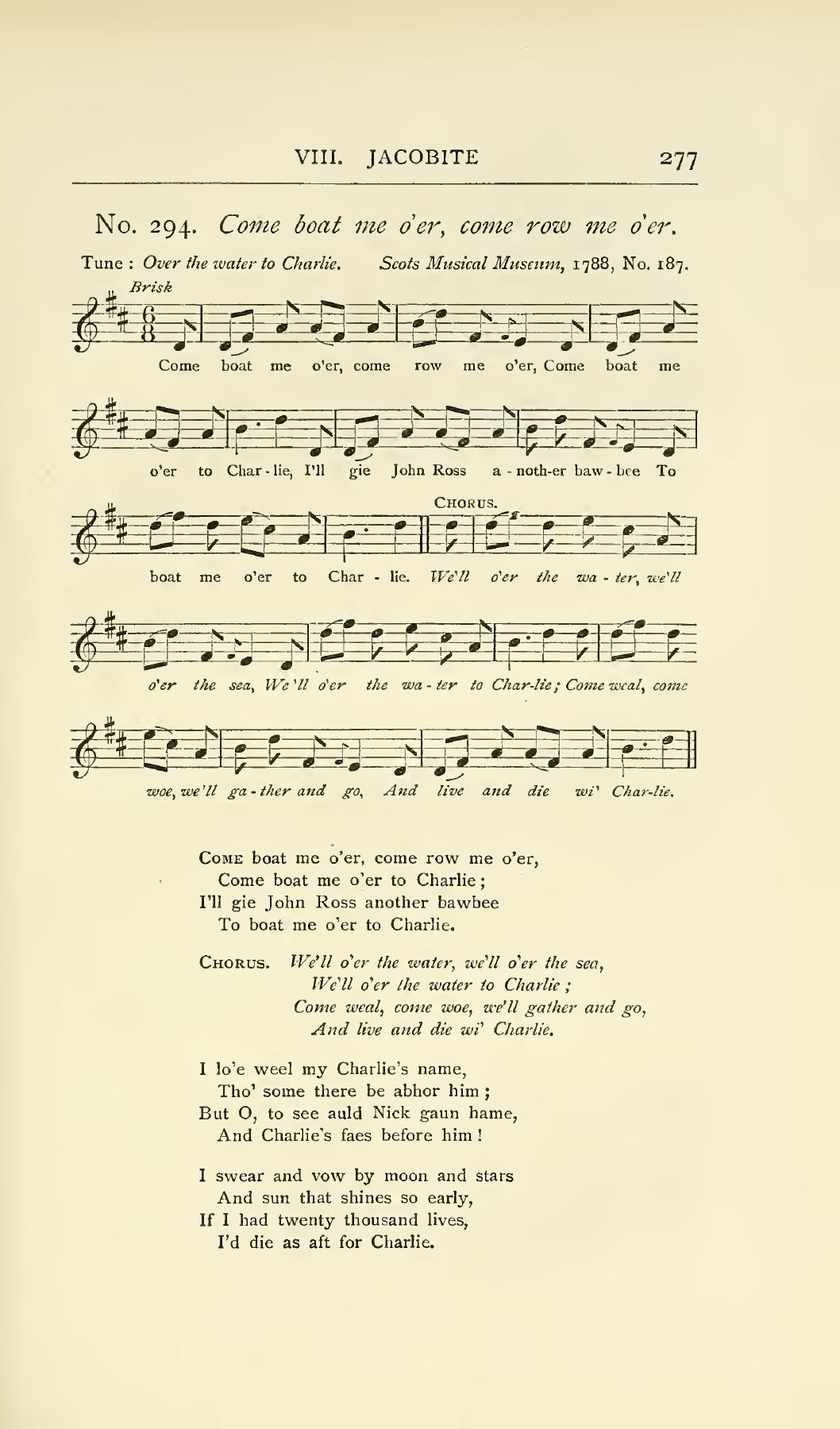 View score Dick’s Songs of Robert Burns (1903)
Lyrics
Choose an edition
Version notes
| Dick (1903) · no. 294 | Cunningham · 1855Ebook transcription |
|---|---|
| live and die | live or die |
| We’ll o’er the water, we’ll o’er the sea | We’ll o’er the water and o’er the sea |
| once after first quatrain | after first and final verses |
Dick (1903) · no. 294
Come boat me o'er, come row me o'er,
Come boat me o'er to Charlie;
I'll gie John Ross another bawbee
To boat me o'er to Charlie.

CHORUS.
We'll o'er the water, we'll o'er the sea,
We'll o'er the water to Charlie;
Come weal, come woe, we'll gather and go,
And live and die wi' Charlie.

I lo'e weel my Charlie's name,
Tho' some there be abhor him;
But O, to see auld Nick gaun hame,
And Charlie's faes before him!

I swear and vow by moon and stars
And sun that shines so early,
If I had twenty thousand lives,
I'd die as aft for Charlie.
View the source edition · no. 294; p. 277
About this edition
Dick prints three quatrains with a labelled chorus after the first. Cunningham includes the chorus in its first numbered block and writes it again after the last verse. Dick’s chorus has we’ll o’er the sea rather than and o’er the sea, and ends live and die where Cunningham has live or die.
Cunningham (1855)
Come boat me o’er, come row me o’er,
  Come boat me o’er to Charlie;
I’ll gie John Ross another bawbee,
  To boat me o’er to Charlie.
    We’ll o’er the water and o’er the sea,
      We’ll o’er the water to Charlie;
    Come weal, come woe, we’ll gather and go,
      And live or die wi’ Charlie.

I lo’e weel my Charlie’s name,
  Tho’ some there be abhor him:
But O, to see auld Nick gaun hame,
  And Charlie’s faes before him!

I swear and vow by moon and stars,
  And sun that shines so early,
If I had twenty thousand lives,
  I’d die as aft for Charlie.
    We’ll o’er the water and o’er the sea,
      We’ll o’er the water to Charlie;
    Come weal, come woe, we’ll gather and go,
      And live or die wi’ Charlie!
Digital text from Project Gutenberg.
View the source edition · p. 230
About this edition
Dick prints three quatrains with a labelled chorus after the first. Cunningham includes the chorus in its first numbered block and writes it again after the last verse. Dick’s chorus has we’ll o’er the sea rather than and o’er the sea, and ends live and die where Cunningham has live or die.
Scots Musical Museum, vol. II (1788) · no. 187
View the source edition · Volume 2, no. 187; p. 195
Music
View historical scores
Dick’s Songs of Robert Burns (1903)
no. 294; p. 277