The blude red rose at Yule may blaw
Behind the song
A blood-red rose can bloom at Yule sooner than an old man will have command of the young singer. His money will do him no more good. Cunningham attributes the words to Burns for the Scots Musical Museum and connects the air with an older Jacobite song.[1]
Read the fuller story
The opening imagines a rose flowering at Christmas, lilies growing in snow and the deepest sea freezing over. Such impossibilities prepare the repeated declaration that the suitor will never “daunton” the speaker. His flattery is set beside her youth as something she has already seen through.[1]
The middle stanzas turn to his provisions, money, animals and land. These may purchase property, but they cannot purchase her. The last stanza returns to the man himself in a mocking physical portrait, then repeats the refusal and the accusation against his flattering tongue.[1]
Cunningham prints “To daunton me” as the tune and says its Jacobite strain must have been in the poet’s mind. The selected words make their argument through the woman’s own repeated assertion, moving from extravagant natural impossibility to a plain limit on what money can buy.[1]
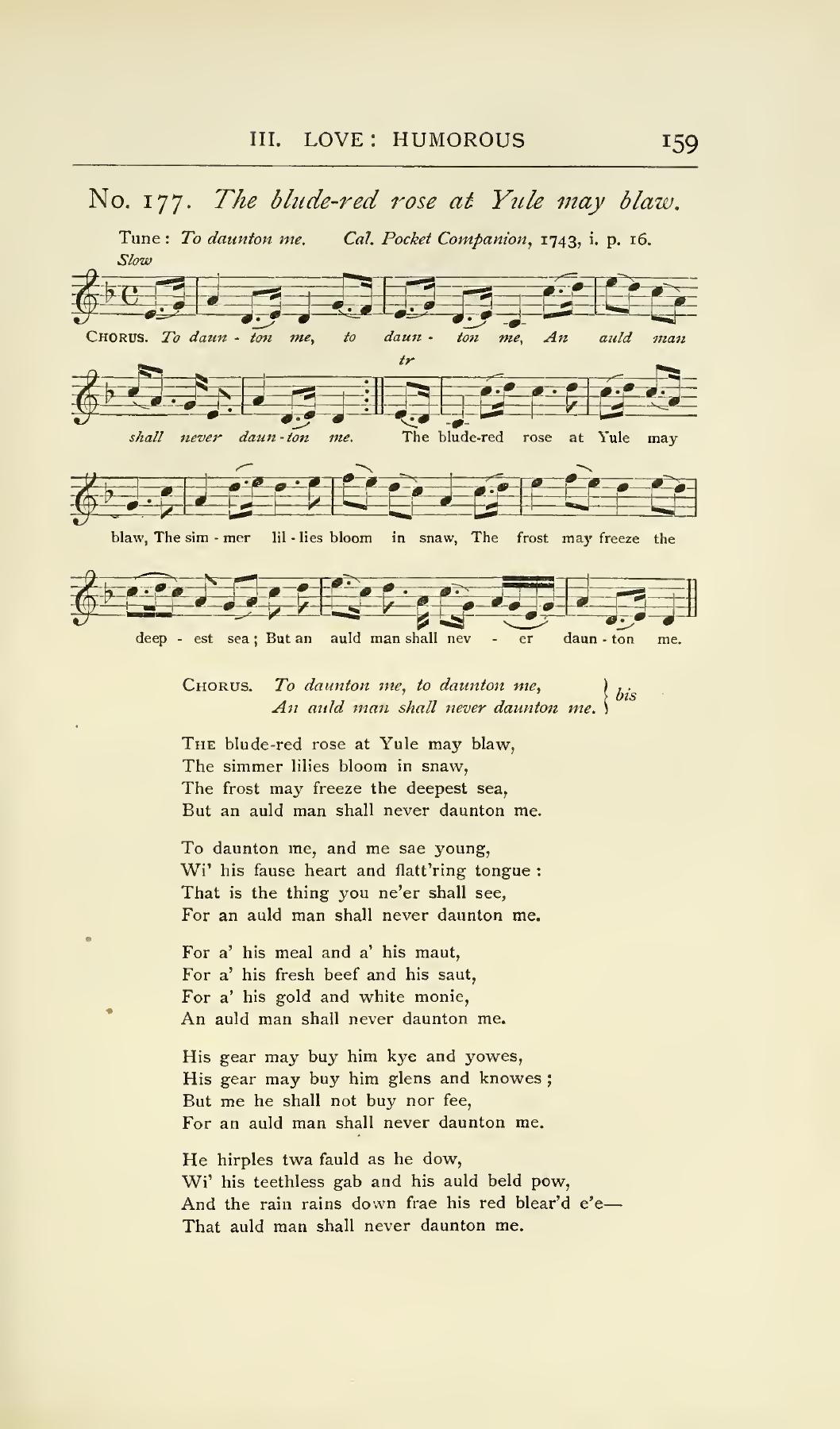 View score Dick’s Songs of Robert Burns (1903)
Lyrics
Choose an edition
Cunningham (1855)
The blude red rose at Yule may blaw,
The simmer lilies bloom in snaw,
The frost may freeze the deepest sea;
But an auld man shall never daunton me.
  To daunton me, and me so young,
  Wi’ his fause heart and flatt’ring tongue.
  That is the thing you ne’er shall see;
  For an auld man shall never daunton me.

For a’ his meal and a’ his maut,
For a’ his fresh beef and his saut,
For a’ his gold and white monie,
An auld man shall never daunton me.

His gear may buy him kye and yowes,
His gear may buy him glens and knowes;
But me he shall not buy nor fee,
For an auld man shall never daunton me.

He hirples twa fauld as he dow,
Wi’ his teethless gab and Ma auld beld pow,
And the rain rains down frae his red bleer’d ee—
That auld man shall never daunton me.
  To daunton me, and me sae young,
  Wi’ his fause heart and flatt’ring tongue,
  That is the thing you ne’er shall see;
  For an auld man shall never daunton me.
Digital text from Project Gutenberg.
View the source edition · p. 229
About this edition
Cunningham’s preface discusses several poems he left out of the collection.
Dick (1903) · no. 177
The words are on the score page.
View the source edition · no. 177; p. 159
Scots Musical Museum, vol. II (1788) · no. 182
View the source edition · Volume 2, no. 182; p. 190
Music
View historical scores
Dick’s Songs of Robert Burns (1903)
no. 177; p. 159
Words attributed to Burns
Cunningham attributes these words to Burns for the Museum and conjectures a connection with the older Jacobite To daunton me; its earlier words have not been independently compared.
Words Robert Burns
Burns’s role Wrote the words