Raving winds around her blowing
Behind the song
Wind, falling leaves and a roaring river surround Isabella’s lament. The song gives her grief the darkness of a night without morning. Cunningham’s headnote quotes Burns saying he composed the verses on Isabella M’Leod of Raza, with reference to losses in her family.[1]
Read the fuller story
The opening four lines place Isabella in an autumn landscape before handing the song to her voice. Each repeated ending keeps wind, woodland, river and mourner close together. Her remembered days of sunshine give way to an imagined night of sorrow that offers no prospect of renewal.[1]
The second stanza turns from the scene around Isabella to the movement of her thoughts. She dwells on the past and sees the future as hopeless. Grief freezes the blood, despair takes hold of the imagination, and life itself becomes a burden she wishes to surrender. The language follows the extremity of the lamenting voice.[1]
Cunningham heads the song with “Macgregor of Rura’s Lament” as its tune. His personal explanation connects that lament to Isabella M’Leod through a quoted composition statement. The lyric gives its grief a stark, continuous form: the external storm leads into a mind that can picture no change in its suffering.[1]
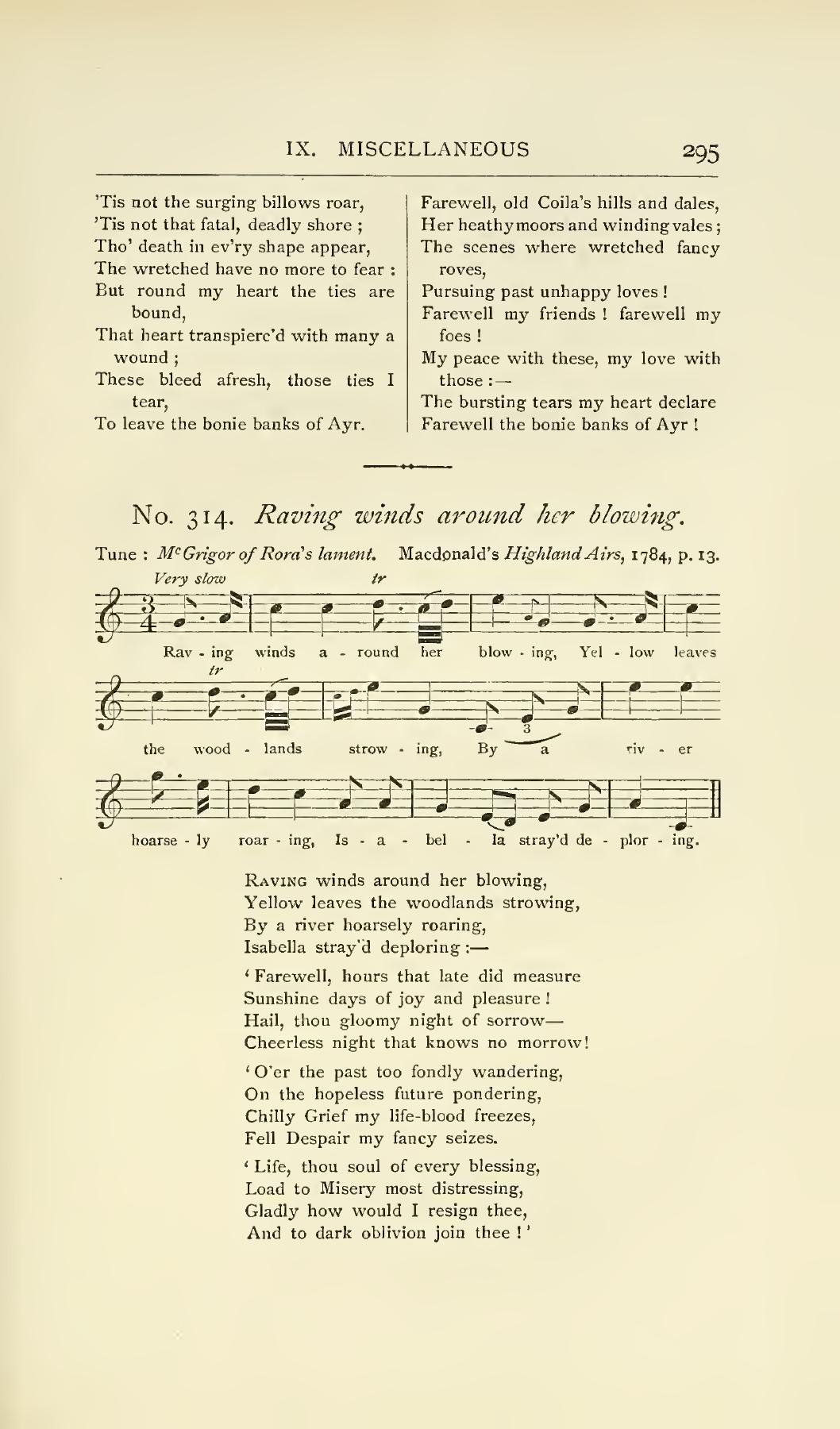 View score Dick’s Songs of Robert Burns (1903)
Lyrics
Choose an edition
Cunningham (1855)
Raving winds around her blowing,
Yellow leaves the woodlands strowing,
By a river hoarsely roaring,
Isabella stray’d deploring—
“Farewell hours that late did measure
Sunshine days of joy and pleasure;
Hail, thou gloomy night of sorrow,
Cheerless night that knows no morrow!

“O’er the past too fondly wandering,
On the hopeless future pondering;
Chilly grief my life-blood freezes,
Fell despair my fancy seizes.
Life, thou soul of every blessing,
Load to misery most distressing,
Gladly how would I resign thee,
And to dark oblivion join thee!”
Digital text from Project Gutenberg.
View the source edition · p. 228
About this edition
Cunningham’s preface discusses several poems he left out of the collection.
Dick (1903) · no. 314
The words are on the score page.
View the source edition · no. 314; p. 295
Scots Musical Museum, vol. II (1788) · no. 173
View the source edition · Volume 2, no. 173; p. 181
Music
View historical scores
Dick’s Songs of Robert Burns (1903)
no. 314; p. 295