Landlady, count the Lawin
Behind the song
It is nearly dawn and the landlady can count the lawin, or reckoning. Everyone else is blind drunk, the singer says. He is merely jolly fou, cheerfully drunk. The chorus gives the company a chance to ask who is drunk now. [1]
He addresses the drinking vessel next. If that cog could stay full, he would stay and sing to it. The last verse makes a toast of the whole business, asking good health for the company and a blessing on the king. [1]
Read the fuller story
Cunningham assigns the first two verses to Burns and connects the last with an older song about a threatened Swedish invasion and the restoration of the Stuarts. Dick describes an early eighteenth-century Jacobite song printed on the same Museum page and quotes a stanza with its own drinking chorus. That quoted song puts trumpets, drums and swords beside the command to fill the bumpers. [2][3]
Dick prints the air Hey tutti, taiti, marked Lively, and his chorus has four lines, including a repeated Hey tutti, taiti. Cunningham’s written chorus has three lines and is printed again after the final verse. Dick identifies the tune, slightly varied, with the air for which Burns wrote Scots wha hae. The selected song keeps that melody in the social world of the landlady’s bill, the full cup and the company’s toast. [1][2][3]
Story references
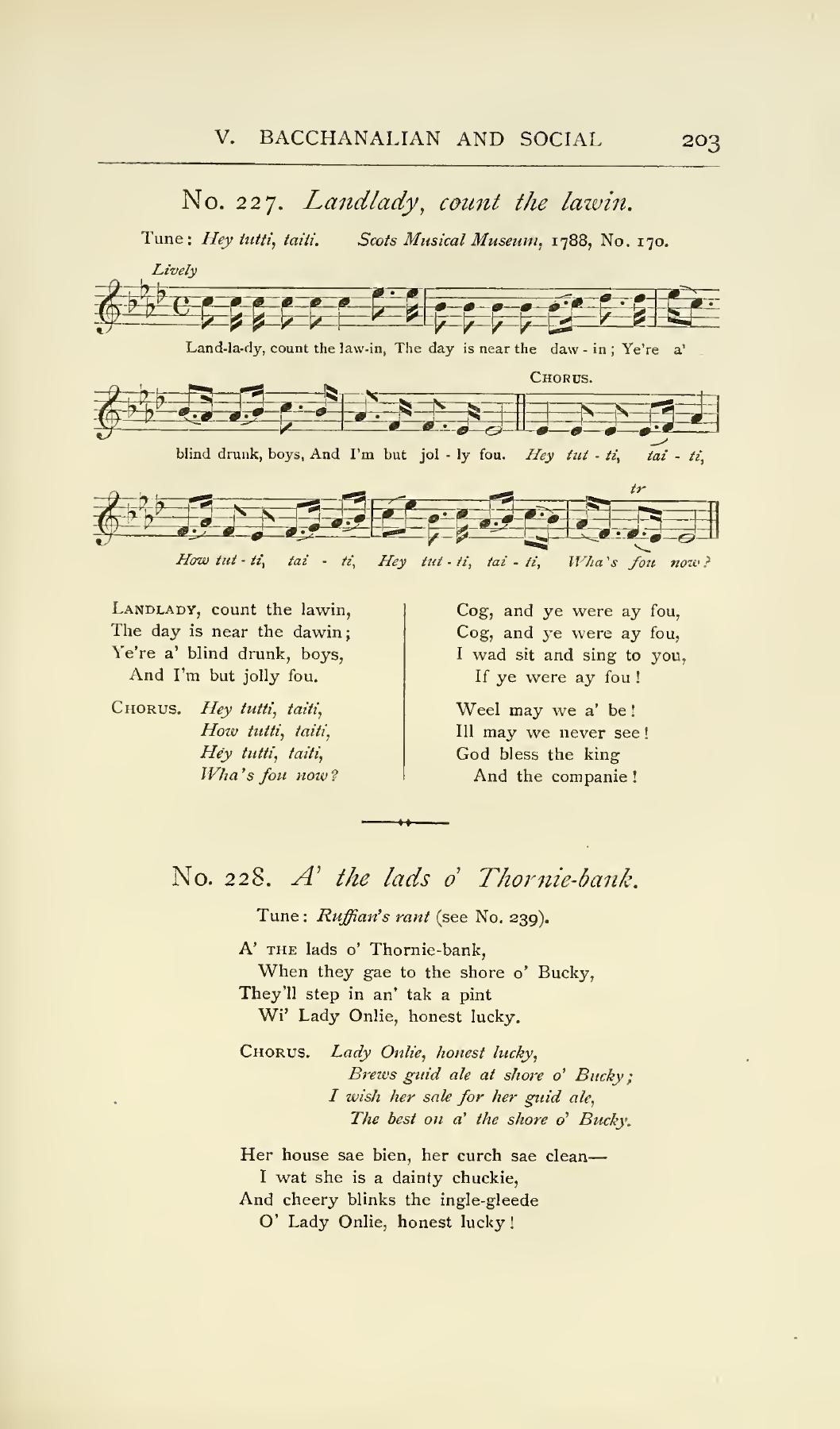 View score Dick’s Songs of Robert Burns (1903)
Lyrics
Choose an edition
Version notes
| Dick (1903) · no. 227 | Cunningham · 1855Ebook transcription |
|---|---|
| four-line chorus after first verse, Hey/How/Hey/Wha’s | three-line chorus Hey/How/Wha’s after first and last verses |
| Cog, and ye were ay fou | Cog an’ ye were ay fou |
| Weel may we a’ be! | Weel may ye a’ be! |
Dick (1903) · no. 227
Landlady, count the lawin,
The day is near the dawin;
Ye're a' blind drunk, boys,
And I'm but jolly fou.

CHORUS.
Hey tutti, taiti,
How tutti, taiti,
Hey tutti, taiti,
Wha's fou now?

Cog, and ye were ay fou,
Cog, and ye were ay fou,
I wad sit and sing to you,
If ye were ay fou!

Weel may we a' be!
Ill may we never see!
God bless the king
And the companie!
View the source edition · no. 227; p. 203
About this edition
Dick prints a four-line opening verse, a four-line labelled chorus, then two quatrains. Cunningham prints a three-line chorus after the first and last verses. Dick’s toast begins Weel may we a’ be; Cunningham has ye. Dick writes Cog, and ye were ay fou; Cunningham contracts an’ and omits the comma after Cog.
Cunningham (1855)
Landlady, count the lawin,
The day is near the dawin;
Ye’re a’ blind drunk, boys,
  And I’m but jolly fou,
    Hey tutti, taiti,
    How tutti, taiti—
    Wha’s fou now?

Cog an’ ye were ay fou,
Cog an’ ye were ay fou,
I wad sit and sing to you
  If ye were ay fou.

Weel may ye a’ be!
Ill may we never see!
God bless the king,
  And the companie!
    Hey tutti, taiti,
    How tutti, taiti—
    Wha’s fou now?
Digital text from Project Gutenberg.
View the source edition · p. 228
About this edition
Dick prints a four-line opening verse, a four-line labelled chorus, then two quatrains. Cunningham prints a three-line chorus after the first and last verses. Dick’s toast begins Weel may we a’ be; Cunningham has ye. Dick writes Cog, and ye were ay fou; Cunningham contracts an’ and omits the comma after Cog.
Scots Musical Museum, vol. II (1788) · no. 170
View the source edition · Volume 2, no. 170; p. 178
Music
View historical scores
Dick’s Songs of Robert Burns (1903)
no. 227; p. 203