Duncan Davison
Behind the song
Duncan follows Meg across the moor and she uses her spinning gear to keep him off. A promise of marriage moves the song towards the prospect of a small house together and a cheerful argument for kissing. [1]
Read the fuller story
Three eight-line stanzas make the spinning gear part of the courtship. Meg threatens Duncan with it as they cross the moor, then sets the wheel between them when they rest by a burn. His oath that she will be a bride the next morning is followed by her throwing the implements across the water. The brisk sequence leaves the lovers’ exchanges to carry the comedy. [1]
The final stanza pictures a wee house where the pair could live like king and queen, with the wheel again beside them in the evening. Three closing comparisons argue that drinking, fighting and kissing need not end badly. The last imagines a lover welcomed back again, giving the song its confident farewell. [1]
Cunningham says this version appears in the Museum and alludes to other versions of Duncan Davison that he considers less delicate. His headnote supplies that statement about circulation while leaving those other texts unquoted. The selected narrative follows the three stanzas printed here. [1]
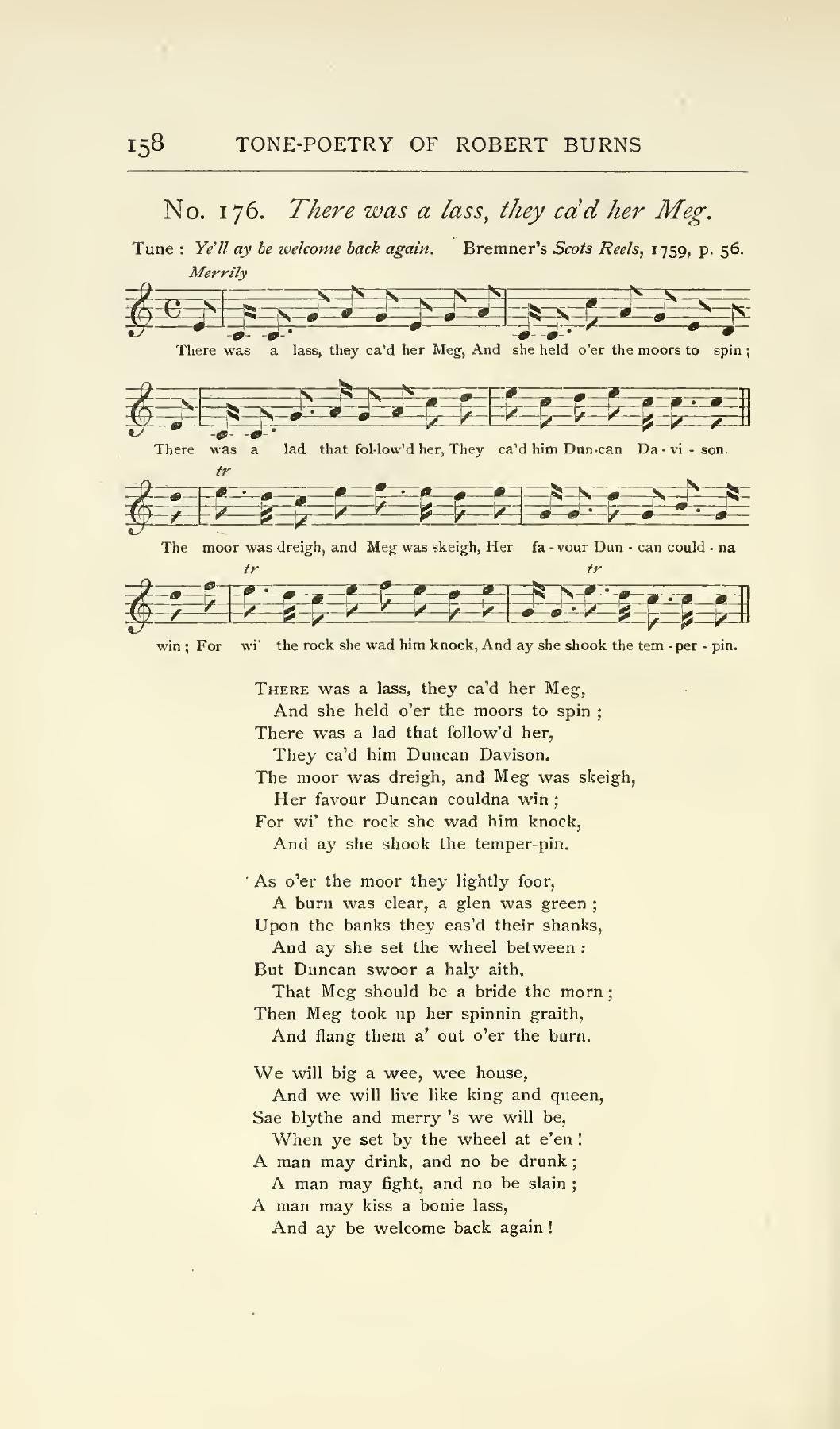 View score Dick’s Songs of Robert Burns (1903)
Lyrics
Choose an edition
Cunningham (1855)
There was a lass, they ca’d her Meg,
  And she held o’er the moors to spin;
There was a lad that follow’d her,
  They ca’d him Duncan Davison.
The moor was driegh, and Meg was skiegh,
  Her favour Duncan could na win;
For wi’ the roke she wad him knock.
  And ay she shook the temper-pin.

As o’er the moor they lightly foor,
  A burn was clear, a glen was green,
Upon the banks they eas’d-their shanks,
  And ay she set the wheel between:
But Duncan swore a haly aith,
  That Meg should be a bride the morn,
Then Meg took up her spinnin’ graith,
  And flang them a’ out o’er the burn.

We’ll big a house,—a wee, wee house,
  And we will live like king and queen,
Sae blythe and merry we will be
  When ye set by the wheel at e’en.
A man may drink and no be drunk;
  A man may fight and no be slain;
A man may kiss a bonnie lass,
  And ay be welcome back again.
Digital text from Project Gutenberg.
View the source edition · p. 226
About this edition
Cunningham’s preface discusses several poems he left out of the collection.
Dick (1903) · no. 176
The words are on the score page.
View the source edition · no. 176; p. 158
Scots Musical Museum, vol. II (1788) · no. 149
View the source edition · Volume 2, no. 149; p. 156
Music
View historical scores
Dick’s Songs of Robert Burns (1903)
no. 176; p. 158