My Hoggie
Behind the song
The hoggie, a young sheep, is the one animal the speaker has to lose. A faithful dog keeps watch through a night full of alarming sounds. At foggy dawn, a different dog leaps the wall and nearly kills the hoggie.
Read the fuller story
The opening question puts loss before the reader at once: what will become of the speaker if the hoggie dies? “My joy, my pride” gives this sole possession an affectionate place in the song. Night sounds deepen the fear, and the final attack brings the danger across the boundary of the fold.
Cunningham says Burns wrote the words for the Museum after being struck by the pastoral wildness of a Liddesdale air. He identifies only the first line as old. His account credits Burns with building the anxious watch and its ending around that inherited question.[1]
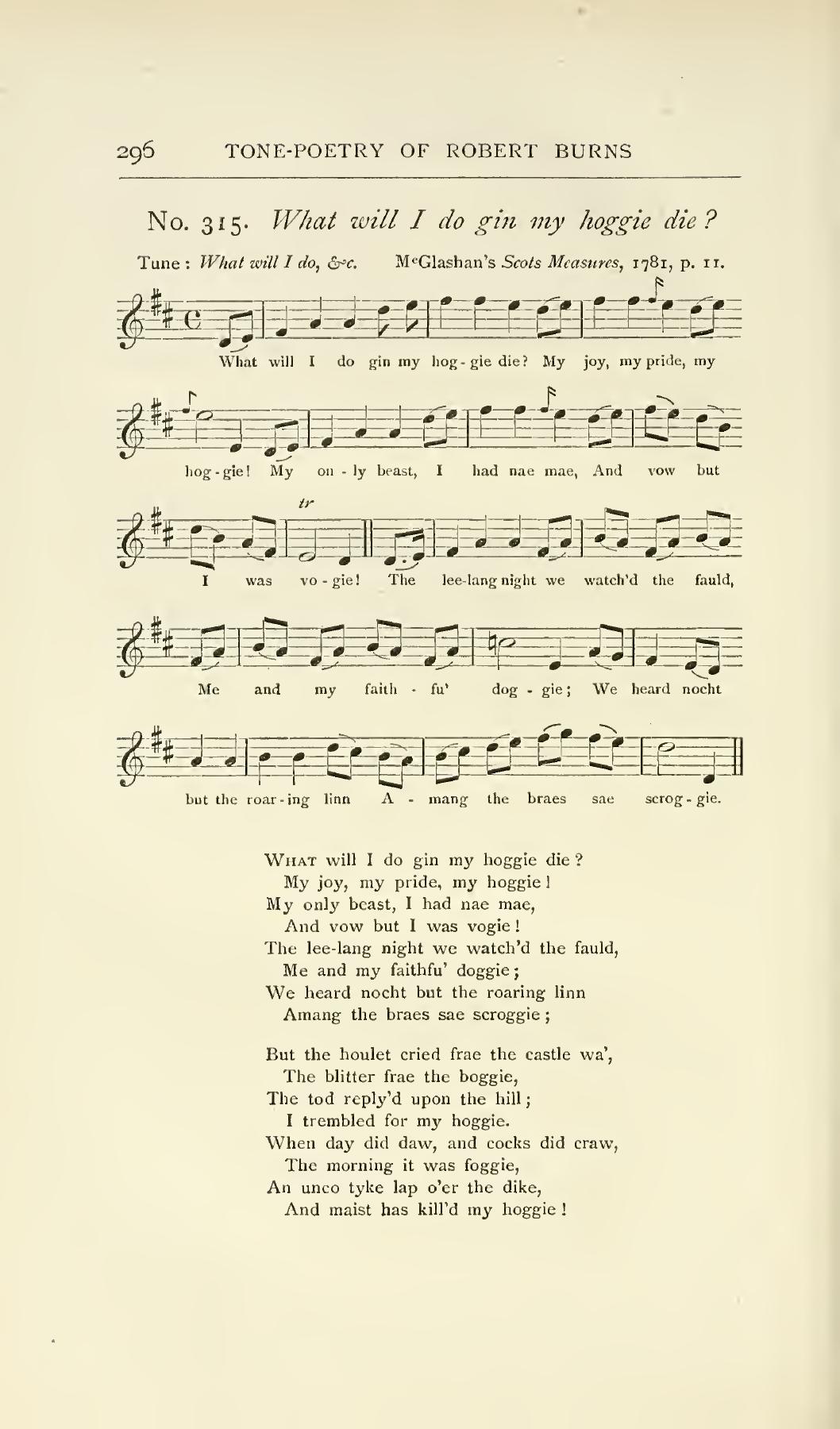 View score Dick’s Songs of Robert Burns (1903)
Lyrics
Choose an edition
Cunningham (1855)
What will I do gin my Hoggie die?
  My joy, my pride, my Hoggie!
My only beast, I had nae mae,
  And vow but I was vogie!
The lee-lang night we watch’d the fauld,
  Me and my faithfu’ doggie;
We heard nought but the roaring linn,
  Amang the braes sae scroggie;
But the houlet cry’d frae the castle wa’,
  The blitter frae the boggie,
The tod reply’d upon the hill,
  I trembled for my Hoggie.
When day did daw, and cocks did craw,
  The morning it was foggie;
An’ unco tyke lap o’er the dyke,
  And maist has kill’d my Hoggie.
Digital text from Project Gutenberg.
View the source edition · p. 224
About this edition
Cunningham’s preface discusses several poems he left out of the collection.
Dick (1903) · no. 315
The words are on the score page.
View the source edition · no. 315; p. 295
About this edition
Dick’s Corrections leaf says the end of the first line of music should be barred. The displayed score preserves the unaltered printing.
Scots Musical Museum, vol. II (1788) · no. 133
View the source edition · Volume 2, no. 133; pp. 139–140
Music
View historical scores
Dick’s Songs of Robert Burns (1903)
no. 315; p. 295; PDF p. 352 (inherited page mapping)
Burns’s words around an older opening — qualified attribution
Cunningham calls the first line old and credits Burns with the remaining words.
Words Robert Burns with an older first line
Burns’s role Burns’s words around an older opening — qualified attribution