Macpherson’s Farewell
Behind the song
James Macpherson was hanged in Banff on Friday 16 November 1700, the town’s weekly market day. The sheriff ordered that he and James Gordon be taken from the tolbooth, where they were held, to the market cross. Both names appear in the town’s payment to the executioner for the rope. [4][5]
Burns gives Macpherson a last request. Untie his hands, bring him his sword, and he will face any man in Scotland. In the chorus he plays a spring, a lively dance tune, and dances beneath the gallows. The challenge and the dance belong to the song. His last farewell is to the sunlight. [1]
Read the fuller story
The prosecution invoked a Scottish law directed against Gypsy people, whom the court called “Egyptians”. The defence challenged its use against Macpherson and Gordon. The jury also found that the men had carried arms, intimidated people at markets and harboured thieves. The sheriff set the hanging for between two and three in the afternoon. [4]
Allan Cunningham’s introduction to the song puts the gallows in Inverness. The New Statistical Account of Scotland places them on Banff’s Gallow Hill. The sheriff named different places for the men tried together at Banff. He specified the cross for Macpherson and Gordon, and Gallow Hill for Peter and Donald Brown. [3][4][5]
An older printed ballad gave Macpherson quite a different speech. Its singer confesses to plunder and murder. In Burns’s verses he speaks of betrayal and grieves that he must die before he can take revenge. The broken fiddle belongs to later tradition. James C. Dick tells how Macpherson offered it to the crowd, then broke it across his knee when nobody would take it. What Macpherson actually said or played at the gallows is unknown. [1][2][4][5]
Dick prints the tune as M’Pherson’s Rant and marks it “Boldly”. Cunningham brings the chorus back after the last verse. There is a small difference you can hear in that verse, too. Dick’s singer says “dare not die” and Cunningham’s says “dares not die”. Thomas Carlyle recalled sending Alfred Tennyson on his way one evening with the tune. He saw Tennyson’s lip quiver. [1][3][6]
Story references
- James C. Dick, The Songs of Robert Burns (1903), no. 311, lyric and tune heading, printed 292, 293.
- Dick (1903), historical note 311, printed 475, 476, 477.
- Allan Cunningham, The Complete Works of Robert Burns (1855), printed 223. Project Gutenberg transcription.
- Banff sheriff court proceedings, November 1700 and February 1701. The Miscellany of the Spalding Club, vol. III (1846), pp. 175–191. The sentences are on pp. 190–191.
- Banff town accounts, payment for the execution rope, transcribed by William Cramond in The Annals of Banff, vol. I (1891), p. 101, third footnote.
- Thomas Carlyle to Edward FitzGerald, 26 October, quoted in Letters of Edward FitzGerald, vol. I, note to p. 181.
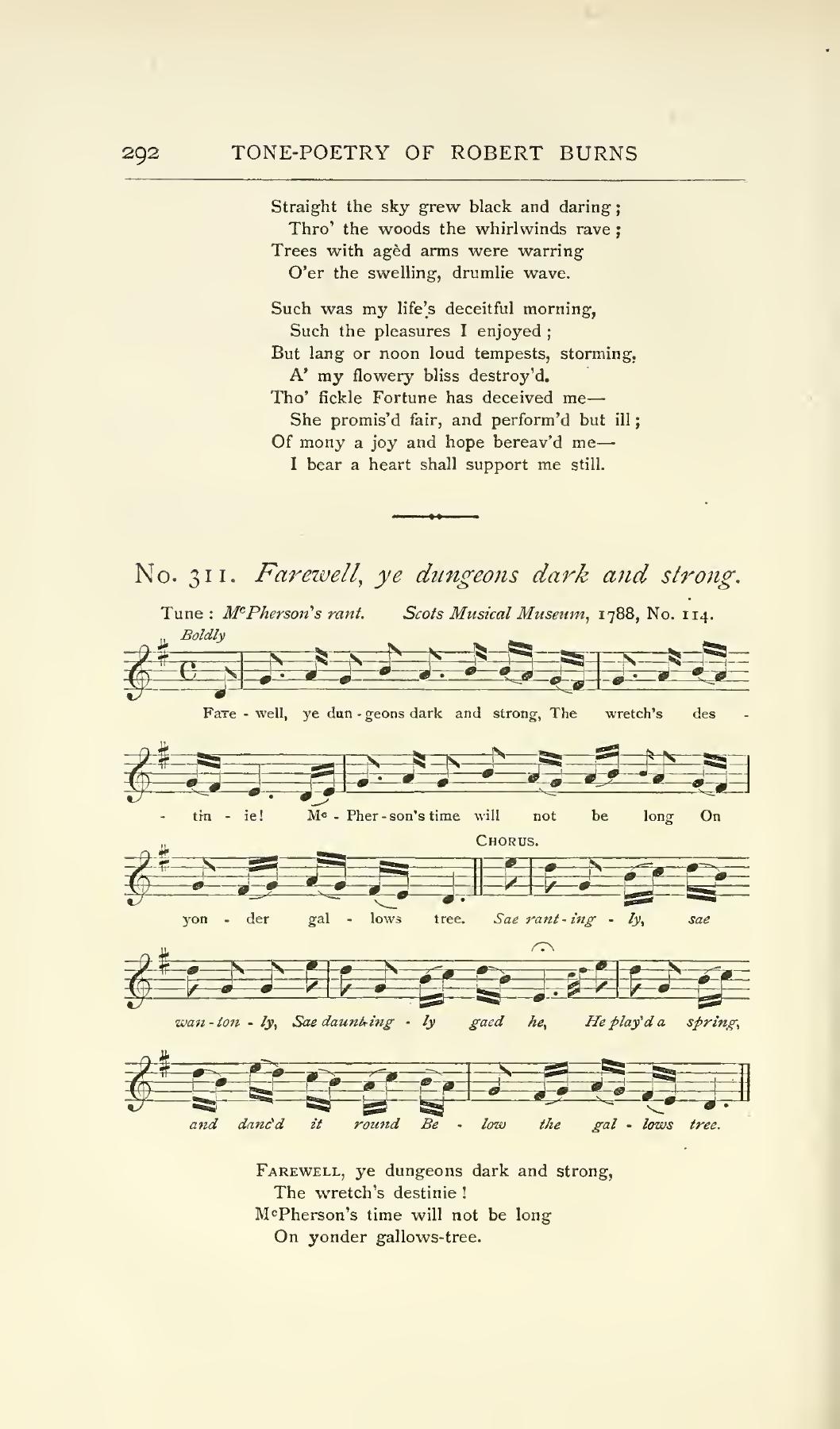 View score Dick’s Songs of Robert Burns (1903)
Lyrics
Choose an edition
Version notes
| Dick (1903) · no. 311 | Cunningham · 1855Ebook transcription |
|---|---|
| The wretch that dare not die | The wretch that dares not die |
| after first stanza | after first and final stanzas |
Dick (1903) · no. 311
Farewell, ye dungeons dark and strong,
The wretch's destinie!
McPherson's time will not be long
On yonder gallows-tree.

Chorus. Sae rantingly, sae wantonly,
Sae dauntingly gaed he,
He play'd a spring, and danc'd it round
Below the gallows tree.

O, what is death but parting breath!
On many a bloody plain
I've dared his face, and in this place
I scorn him yet again!

Untie these bands from off my hands,
And bring to me my sword,
And there's no a man in all Scotland
But I'll brave him at a word.

I've liv'd a life of sturt and strife;
I die by treacherie:
It burns my heart I must depart,
And not avenged be.

Now farewell light, thou sunshine bright,
And all beneath the sky!
May coward shame distain his name,
The wretch that dare not die!
These are the words printed below the score.
View the source edition · no. 311; pp. 292–293
About this edition
Five quatrains and a chorus in each; Cunningham repeats the chorus at the end. Dick closes “The wretch that dare not die”; Cunningham “The wretch that dares not die”. Dick’s “McPherson” uses a raised c in print; the reading renders it inline.
Cunningham (1855)
Farewell, ye dungeons dark and strong,
  The wretch’s destinie!
Macpherson’s time will not be long
  On yonder gallows-tree.
    Sae rantingly, sae wantonly,
      Sae dauntingly gaed he;
    He play’d a spring, and danc’d it round,
      Below the gallows-tree.

Oh, what is death but parting breath?
  On many a bloody plain
I’ve dar’d his face, and in this place
  I scorn him yet again!

Untie these bands from off my hands,
  And bring to me my sword;
And there’s no a man in all Scotland,
  But I’ll brave him at a word.

I’ve liv’d a life of sturt and strife;
  I die by treacherie:
It burns my heart I must depart,
  And not avenged be.

Now farewell light—thou sunshine bright,
  And all beneath the sky!
May coward shame distain his name,
  The wretch that dares not die!
    Sae rantingly, sae wantonly,
      Sae dauntingly gaed he;
    He play’d a spring, and danc’d it round,
      Below the gallows-tree.
Digital text from Project Gutenberg.
View the source edition · p. 223
About this edition
Five quatrains and a chorus in each; Cunningham repeats the chorus at the end. Dick closes “The wretch that dare not die”; Cunningham “The wretch that dares not die”. Dick’s “McPherson” uses a raised c in print; the reading renders it inline.
Scots Musical Museum, vol. II (1788) · no. 114
View the source edition · Volume 2, no. 114; p. 117
Music
View historical scores
Dick’s Songs of Robert Burns (1903)
no. 311; pp. 292–293