O Whistle, and I’ll Come to You
Behind the song
Use the back gate and the stile. Look as though you’re going elsewhere. At church or market, a stolen glance will do. The singer gives her lover these instructions and promises to come when he whistles. [1]
The chorus makes a bold promise to go to him even if her father, mother and everyone else object. The repeated lines let the lovers enjoy the game of keeping their meetings secret. [1]
Read the fuller story
Dick quotes Burns writing to Thomson in August 1793 that he admired the air and had just fitted verses to it. Both Dick and Cunningham discuss a later change to the refrain naming Jeanie. Dick associates that change with Jean Lorimer. Their accounts place the song within Burns’s continuing adaptation of words for a tune and a changing personal address. [2][3]
Cunningham preserves two related forms. Come Down the Back Stairs has an eight-line chorus and an eight-line verse with short lines. His later O Whistle text extends the instructions with a further verse: the man may make light of her beauty, but he must take care when courting anyone else. The woman knows that a show of indifference can carry its own risks. [3]
The score here is Dick’s lively 6/8 setting, headed Whistle an’ I’ll come to ye, my lad and citing Museum 1788, no. 106. His historical commentary discusses the later Thomson form. The dates therefore accompany particular text and music witnesses, while the two Cunningham companions make the changing instructions visible. [1][2][3]
Story references
- James C. Dick, The Songs of Robert Burns (1903), no. 190: lyric and musical heading; printed pp. 170–170; PDF pp. 226–226.
- Dick (1903), historical note 190, printed 415, 416.
- Allan Cunningham, The Complete Works of Robert Burns (1855), printed 222; HTML #songsXXXIV; printed 284; HTML #CCII. Project Gutenberg transcription.
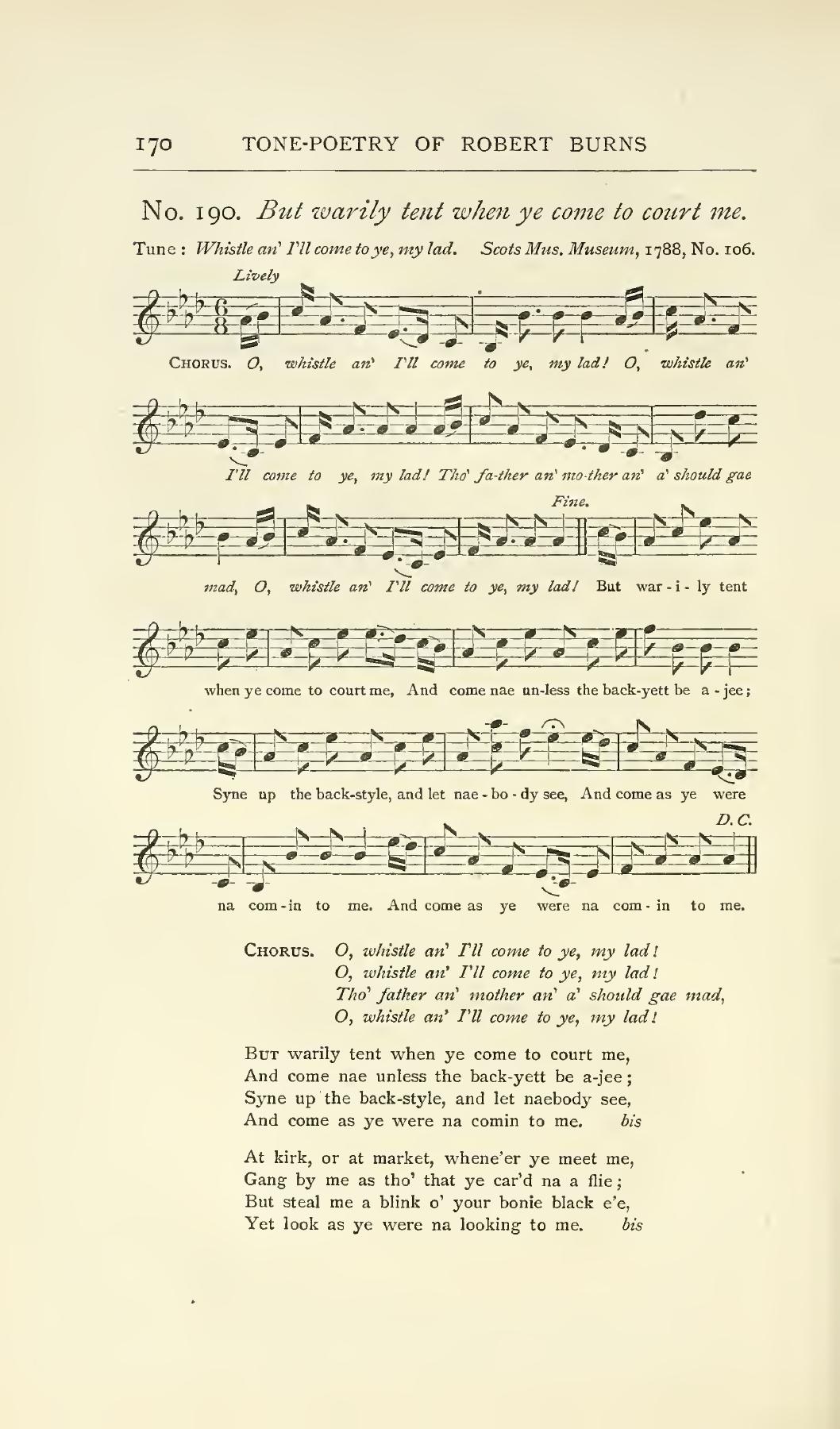 View score Dick’s Songs of Robert Burns (1903)
Lyrics
Choose an edition
Dick (1903) · no. 190
Chorus. O, whistle an’ I’ll come to ye, my lad!
    O, whistle an’ I’ll come to ye, my lad!
    Tho’ father an’ mother an’ a’ should gae mad,
    O, whistle an’ I’ll come to ye, my lad!

But warily tent when ye come to court me,
And come nae unless the back-yett be a-jee;
Syne up the back-style, and let naebody see,
And come as ye were na comin to me.

At kirk, or at market, whene’er ye meet me,
Gang by me as tho’ that ye car’d na a flie;
But steal me a blink o’ your bonie black e’e,
Yet look as ye were na looking to me.
View the source edition · no. 190; p. 170
About this edition
Dick has a four-line chorus and two quatrains, with each verse’s final line marked bis. Cunningham’s Come Down the Back Stairs has shorter lines and a repeated back-stairs direction. His later O Whistle text adds “Ay vow and protest” and repeats its final lines in full.
Cunningham (1855) · p. 222
  O whistle, and I’ll come
    To you, my lad;
  O whistle, and I’ll come
    To you, my lad:
  Tho’ father and mither
    Should baith gae mad,
  O whistle, and I’ll come
    To you, my lad.

Come down the back stairs
  When ye come to court me;
Come down the back stairs
  When ye come to court me;
Come down the back stairs,
  And let naebody see,
And come as ye were na
  Coming to me.
Digital text from Project Gutenberg.
View the source edition · p. 222
About this edition
Dick has a four-line chorus and two quatrains, with each verse’s final line marked bis. Cunningham’s Come Down the Back Stairs has shorter lines and a repeated back-stairs direction. His later O Whistle text adds “Ay vow and protest” and repeats its final lines in full.
Cunningham (1855) · p. 284
O whistle, and I’ll come to you, my lad,
O whistle, and I’ll come to you, my lad:
Tho’ father and mither and a’ should gae mad,
O whistle, and I’ll come to you, my lad.
But warily tent, when you come to court me,
And come na unless the back-yett be a-jee;
Syne up the back-stile and let naebody see,
And come as ye were na comin’ to me.
And come as ye were na comin’ to me.

At kirk, or at market, whene’er ye meet me,
Gang by me as tho’ that ye car’d na a flie;
But steal me a blink o’ your bonnie black e’e,
Yet look as ye were na lookin’ at me.
Yet look as ye were na lookin’ at me.

Ay vow and protest that ye care na for me,
And whiles ye may lightly my beauty a wee;
But court na anither, tho’ jokin’ ye be,
For fear that she wyle your fancy frae me.
For fear that she wyle your fancy frae me.

O whistle, and I’ll come to you, my lad,
O whistle, and I’ll come to you, my lad:
Tho’ father and mither and a’ should gae mad,
O whistle, and I’ll come to you, my lad.
Digital text from Project Gutenberg.
View the source edition · p. 284
About this edition
Dick has a four-line chorus and two quatrains, with each verse’s final line marked bis. Cunningham’s Come Down the Back Stairs has shorter lines and a repeated back-stairs direction. His later O Whistle text adds “Ay vow and protest” and repeats its final lines in full.
Scots Musical Museum, vol. II (1788) · no. 106
View the source edition · Volume 2, no. 106; p. 109
Music
View historical scores
Dick’s Songs of Robert Burns (1903)
no. 190; p. 170