O whar did ye get that hauver meal bannock?
Behind the song
An oatmeal bannock brings to mind a young soldier met between Saint Johnston and Dundee. A woman wishes him safely home to her and their baby. She sees his smile in the child and imagines bringing up a son like his father.
Read the fuller story
The song turns from the absent soldier to the child’s small features. Blessings fall on his lips and brow; resemblance makes him dearer. The mother’s imagined future takes shape beside the clear-running Tay, with a bower, fine tartan and the hope of making him a man like his father.
Cunningham describes this as one of the first songs Burns sent to Johnson’s Museum. He divides the opening verse between old and new material and credits the whole second verse to Burns. In that account, the tender address to the child develops an inherited beginning into a mother’s hopes.[1]
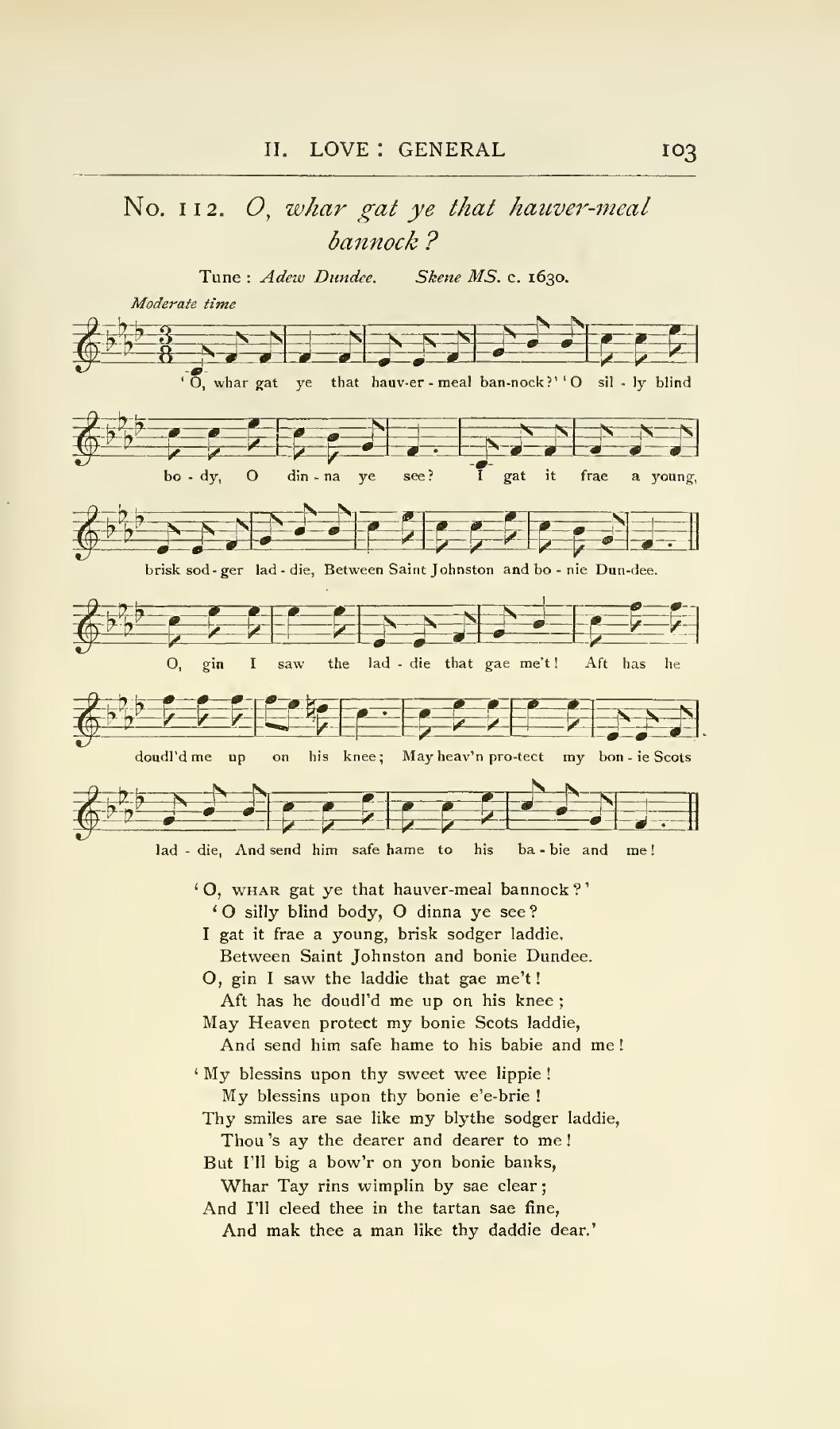 View score Dick’s Songs of Robert Burns (1903)
Lyrics
Cunningham (1855)
O, whar did ye get that hauver meal bannock?
  O silly blind body, O dinna ye see?
I gat it frae a young brisk sodger laddie,
  Between Saint Johnston and bonnie Dundee.
O gin I saw the laddie that gae me’t!
  Aft has he doudl’d me up on his knee;
May Heaven protect my bonnie Scots laddie,
  And send him safe hame to his babie and me!

My blessin’s upon thy sweet wee lippie,
  My blessin’s upon thy bonnie e’e brie!
Thy smiles are sae like my blythe sodger laddie,
  Thou’s ay the dearer and dearer to me!
But I’ll big a bower on yon bonnie banks,
  Where Tay rins wimplin’ by sae clear;
And I’ll cleed thee in the tartan sae fine,
  And mak thee a man like thy daddie dear.
Digital text from Project Gutenberg.
View the source edition · p. 221
About this edition
Cunningham’s preface discusses several poems he left out of the collection.
Dick (1903) · no. 112
The words are on the score page.
View the source edition · no. 112; p. 103
Scots Musical Museum, vol. I (1787) · no. 99
View the source edition · Volume 1, no. 99; p. 100
Music
View historical scores
Dick’s Songs of Robert Burns (1903)
no. 112; p. 103
Reworking and extension attributed to Burns
Cunningham credits Burns with the second verse and part of the first, which also contains older material.
Words Robert Burns and the earlier song tradition
Burns’s role Reworking and extension attributed to Burns