I dream’d I lay where flowers were springing
Behind the song
A dream opens among flowers, birdsong and a clear falling stream. The sky suddenly darkens, trees struggle like aged figures, and the water swells and muddies. In the second stanza, the speaker makes that change of weather an image of a life whose early promise has been disappointed.
Read the fuller story
The two stanzas give the dream and its explanation equal space. The first lets the storm transform the landscape before the second names a “deceitful morning” of life. Fortune promises fairly and performs badly, stripping away joys and hopes. The final line gives the speaker something that remains: a heart able to support him.
Cunningham says the verses were written when Burns was about seventeen. His headnote reads the poet’s early and later days as resembling one another, giving the lyric a retrospective biographical frame. Within the words, the movement ends in a declaration of endurance after the losses described.
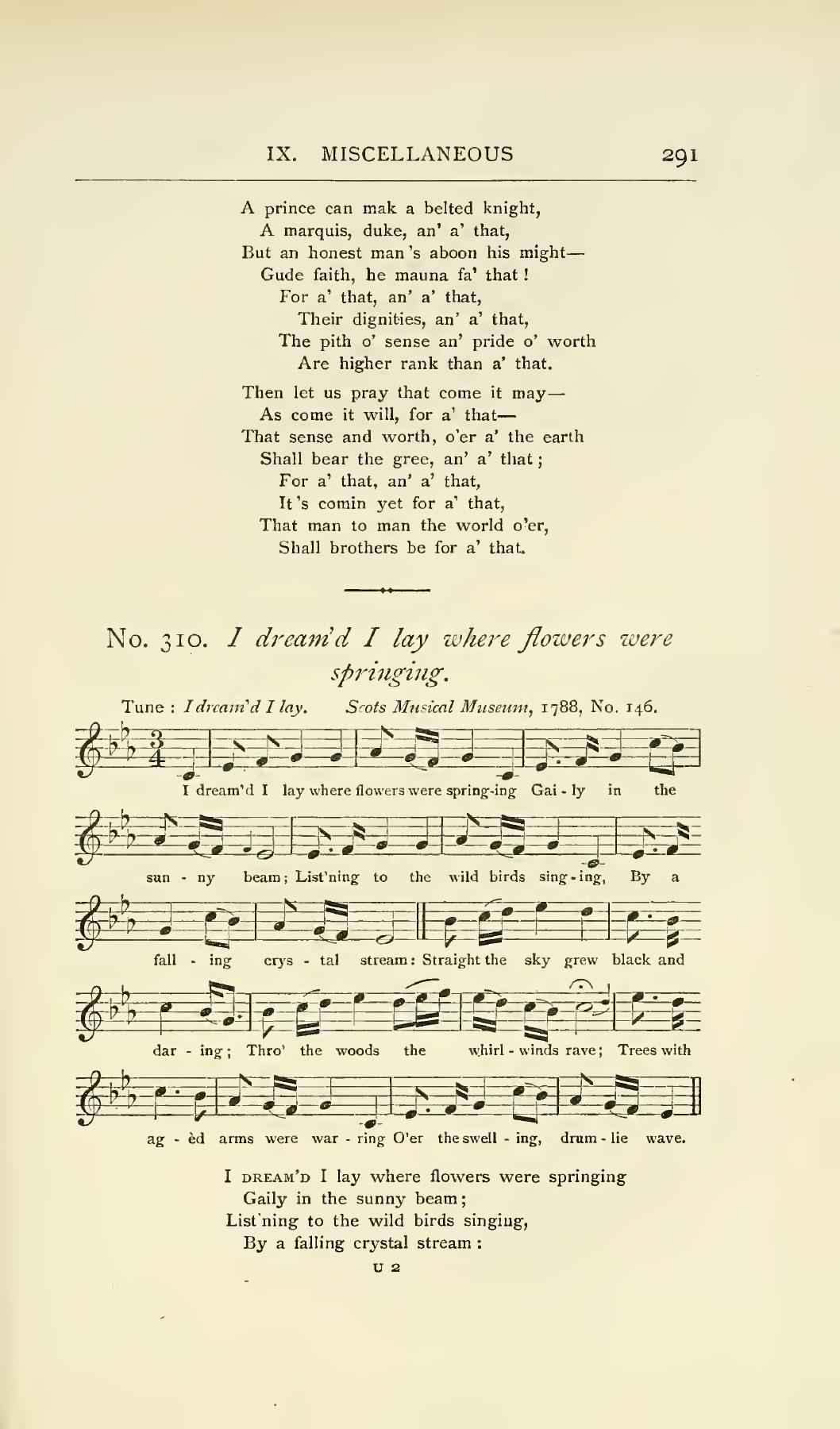 View score Dick’s Songs of Robert Burns (1903)
Lyrics
Choose an edition
Cunningham (1855)
I dream’d I lay where flowers were springing
  Gaily in the sunny beam;
List’ning to the wild birds singing,
  By a falling crystal stream:
Straight the sky grew black and daring;
  Thro’ the woods the whirlwinds rave;
Trees with aged arms were warring.
  O’er the swelling drumlie wave.

Such was my life’s deceitful morning,
  Such the pleasure I enjoy’d:
But lang or noon, loud tempests storming,
  A’ my flowery bliss destroy’d.
Tho’ fickle fortune has deceiv’d me,
  She promis’d fair, and perform’d but ill;
Of mony a joy and hope bereav’d me,
  I bear a heart shall support me still.
Digital text from Project Gutenberg.
View the source edition · p. 208
About this edition
Cunningham’s preface discusses several poems he left out of the collection.
Dick (1903) · no. 310
The words are on the score page.
View the source edition · no. 310; pp. 291–292
Scots Musical Museum, vol. II (1788) · no. 146
View the source edition · Volume 2, no. 146; p. 153
Music
View historical scores
Dick’s Songs of Robert Burns (1903)
no. 310; pp. 291–292