The Heron Ballads. Ballad Second
Behind the poem
“Fy, let us a’ to Kirkcudbright” calls a crowd to an election. As the campaigners turn up, the song cheers its allies and jeers at the opposition, bringing local fortunes and family interests into the street where the contest can be heard.[1]
Read the fuller story
Eleven stanzas use the recurring promise “An’ there will be” to keep the crowd arriving. Military language gives Murray light horse to command and Gordon a battle to win. Later portraits bring in a sheriff, ministers, wealthy men, landowners and officials. Some receive a brief compliment; others face charges of greed, vanity, stupidity or sexual hypocrisy. The ending reserves especially coarse mockery for the Broughton interest.[1]
Heron appears as “trusty Kerroughtree”, with honour as his law and enough worth to serve as a sample of all the virtues packed together. Such concentrated approval marks the poem’s political allegiance. Even admiration has its limits: the people from St Mary’s are highly honoured, yet the verse withholds their votes.[1]
Cunningham’s introduction objects to the severity of these portraits and calls some of the satire venomous. He also challenges an inherited charge against the Murrays of Broughton and Caillie, arguing that the family had been wrongly associated with betrayal of Prince Charles Stewart. His protest gives the reader a second perspective on the ballad’s partisan judgements. The edition’s footnotes identify several of the figures, including Bushby of Tinwald-Downs, Oswald of Auchuncruive and John Syme of the Stamp-office.[1]
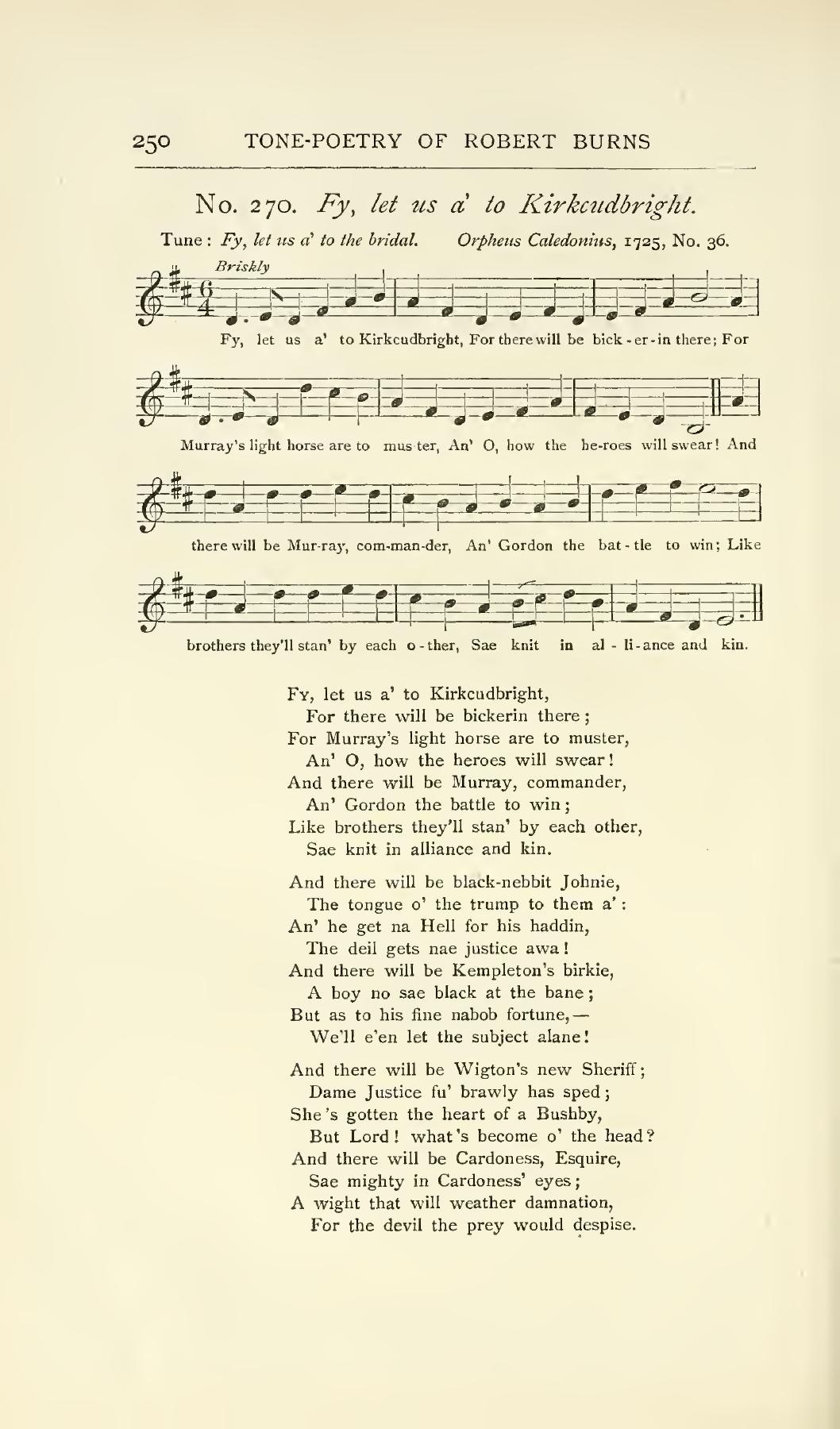 View score Dick’s Songs of Robert Burns (1903)
Poem
Choose an edition
Cunningham (1855)
Fy, let us a’ to Kirkcudbright,
  For there will be bickerin’ there;
For Murray’s light horse are to muster,
  And O, how the heroes will swear!
An’ there will be Murray commander,
  And Gordon the battle to win;
Like brothers they’ll stand by each other,
  Sae knit in alliance an’ kin.

An’ there will be black-lippit Johnnie,
  The tongue o’ the trump to them a’;
And he get na hell for his haddin’
  The deil gets na justice ava’;
And there will Kempleton’s birkie,
  A boy no sae black at the bane,
But, as for his fine nabob fortune,
  We’ll e’en let the subject alane.

An’ there will be Wigton’s new sheriff,
  Dame Justice fu’ brawlie has sped,
She’s gotten the heart of a Bushby,
  But, Lord, what’s become o’ the head?
An’ there will be Cardoness, Esquire,
  Sae mighty in Cardoness’ eyes;
A wight that will weather damnation,
  For the devil the prey will despise.

An’ there will be Douglasses doughty,
  New christ’ning towns far and near;
Abjuring their democrat doings,
  By kissing the —— o’ a peer;
An’ there will be Kenmure sae gen’rous,
  Whose honour is proof to the storm,
To save them from stark reprobation,
  He lent them his name to the firm.

But we winna mention Redcastle,
  The body, e’en let him escape!
He’d venture the gallows for siller,
  An’ ’twere na the cost o’ the rape.
An’ where is our king’s lord lieutenant,
  Sae fam’d for his gratefu’ return?
The billie is gettin’ his questions,
  To say in St. Stephen’s the morn.

An’ there will be lads o’ the gospel,
  Muirhead, wha’s as gude as he’s true;
An’ there will be Buittle’s apostle,
  Wha’s more o’ the black than the blue;
An’ there will be folk from St. Mary’s,
  A house o’ great merit and note,
The deil ane but honours them highly,—
  The deil ane will gie them his vote!

An’ there will be wealthy young Richard,
  Dame Fortune should hing by the neck;
For prodigal, thriftless, bestowing,
  His merit had won him respect:
An’ there will be rich brother nabobs,
  Tho’ nabobs, yet men of the first,
An’ there will be Collieston’s whiskers,
  An’ Quintin, o’ lads not the worst.

An’ there will be stamp-office Johnnie,
  Tak’ tent how ye purchase a dram;
An’ there will be gay Cassencarrie,
  An’ there will be gleg Colonel Tam;
An’ there will be trusty Kerroughtree,
  Whose honour was ever his law,
If the virtues were pack’d in a parcel,
  His worth might be sample for a’.

An’ can we forget the auld major,
  Wha’ll ne’er be forgot in the Greys,
Our flatt’ry we’ll keep for some other,
  Him only ’tis justice to praise.
An’ there will be maiden Kilkerran,
  And also Barskimming’s gude knight,
An’ there will be roarin’ Birtwhistle,
  Wha luckily roars in the right.

An’ there, frae the Niddisdale borders,
  Will mingle the Maxwells in droves;
Teugh Johnnie, staunch Geordie, an’ Walie,
  That griens for the fishes an’ loaves;
An’ there will be Logan Mac Douall,
  Sculdudd’ry an’ he will be there,
An’ also the wild Scot of Galloway,
  Sodgerin’, gunpowder Blair.

Then hey the chaste interest o’ Broughton,
  An’ hey for the blessings ’twill bring?
It may send Balmaghie to the Commons,
  In Sodom ’twould make him a king;
An’ hey for the sanctified M——y,
  Our land who wi’ chapels has stor’d;
He founder’d his horse among harlots,
  But gied the auld naig to the Lord.
Digital text from Project Gutenberg.
View the source edition · p. 190
About this edition
Cunningham’s preface discusses several poems he left out of the collection.
Dick (1903) · no. 270
The words are on the score page.
View the source edition · no. 270; pp. 250–252
Music
View historical scores
Dick’s Songs of Robert Burns (1903)
no. 270; pp. 250–252
Written by Burns
Cunningham presents the poem as a Heron election ballad and challenges the fairness of several personal attacks.
Words Robert Burns
Burns’s role Author of the verses, as presented by Cunningham
Cunningham, Complete Works of Robert Burns (Boston, 1855), CXLIX, pp. 190–192; retained HTML #CXLIX.