A Vision
Behind the poem
By a roofless tower, a ghostly minstrel appears with “Libertie!” on his bonnet and sings a song that could wake the dead. The narrator describes its grief and anger before deciding to keep the words to himself.[1]
Read the fuller story
The opening carefully gathers the sights and sounds of a night outdoors. Wallflowers grow by the roofless tower, an owl mourns among ivy, and a fox calls across the hills. Water rushes towards the Nith. The northern lights bring a stranger movement into the scene, shifting like fortune’s favours, “tint as win”—lost as soon as gained. That unstable brightness prepares for the sudden appearance of the spirit. The narrator’s fear makes the encounter feel immediate even before the political motto is revealed.[1]
The minstrel mourns a decline from happier days. His harp gives that contrast emotional force, while the final “I winna ventur’t in my rhymes” turns the speaker’s caution into part of the poem. It can be read as a teasing invitation to imagine dangerous criticism. The withheld speech leaves room for the reader’s suspicions and sympathies, rather than supplying a detailed political programme.[1]
Cunningham places the scene at Lincluden, near the meeting of the Cluden and Nith, and describes the ruins as a favourite haunt of Burns. He also suggests that the poet may have feared publishing the spirit’s song in unsettled times. That explanation is the editor’s conjecture. The text itself gives the apparition a male minstrel’s form, although Cunningham’s introduction speaks of a female visitant. His edition also prints alternative readings, including a different approach to the apparition.[1]
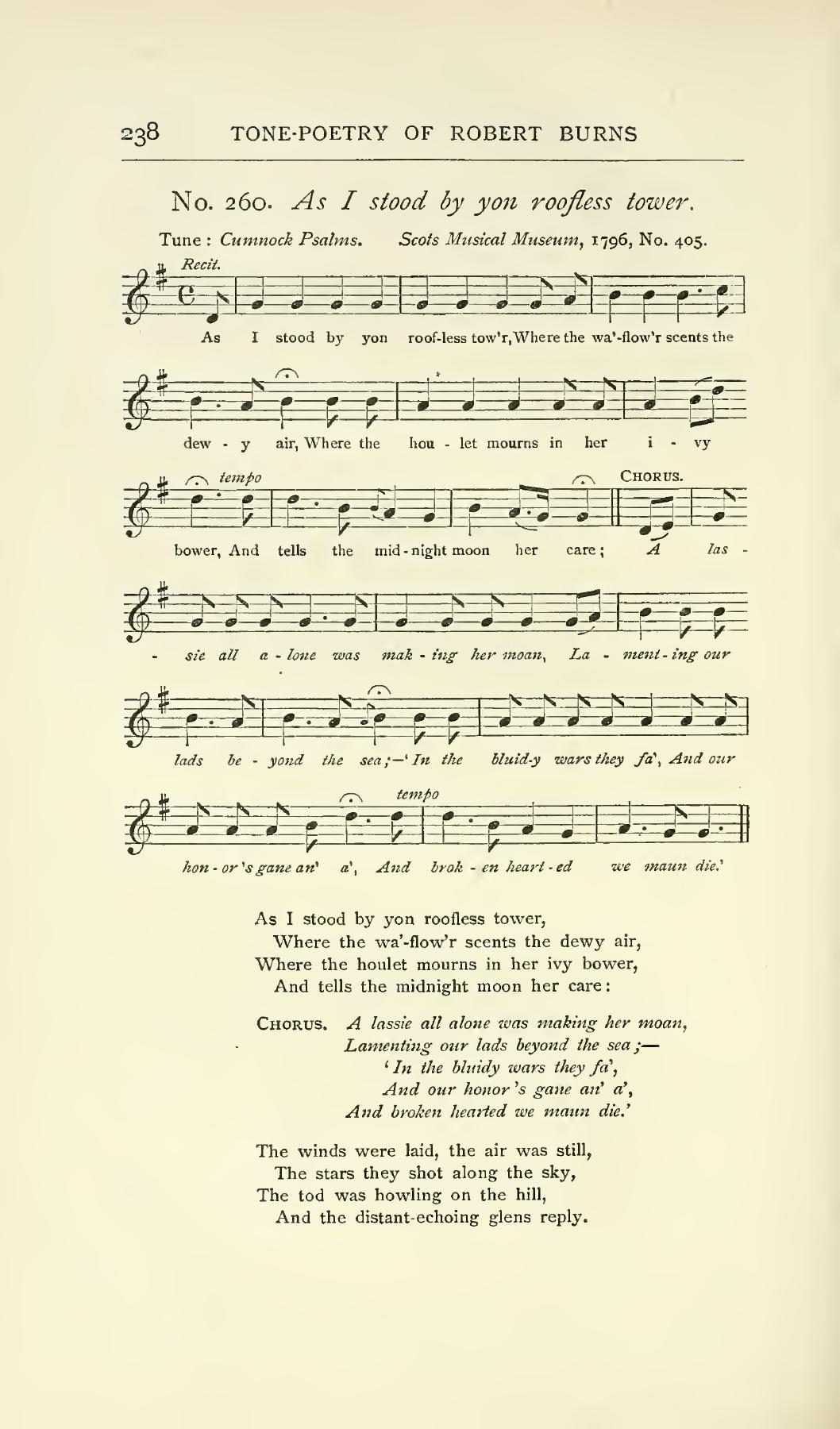 View score Dick’s Songs of Robert Burns (1903)
Poem
Choose an edition
Cunningham (1855)
As I stood by yon roofless tower,
  Where the wa’-flower scents the dewy air,
Where th’ howlet mourns in her ivy bower
  And tells the midnight moon her care;

The winds were laid, the air was still,
  The Stars they shot along the sky;
The fox was howling on the hill,
  And the distant echoing glens reply.

The stream, adown its hazelly path,
  Was rushing by the ruin’d wa’s,
Hasting to join the sweeping Nith,
  Whose distant roaring swells and fa’s.

The cauld blue north was streaming forth
  Her lights, wi’ hissing eerie din;
Athort the lift they start and shift,
  Like fortune’s favours, tint as win.

By heedless chance I turn’d mine eyes,
  And, by the moon-beam, shook to see
A stern and stalwart ghaist arise,
  Attir’d as minstrels wont to be.

Had I a statue been o’ stane,
  His darin’ look had daunted me;
And on his bonnet grav’d was plain,
  The sacred posy—‘Libertie!’

And frae his harp sic strains did flow,
  Might rous’d the slumb’ring dead to hear;
But, oh! it was a tale of woe,
  As ever met a Briton’s ear.

He sang wi’ joy the former day,
  He weeping wail’d his latter times;
But what he said it was nae play,—
  I winna ventur’t in my rhymes.

To join yon river on the Strath.

Now looking over firth and fauld,
  Her horn the pale-fac’d Cynthia rear’d;
When, lo, in form of minstrel auld,
  A storm and stalwart ghaist appear’d.
Digital text from Project Gutenberg.
View the source edition · p. 181
About this edition
Cunningham’s preface discusses several poems he left out of the collection.
Dick (1903) · no. 260
The words are on the score page.
View the source edition · no. 260; pp. 238–239
Scots Musical Museum, vol. V (catalogued 1796) · no. 405
View the source edition · Volume 5, no. 405; p. 418
Music
View historical scores
Dick’s Songs of Robert Burns (1903)
no. 260; pp. 238–239
Written by Burns
Cunningham identifies this as Burns’s vision and places its scene at Lincluden. His suggestion about withholding the spirit’s song is conjectural.
Words Robert Burns
Burns’s role Author of the vision in verse
Cunningham, Complete Works of Robert Burns (Boston, 1855), CXXIX, pp. 181–182; retained HTML #CXXIX.