The Whistle
Behind the poem
On Friday 16 October 1789, three men sat down to drink for an ebony whistle at Friars Carse. The prize went to the last man able to blow it. Alexander Fergusson of Craigdarroch beat his host, Robert Riddell, and Sir Robert Laurie of Maxwelton. John McMurdo, the judge, put Fergusson’s share of the claret at more than five bottles. [2][4]
That morning Burns had written to Riddell from Ellisland, wishing him victory that night and a clear head the next day. Did Burns go along himself? William Hunter, who uncorked the wine, remembered him writing at a little table by the window overlooking the Nith. Hunter gave that account fifty-two years later. Burns’s letter leaves his own evening plans open. [5][6]
Read the fuller story
The three men had signed the terms at Cowhill on 10 October. They named their judge and two prospective witnesses. The prose history printed with the ballad puts the contest a year late, in 1790. The agreement gives 16 October 1789 as the day appointed, and McMurdo’s note confirms that the wager was settled at Carse that day. [2][4]
Burns gives the whistle a history of its own. In his telling, a Danish drinking champion brought it to Scotland in the train of Anne of Denmark. An ancestor of Sir Robert’s drank the Dane under the table. By the time the three kinsmen met at Friars Carse, Riddell held the trophy. In the ballad he bows out and Sir Robert falls as the sun comes up. The bard offers to make Craigdarroch immortal in verse and calls for one more bottle. [1][2][4]
Later readers took quite different views of the bard’s place at the table. Allan Cunningham pictured Burns matching the men drink for drink. James C. Dick doubted he even went, since Burns had told Riddell he would send a servant that evening to collect two envelopes for the post. Hunter recalled bringing Burns hot water for his spirits while the three competitors drank claret. He also said Burns later told him he had written the whole ballad there. Whether Burns stayed to see Fergusson blow the whistle, or finished the verses that night, is still uncertain. [2][3][5][6]
The host may also have supplied the music. Dick passes on William Stenhouse’s attribution of the tune to Robert Riddell. [3]
Story references
- James C. Dick, The Songs of Robert Burns (1903), No. 229; printed pp. 204–206; PDF pp. 260–262
- Allan Cunningham, The Complete Works of Robert Burns (1855), printed 176; HTML #CXXII. Project Gutenberg transcription.
- James C. Dick, The Songs of Robert Burns (1903), Dick note 229; printed 431,432; PDF 487,488
- Agreement signed at Cowhill, 10 October 1789, and John McMurdo’s endorsement of the result. Reprinted in The Complete Poetical Works of Robert Burns, p. 100.
- Robert Burns to Captain Riddell, Ellisland, 16 October 1789. Allan Cunningham’s edition, letter CLXXII.
- William Hunter’s signed recollection, Closeburn Hall, 2 December 1841. Reprinted in Rambles Through the Land of Burns, chapter 18.
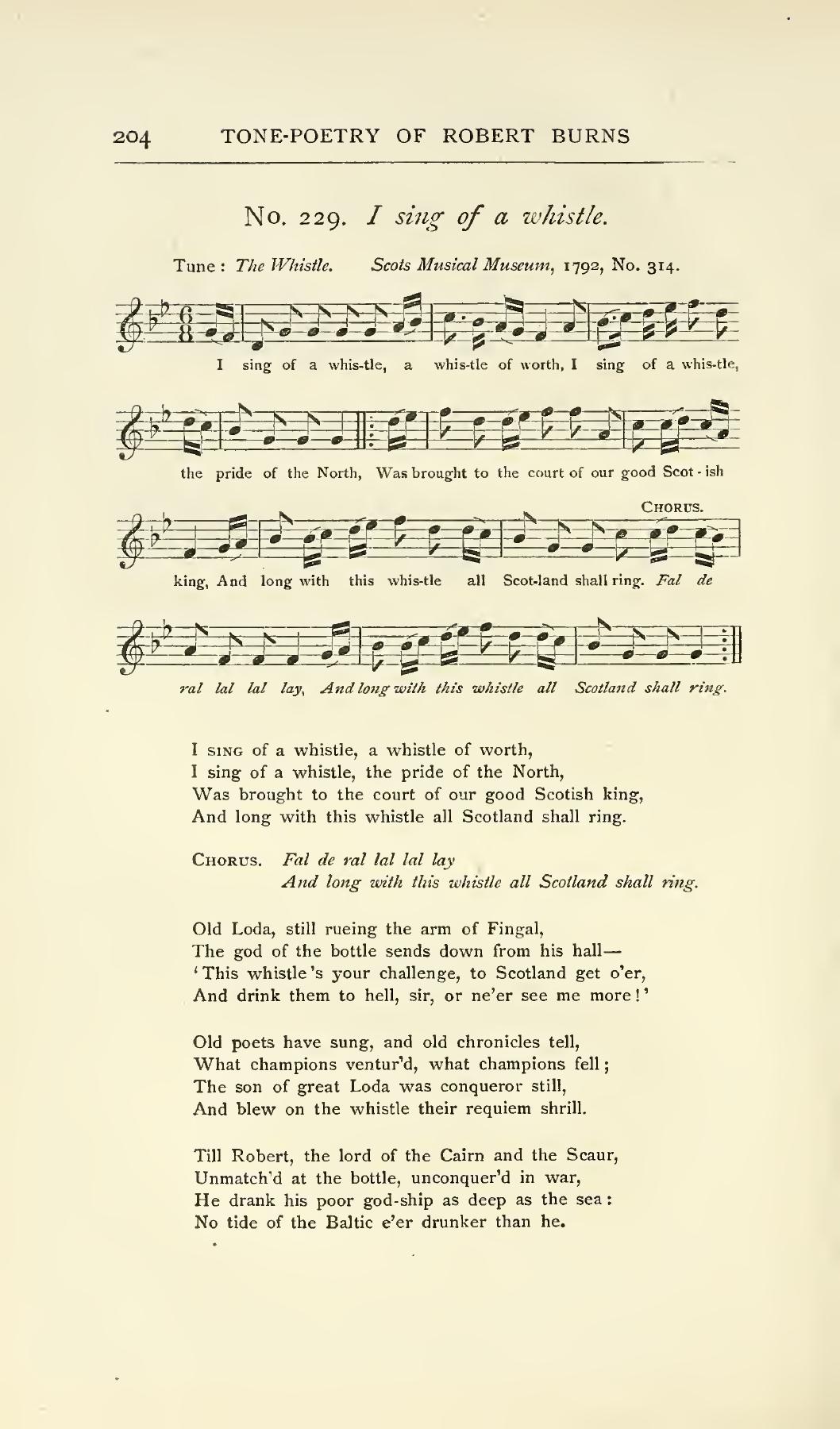 View score Dick’s Songs of Robert Burns (1903)
Poem
Choose an edition
Version notes
| Dick (1903) · no. 229 | Cunningham · 1855Ebook transcription |
|---|---|
| Fal de ral lal lal lay / And long with this whistle all Scotland shall ring. | No separate chorus printed |
| their requiem | his requiem |
| god-ship / apiece / high ruling-elder | godship / a-piece / high-ruling Elder |
| But for wine / cautious / in light | Bur for wine / cautions / in light |
More differences between these editions
| Dick (1903) · no. 229 | Cunningham · 1855Ebook transcription |
|---|---|
| hall— / challenge, / sea: / foe, or his friend; | hall— / challenge—to / sea, / foe—or his friend, |
| Though Fate said, A hero should perish in light | Though fate said—a hero shall perish in light |
| he’d die ere he’d yield | he’d die or he’d yield |
| 16October 1789 in Dick note229 | Friday 16 October 1790 in Cunningham preface |
| Dick doubts attendance from letter | Cunningham describes Burns drinking bottle about |
Dick (1903) · no. 229
I sing of a whistle, a whistle of worth,
I sing of a whistle, the pride of the North,
Was brought to the court of our good Scottish king,
And long with this whistle all Scotland shall ring.

Chorus. Fal de ral lal lal lay
And long with this whistle all Scotland shall ring.

Old Loda, still rueing the arm of Fingal,
The god of the bottle sends down from his hall—
'This whistle's your challenge, to Scotland get o'er,
And drink them to hell, sir, or ne'er see me more!'

Old poets have sung, and old chronicles tell,
What champions ventur'd, what champions fell;
The son of great Loda was conqueror still,
And blew on the whistle their requiem shrill.

Till Robert, the lord of the Cairn and the Scaur,
Unmatch'd at the bottle, unconquer'd in war,
He drank his poor god-ship as deep as the sea:
No tide of the Baltic e'er drunker than he.

Thus Robert, victorious, the trophy has gain'd;
Which now in his house has for ages remain'd;
Till three noble chieftains, and all of his blood,
The jovial contest again have renew'd.

Three joyous good fellows, with hearts clear of flaw;
Craigdarroch, so famous for wit, worth, and law;
And trusty Glenriddel, so skill'd in old coins;
And gallant Sir Robert, deep-read in old wines.

Craigdarroch began, with a tongue smooth as oil,
Desiring Glenriddel to yield up the spoil;
Or else he would muster the heads of the clan,
And once more, in claret, try which was the man.

'By the gods of the ancients!' Glenriddel replies,
'Before I surrender so glorious a prize,
I'll conjure the ghost of the great Rorie More,
And bumper his horn with him twenty times o'er.'

Sir Robert, a soldier, no speech would pretend,
But he ne'er turn'd his back on his foe, or his friend;
Said, 'Toss down the whistle, the prize of the field,'
And, knee-deep in claret, he'd die ere he'd yield.

To the board of Glenriddel our heroes repair,
So noted for drowning of sorrow and care;
But for wine and for welcome not more known to fame,
Than the sense, wit, and taste of a sweet lovely dame.

A Bard was selected to witness the fray,
And tell future ages the feats of the day;
A Bard who detested all sadness and spleen,
And wish'd that Parnassus a vineyard had been.

The dinner being over, the claret they ply,
And ev'ry new cork is a new spring of joy;
In the bands of old friendship and kindred so set,
And the bands grew the tighter the more they were wet.

Gay Pleasure ran riot as bumpers ran o'er;
Bright Phœbus ne'er witness'd so joyous a core,
And vow'd that to leave them he was quite forlorn,
Till Cynthia hinted he'd see them next morn.

Six bottles apiece had well wore out the night,
When gallant Sir Robert, to finish the fight,
Turn'd o'er in one bumper a bottle of red,
And swore 'twas the way that their ancestor did.

Then worthy Glenriddel, so cautious and sage,
No longer the warfare ungodly would wage;
A high ruling-elder to wallow in wine!
He left the foul business to folks less divine.

The gallant Sir Robert fought hard to the end;
But who can with Fate and quart-bumpers contend?
Though Fate said, 'A hero should perish in light:'
So up rose bright Phœbus—and down fell the knight.

Next up rose our Bard, like a prophet in drink:—
'Craigdarroch, thou'lt soar when creation shall sink;
But if thou would flourish immortal in rhyme,
Come—one bottle more—and have at the sublime!

'Thy line, that have struggled for Freedom with Bruce,
Shall heroes and patriots ever produce:
So thine be the laurel, and mine be the bay;
The field thou hast won, by yon bright god of day!'
View the source edition · no. 229; pp. 204–206
About this edition
Dick prints eighteen quatrains and a two-line chorus after the opening; Cunningham prints the eighteen quatrains without that chorus. Dick has their requiem where Cunningham has his requiem, die ere he’d yield where Cunningham has die or he’d yield, and should perish where Cunningham has shall perish. The held Cunningham HTML prints Bur for wine and cautions, against Dick’s But for wine and cautious. The prefaces also disagree over the contest year and Burns’s attendance. Dick closes Sir Robert’s spoken quotation after field; Cunningham prints that speech without quotation marks.
Cunningham (1855)
I sing of a whistle, a whistle of worth,
I sing of a whistle, the pride of the North,
Was brought to the court of our good Scottish king,
And long with this whistle all Scotland shall ring.

Old Loda, still rueing the arm of Fingal,
The god of the bottle sends down from his hall—
“This whistle’s your challenge—to Scotland get o’er,
And drink them to hell, Sir! or ne’er see me more!”

Old poets have sung, and old chronicles tell,
What champions ventur’d, what champions fell;
The son of great Loda was conqueror still,
And blew on his whistle his requiem shrill.

Till Robert, the Lord of the Cairn and the Scaur,
Unmatch’d at the bottle, unconquer’d in war,
He drank his poor godship as deep as the sea,
No tide of the Baltic e’er drunker than he.

Thus Robert, victorious, the trophy has gain’d;
Which now in his house has for ages remain’d;
Till three noble chieftains, and all of his blood,
The jovial contest again have renew’d.

Three joyous good fellows, with hearts clear of flaw;
Craigdarroch, so famous for wit, worth, and law;
And trusty Glenriddel, so skill’d in old coins;
And gallant Sir Robert, deep-read in old wines.

Craigdarroch began, with a tongue smooth as oil,
Desiring Glenriddel to yield up the spoil;
Or else he would muster the heads of the clan,
And once more, in claret, try which was the man.

“By the gods of the ancients!” Glenriddel replies,
“Before I surrender so glorious a prize,
I’ll conjure the ghost of the great Rorie More,
And bumper his horn with him twenty times o’er.”

Sir Robert, a soldier, no speech would pretend,
But he ne’er turn’d his back on his foe—or his friend,
Said, toss down the whistle, the prize of the field,
And, knee-deep in claret, he’d die or he’d yield.

To the board of Glenriddel our heroes repair,
So noted for drowning of sorrow and care;
Bur for wine and for welcome not more known to fame
Than the sense, wit, and taste of a sweet lovely dame.

A bard was selected to witness the fray,
And tell future ages the feats of the day;
A bard who detested all sadness and spleen,
And wish’d that Parnassus a vineyard had been.

The dinner being over, the claret they ply,
And ev’ry new cork is a new spring of joy;
In the bands of old friendship and kindred so set,
And the bands grew the tighter the more they were wet.

Gay Pleasure ran riot as bumpers ran o’er;
Bright Phœbus ne’er witness’d so joyous a core,
And vow’d that to leave them he was quite forlorn,
Till Cynthia hinted he’d find them next morn.

Six bottles a-piece had well wore out the night,
When gallant Sir Robert, to finish the fight,
Turn’d o’er in one bumper a bottle of red,
And swore ’twas the way that their ancestor did.

Then worthy Glenriddel, so cautions and sage,
No longer the warfare, ungodly, would wage;
A high-ruling Elder to wallow in wine!
He left the foul business to folks less divine.

The gallant Sir Robert fought hard to the end;
But who can with fate and quart-bumpers contend?
Though fate said—a hero shall perish in light;
So up rose bright Phœbus—and down fell the knight.

Next up rose our bard, like a prophet in drink;—
“Craigdarroch, thou’lt soar when creation shall sink;
But if thou would flourish immortal in rhyme,
Come—one bottle more—and have at the sublime!

“Thy line, that have struggled for freedom with Bruce,
Shall heroes and patriots ever produce:
So thine be the laurel, and mine be the bay;
The field thou hast won, by yon bright god of day!”
Digital text from Project Gutenberg.
View the source edition · p. 176
About this edition
Dick prints eighteen quatrains and a two-line chorus after the opening; Cunningham prints the eighteen quatrains without that chorus. Dick has their requiem where Cunningham has his requiem, die ere he’d yield where Cunningham has die or he’d yield, and should perish where Cunningham has shall perish. The held Cunningham HTML prints Bur for wine and cautions, against Dick’s But for wine and cautious. The prefaces also disagree over the contest year and Burns’s attendance. Dick closes Sir Robert’s spoken quotation after field; Cunningham prints that speech without quotation marks.
Scots Musical Museum, vol. IV (1792) · no. 314
View the source edition · Volume 4, no. 314; pp. 324–325
Music
View historical scores
Dick’s Songs of Robert Burns (1903)
no. 229; pp. 204–206