Lament of Mary Queen of Scots, on the approach of Spring
Behind the poem
Mary, Queen of Scots, hears larks, blackbirds and thrushes and sees the earth turn green beyond her prison. In Burns’s imagined lament, even the humblest labourer in Scotland can walk among the daisies, a freedom the queen can only watch. [1]
Mary remembers happier days in France, rails against the woman she calls both sister and enemy, and prays for her son. She asks that he be spared her enemies and remember her friends. Winter can rage around Mary’s grave, she says, if spring will bring its flowers to it in peace. [1]
Read the fuller story
Cunningham says that Lady Winifred Maxwell Constable requested the poem, and describes her gift of a snuff-box bearing Mary’s portrait. Dick records a copy sent to Dr John Moore in a letter dated 27 February 1791 and quotes Burns calling the poem a compliment to Mary’s memory in a letter to Lady Constable. Those accounts place Burns’s dramatic lament within his own correspondence and interest in the queen’s story. [2][3]
Dick prints seven eight-line stanzas, with the fourth continuing across the two columns of the page. The setting is Mary Queen of Scots lament, marked Slow. His heading dates the Museum reference 1796, while the historical note gives 1797. Cunningham numbers the same seven stanzas and prints several different spellings and stops. The sustained first-person voice lets remembered royalty, captivity and maternal hope occupy the same song. [1][3][2]
Story references
- James C. Dick, The Songs of Robert Burns (1903), No. 279; printed pp. 261–261; PDF pp. 317–317
- Allan Cunningham, The Complete Works of Robert Burns (1855), printed 175; HTML #CXXI. Project Gutenberg transcription.
- James C. Dick, The Songs of Robert Burns (1903), Dick note 279; printed 461,462; PDF 517,518
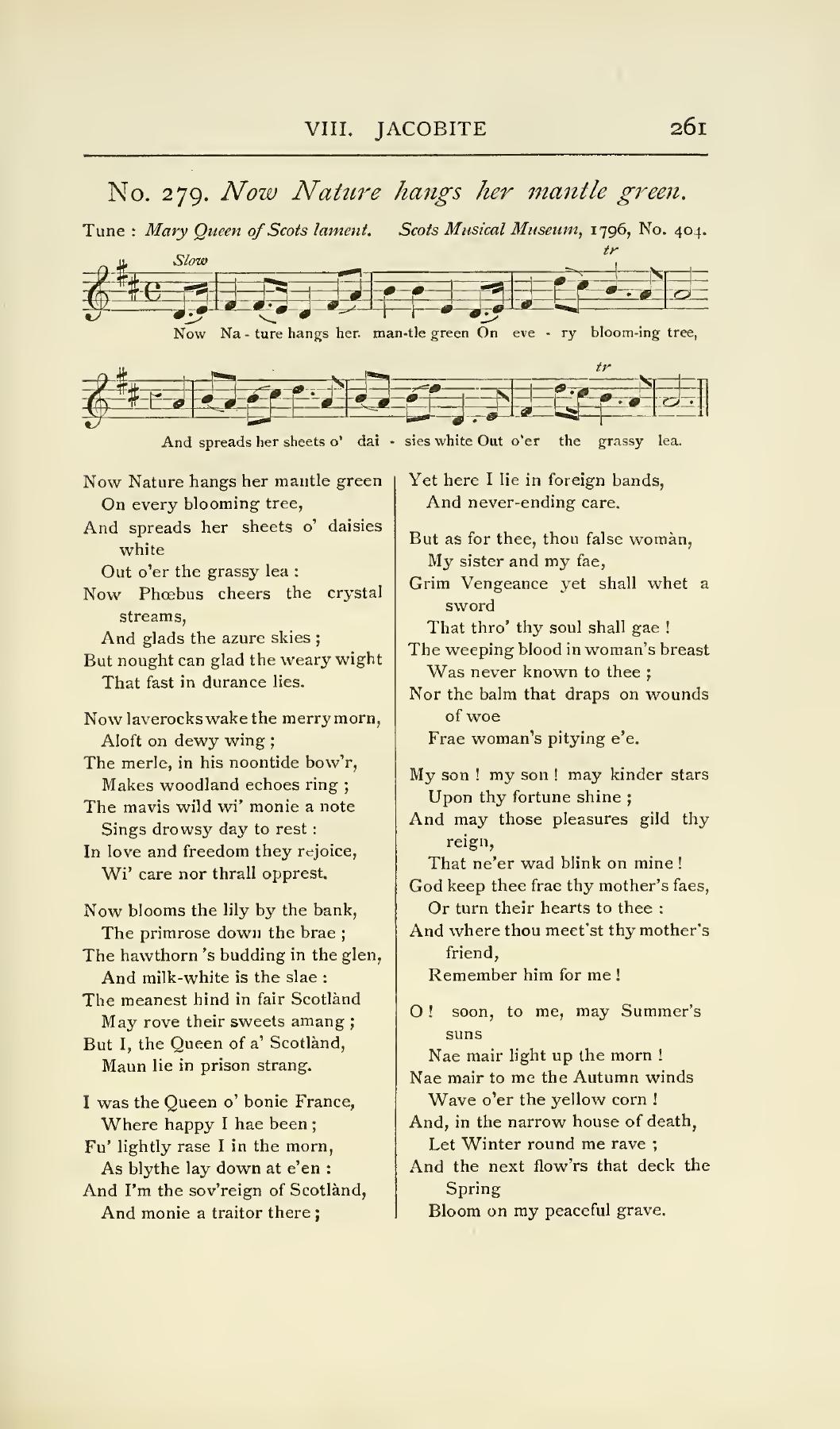 View score Dick’s Songs of Robert Burns (1903)
Poem
Choose an edition
Version notes
| Dick (1903) · no. 279 | Cunningham · 1855Ebook transcription |
|---|---|
| laverocks | lav’rocks |
| monie | mony |
| bonie | bonnie |
| sov’reign of Scotland | sov’reign o’ Scotland |
More differences between these editions
| Dick (1903) · no. 279 | Cunningham · 1855Ebook transcription |
|---|---|
| Summer’s suns / Autumn / Winter / Spring | summer suns / autumn / winter / spring |
| grave. | grave! |
Dick (1903) · no. 279
Now Nature hangs her mantle green
On every blooming tree,
And spreads her sheets o' daisies white
Out o'er the grassy lea:
Now Phœbus cheers the crystal streams,
And glads the azure skies;
But nought can glad the weary wight
That fast in durance lies.

Now laverocks wake the merry morn,
Aloft on dewy wing;
The merle, in his noontide bow'r,
Makes woodland echoes ring;
The mavis wild wi' monie a note
Sings drowsy day to rest:
In love and freedom they rejoice,
Wi' care nor thrall opprest.

Now blooms the lily by the bank,
The primrose down the brae;
The hawthorn's budding in the glen,
And milk-white is the slae:
The meanest hind in fair Scotland
May rove their sweets amang;
But I, the Queen of a' Scotland,
Maun lie in prison strang.

I was the Queen o' bonie France,
Where happy I hae been;
Fu' lightly rase I in the morn,
As blythe lay down at e'en:
And I'm the sov'reign of Scotland,
And monie a traitor there;
Yet here I lie in foreign bands,
And never-ending care.

But as for thee, thou false woman,
My sister and my fae,
Grim Vengeance yet shall whet a sword
That thro' thy soul shall gae!
The weeping blood in woman's breast
Was never known to thee;
Nor th' balm that draps on wounds of woe
Frae woman's pitying e'e.

My son! my son! may kinder stars
Upon thy fortune shine;
And may those pleasures gild thy reign,
That ne'er wad blink on mine!
God keep thee frae thy mother's faes,
Or turn their hearts to thee:
And where thou meet'st thy mother's friend,
Remember him for me!

O! soon, to me, may Summer's suns
Nae mair light up the morn!
Nae mair to me the Autumn winds
Wave o'er the yellow corn!
And, in the narrow house of death,
Let Winter round me rave;
And the next flow'rs that deck the Spring
Bloom on my peaceful grave.
View the source edition · no. 279; p. 261
About this edition
Both editions retain all seven eight-line stanzas; Dick’s fourth crosses the column break. Dick has laverocks, monie, bonie and sov’reign of Scotland; Cunningham lav’rocks, mony, bonnie and sov’reign o’ Scotland. Dick capitalises the final seasons and has Summer’s suns; Cunningham lower-cases them and reads summer suns. Numerous stops differ, including the last grave period/exclamation.
Cunningham (1855)
Now Nature hangs her mantle green
  On every blooming tree,
And spreads her sheets o’ daisies white
  Out o’er the grassy lea:
Now Phœbus cheers the crystal streams,
  And glads the azure skies;
But nought can glad the weary wight
  That fast in durance lies.

Now lav’rocks wake the merry morn,
  Aloft on dewy wing;
The merle, in his noontide bow’r,
  Makes woodland echoes ring;
The mavis wild wi’ mony a note,
  Sings drowsy day to rest:
In love and freedom they rejoice,
  Wi’ care nor thrall opprest.

Now blooms the lily by the bank,
  The primrose down the brae;
The hawthorn’s budding in the glen,
  And milk-white is the slae;
The meanest hind in fair Scotland
  May rove their sweets amang;
But I, the Queen of a’ Scotland,
  Maun lie in prison strang!

I was the Queen o’ bonnie France,
  Where happy I hae been;
Fu’ lightly rase I in the morn,
  As blythe lay down at e’en:
And I’m the sov’reign o’ Scotland,
  And mony a traitor there;
Yet here I lie in foreign bands
  And never-ending care.

But as for thee, thou false woman!
  My sister and my fae,
Grim vengeance yet shall whet a sword
  That thro’ thy soul shall gae!
The weeping blood in woman’s breast
  Was never known to thee;
Nor th’ balm that draps on wounds of woe
  Frae woman’s pitying e’e.

My son! my son! may kinder stars
  Upon thy fortune shine;
And may those pleasures gild thy reign,
  That ne’er wad blink on mine!
God keep thee frae thy mother’s faes,
  Or turn their hearts to thee:
And where thou meet’st thy mother’s friend
  Remember him for me!

O! soon, to me, may summer suns
  Nae mair light up the morn!
Nae mair, to me, the autumn winds
  Wave o’er the yellow corn!
And in the narrow house o’ death
  Let winter round me rave;
And the next flow’rs that deck the spring
  Bloom on my peaceful grave!
Digital text from Project Gutenberg.
View the source edition · p. 175
About this edition
Both editions retain all seven eight-line stanzas; Dick’s fourth crosses the column break. Dick has laverocks, monie, bonie and sov’reign of Scotland; Cunningham lav’rocks, mony, bonnie and sov’reign o’ Scotland. Dick capitalises the final seasons and has Summer’s suns; Cunningham lower-cases them and reads summer suns. Numerous stops differ, including the last grave period/exclamation.
Scots Musical Museum, vol. V (catalogued 1796) · no. 404
View the source edition · Volume 5, no. 404; p. 417
Music
View historical scores
Dick’s Songs of Robert Burns (1903)
no. 279; p. 261