Written in a wrapper, enclosing a letter to Captain Grose
Behind the poem
Where has Captain Francis Grose gone? He could be among friends or enemies, drowned in the Forth or eaten in the Highlands. A nonsense refrain carries each new suggestion in a letter wrapper whose practical request is to send the enclosure on to the missing antiquary.[1]
Read the fuller story
Cunningham explains that Burns had prepared antiquarian and legendary notes about ruins in Kyle, then sent them through Cardonnel, whom he describes as a northern antiquary. He presents the rhyming inquiry as an addition that Burns could not resist, and says Cardonnel circulated it. That account gives the poem a practical setting in correspondence, though the displayed verse quickly leaves practical probability behind. Its actual request is simple: transmit the enclosed letter.[1]
The alternating lines are central to the joke. Each question or assertion is followed by “Igo and ago” or “Iram, coram, dago”, so even the prospect of a dreadful fate falls into an easy recurring pattern. The fourth stanza shifts from the biblical comfort of Abraham’s bosom to a bawdy image involving Sarah. A following blessing brings Grose back under divine protection, with even the devil supposedly afraid to meddle with him. The humour depends on the cheerful movement between solicitude, irreverence and exaggerated confidence in the friend.[1]
The final wishes return to antiquarian collecting. Grose is to possess stones of impossible antiquity, and the recipient is wished the coins of Satan’s coronation. These fantastic treasures reward the modest favour of forwarding a letter. The poem’s friendly business is therefore kept in view through all its nonsense: a message needs to reach an absent man, and the wrapper has become entertaining enough to be passed around in its own right.[1]
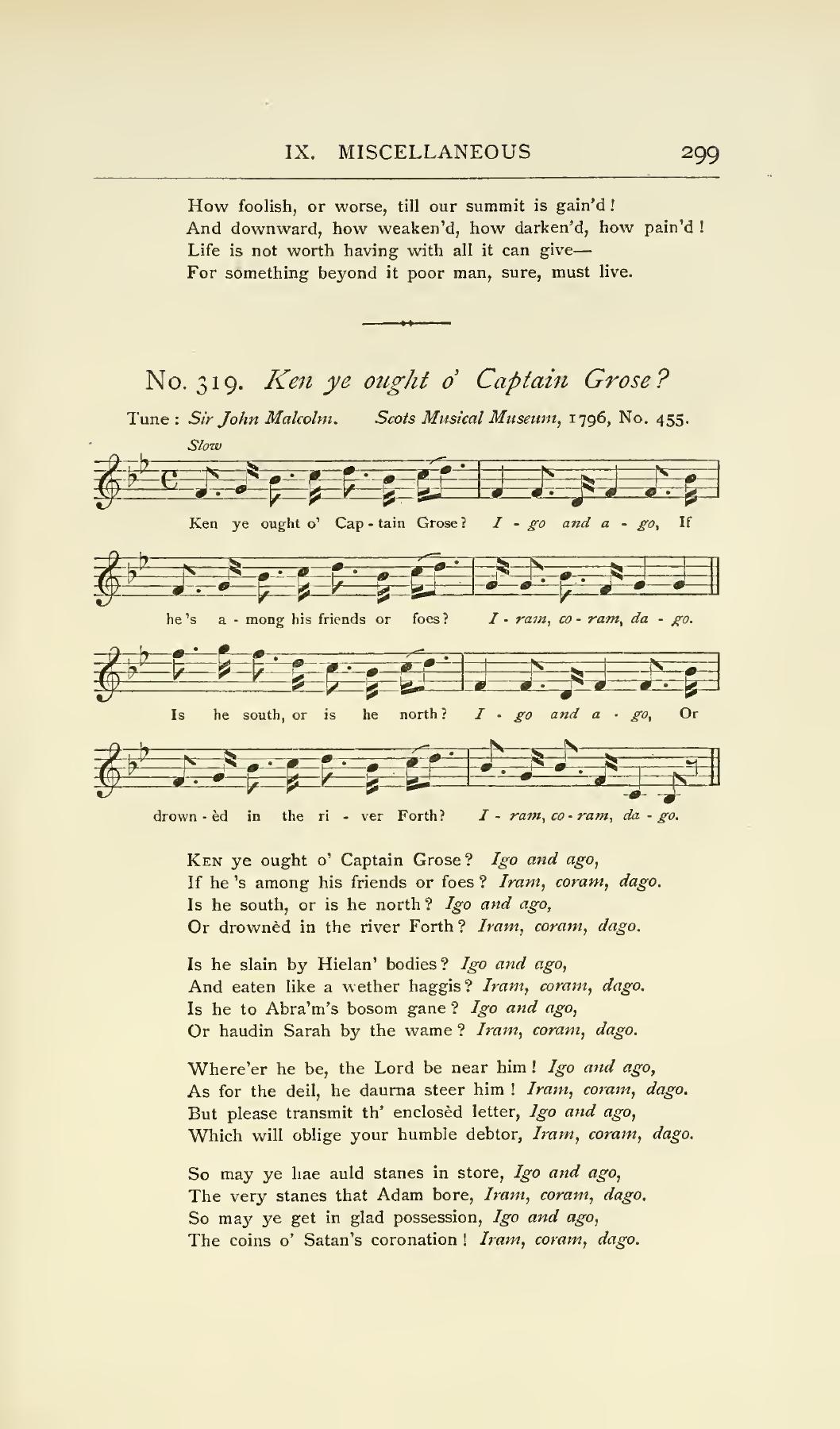 View score Dick’s Songs of Robert Burns (1903)
Poem
Choose an edition
Cunningham (1855)
“Is he slain by Highlan’ bodies?
And eaten like a wether-haggis?”]

Ken ye ought o’ Captain Grose?
        Igo and ago,
If he’s amang his friends or foes?
        Iram, coram, dago.

Is he south or is he north?
        Igo and ago,
Or drowned in the river Forth?
        Iram, coram, dago.

Is he slain by Highlan’ bodies?
        Igo and ago,
And eaten like a wether-haggis?
        Iram, coram, dago.

Is he to Abram’s bosom gane?
        Igo and ago,
Or haudin’ Sarah by the wame?
        Iram, coram, dago.

Where’er he be, the L—d be near him!
        Igo and ago,
As for the deil, he daur na steer him!
        Iram, coram, dago.

But please transmit the enclosed letter,
        Igo and ago,
Which will oblige your humble debtor,
        Iram, coram, dago.

So may he hae auld stanes in store,
        Igo and ago,
The very stanes that Adam bore,
        Iram, coram, dago.

So may ye get in glad possession,
        Igo and ago,
The coins o’ Satan’s coronation!
        Iram, coram, dago.
Digital text from Project Gutenberg.
View the source edition · p. 171
About this edition
Cunningham’s preface discusses several poems he left out of the collection.
Dick (1903) · no. 319
The words are on the score page.
View the source edition · no. 319; p. 299
Music
View historical scores
Dick’s Songs of Robert Burns (1903)
no. 319; p. 299
Written by Burns
Cunningham presents the rhyming inquiry as Burns’s addition to antiquarian correspondence sent through Cardonnel.
Words Robert Burns
Burns’s role Author of the comic verse enclosing a letter to Grose