The Five Carlins. A Scots Ballad
Behind the poem
Five carlins, or old women, quarrel over which man to send to London for news and errands. Cunningham identifies them as the burghs of Dumfries, Lochmaben, Annan, Kirkcudbright and Sanquhar, choosing who will represent them in Parliament. Some trust a candidate they know, others prefer the young soldier, and one is waiting to see who makes the better offer.[1]
Read the fuller story
Cunningham identifies the five women with the burghs of Dumfries, Lochmaben, Annan, Kirkcudbright and Sanquhar. He relates the poem to the contest between the younger Miller of Dalswinton and Johnstone of Westerhall, and supplies an account of party interests and the eventual result. The ballad itself leaves the outcome open, ending with the hope that king and people will look after themselves.[1]
The candidates first appear as contrasting types: a confident border knight, promising effective representation and courtly connections, and a modest young soldier who promises an honest heart. The women’s speeches complicate that contrast. Meg and Marjory favour the soldier; Bess trusts the knight because she has tried him before; Jean defends loyalty when a patron’s fortunes are low. Joan finally dismisses both sides’ moral talk and declares that the strongest appeal will win her support. The poem gives each position its own voice instead of reducing the meeting to a single argument.[1]
The Scots makes that debate brisk and familiar. A promise is something a candidate will “hecht”; an oath is an “aith”; to ask is to “spier”. The four-line stanzas move from introductions to speeches and then to the unresolved ending, with repeated phrases helping the story travel. The heading names “Chevy Chase” as the tune. That printed association adds a musical route for the words, while the ballad’s personified towns make a complicated contest memorable as a quarrel over who should carry the message to London.[1]
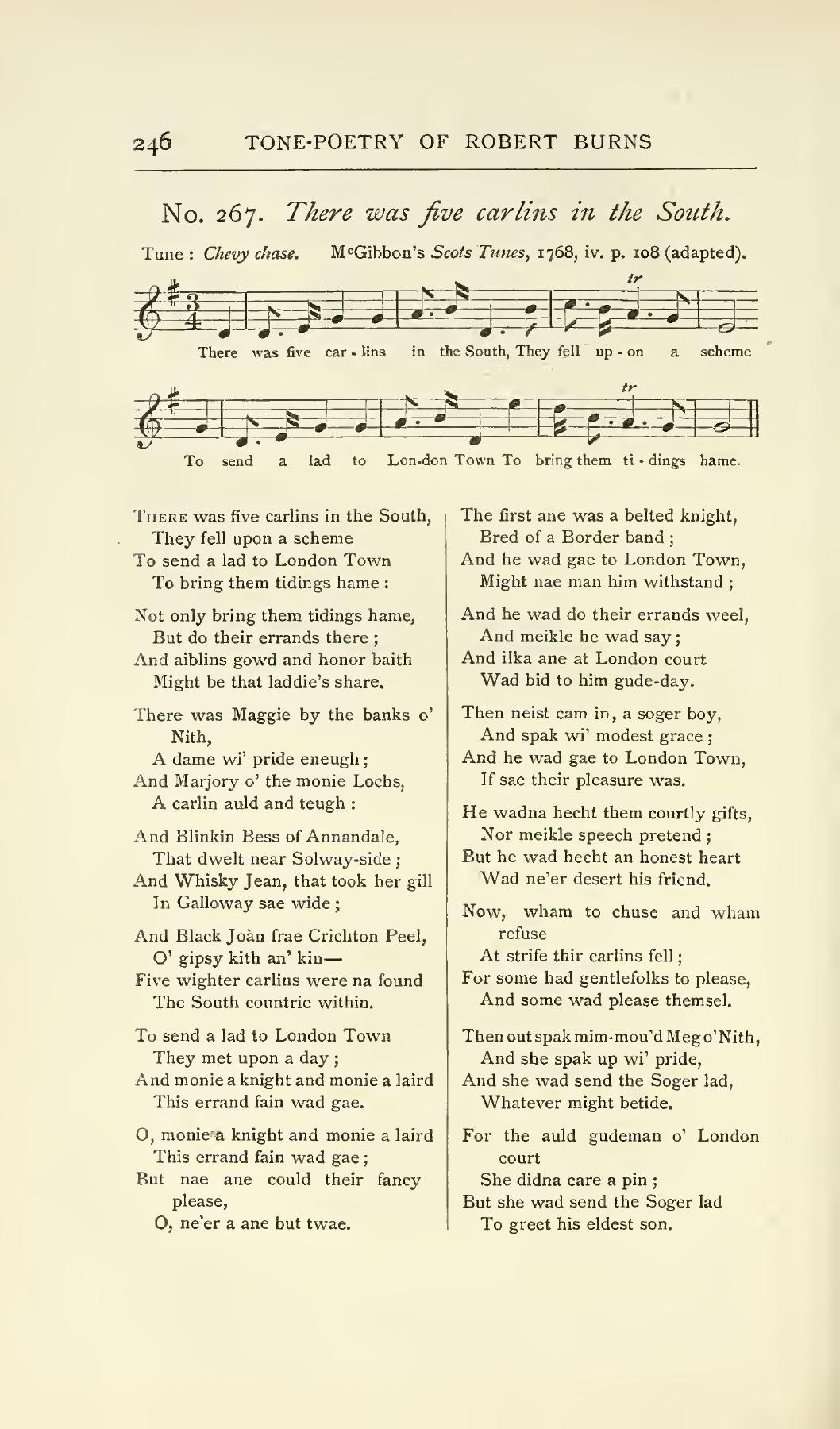 View score Dick’s Songs of Robert Burns (1903)
Poem
Choose an edition
Cunningham (1855)
There were five carlins in the south,
  They fell upon a scheme,
To send a lad to London town,
  To bring them tidings hame.

Not only bring them tidings hame,
  But do their errands there;
And aiblins gowd and honour baith
  Might be that laddie’s share.

There was Maggy by the banks o’ Nith,
  A dame wi’ pride eneugh;
And Marjory o’ the mony lochs,
  A carlin auld and teugh.

And blinkin’ Bess of Annandale,
  That dwelt near Solway-side;
And whiskey Jean, that took her gill
  In Galloway sae wide.

And black Joan, frae Crighton-peel,
  O’ gipsey kith an’ kin;—
Five wighter carlins were na found
  The south countrie within.

To send a lad to London town,
  They met upon a day;
And mony a knight, and mony a laird,
  This errand fain wad gae.

O mony a knight, and mony a laird,
  This errand fain wad gae;
But nae ane could their fancy please,
  O ne’er a ane but twae.

The first ane was a belted knight,
  Bred of a border band;
And he wad gae to London town,
  Might nae man him withstand.

And he wad do their errands weel,
  And meikle he wad say;
And ilka ane about the court
  Wad bid to him gude-day.

The neist cam in a sodger youth,
  And spak wi’ modest grace,
And he wad gae to London town,
  If sae their pleasure was.

He wad na hecht them courtly gifts,
  Nor meikle speech pretend;
But he wad hecht an honest heart,
  Wad ne’er desert his friend.

Then wham to chuse, and wham refuse,
  At strife thir carlins fell;
For some had gentlefolks to please,
  And some wad please themsel’.

Then out spak mim-mou’d Meg o’ Nith,
  And she spak up wi’ pride,
And she wad send the sodger youth,
  Whatever might betide.

For the auld gudeman o’ London court
  She didna care a pin;
But she wad send the sodger youth
  To greet his eldest son.

Then slow raise Marjory o’ the Lochs
  And wrinkled was her brow;
Her ancient weed was russet gray,
  Her auld Scotch heart was true.

“The London court set light by me—
  I set as light by them;
And I wilt send the sodger lad
  To shaw that court the same.”

Then up sprang Bess of Annandale,
  And swore a deadly aith,
Says, “I will send the border-knight
  Spite o’ you carlins baith.

“For far-off fowls hae feathers fair,
  And fools o’ change are fain;
But I hae try’d this border-knight,
  I’ll try him yet again.”

Then whiskey Jean spak o’er her drink,
  “Ye weel ken, kimmersa’,
The auld gudeman o’ London court,
  His back’s been at the wa’.

“And mony a friend that kiss’d his caup,
  Is now a fremit wight;
But it’s ne’er be sae wi’ whiskey Jean,—
  We’ll send the border-knight.”

Says black Joan o’ Crighton-peel,
  A carlin stoor and grim,—
“The auld gudeman, or the young gudeman,
  For me may sink or swim.

“For fools will prate o’ right and wrang,
  While knaves laugh in their sleeve;
But wha blaws best the horn shall win,
  I’ll spier nae courtier’s leave.”

So how this mighty plea may end
  There’s naebody can tell:
God grant the king, and ilka man,
  May look weel to himsel’!
Digital text from Project Gutenberg.
View the source edition · p. 167
About this edition
Cunningham’s preface discusses several poems he left out of the collection.
Dick (1903) · no. 267
The words are on the score page.
View the source edition · no. 267; pp. 246–247
Music
View historical scores
Dick’s Songs of Robert Burns (1903)
no. 267; pp. 246–247
Written by Burns
Cunningham explains the five women as personifications of burghs in an election contest.
Words Robert Burns
Burns’s role Author of the political ballad’s words