The Kirk’s Alarm. A Satire. First Version
Behind the poem
William M’Gill is accused of trying to make faith agree with sense. Burns puts the charge into the mouths of M’Gill’s orthodox opponents, who denounce this reasonable aim as a threat to the Kirk. The satire then turns on individual defenders of orthodoxy, naming or nicknaming them one by one.[1]
Read the fuller story
Cunningham places the satire in the controversy over M’Gill’s essay on Christ’s death. His introduction describes objections to M’Gill’s treatment of original sin and the Trinity, a denunciation by Peebles in November 1788, and debate before the Synod. It says that Burns was persuaded to assist M’Gill with satire, apparently reluctantly. This is Cunningham’s retrospective account of the dispute and Burns’s involvement. The poem itself takes the side of its embattled Doctor by making the campaign against him look vindictive and foolish.[1]
The recurring six-line stanzas make each target instantly recognisable. A doubled name launches the address, two pairs of short lines each lead into a longer line, and the last line delivers the blow. The source notes identify “Dr. Mac” as M’Gill, “Rumble John” as Russell and “Poet Willie” as Peebles. In the verse, preaching becomes a noisy performance: groaning, roaring and ladling out brimstone. Elsewhere the pursuers become a hunting pack, with barking available to anyone unable to bite. The satire makes its opponents’ zeal sound like an appetite for the chase.[1]
One especially pointed stanza praises Dalrymple’s gentle heart and blameless life, then pretends that these count for nothing beside a doctrinal charge. That reversal gives the mockery a moral centre: character and kindness are set against the policing of belief. The later image of spiritual guns turns hard hearts into powder and dense skulls into ammunition. Finally the poem calls on “Poet Burns” himself, teasing his wandering muse and inviting another attack. The first version thus ends by folding its satirist into the noisy public quarrel he has staged.[1]
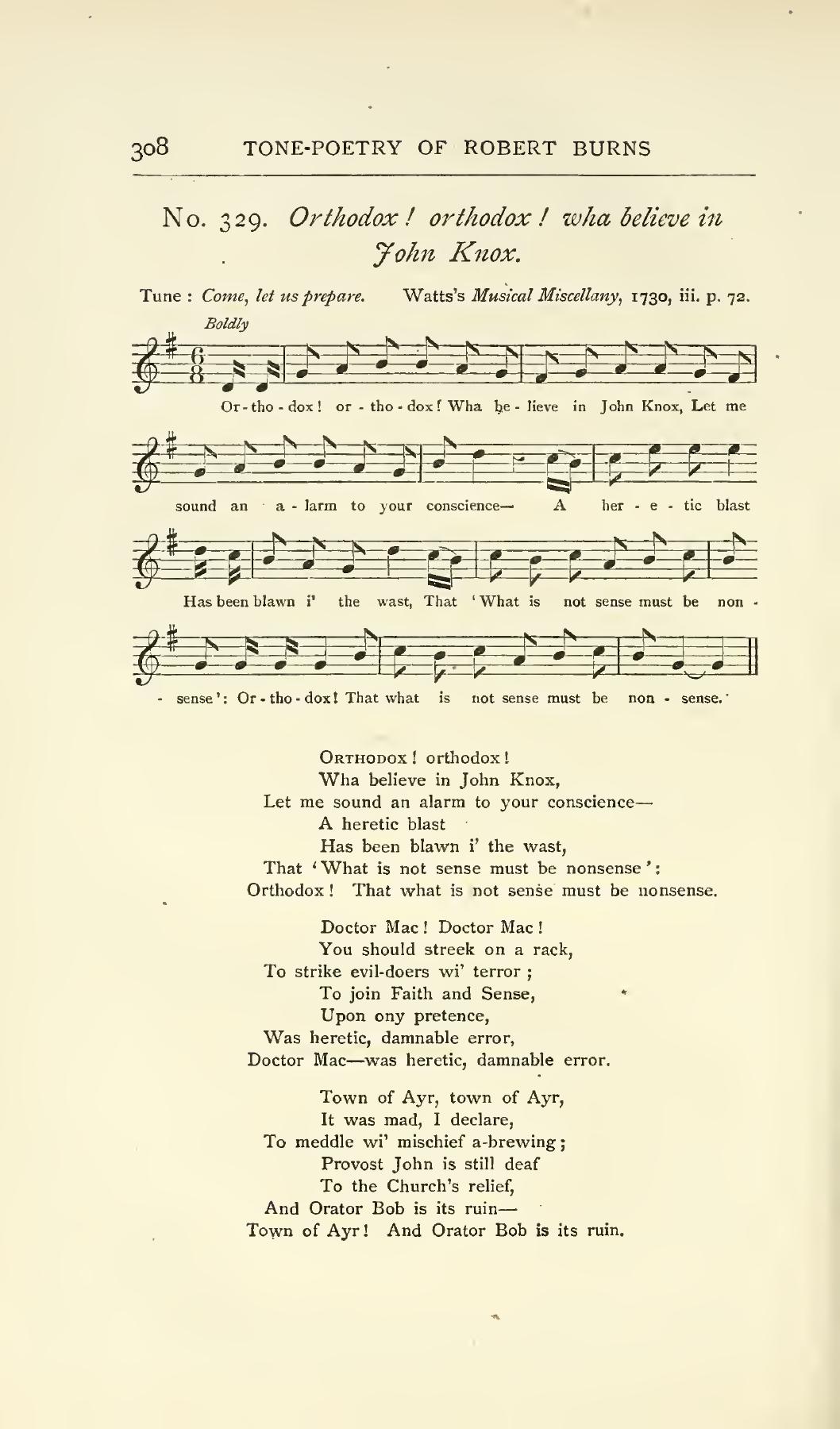 View score Dick’s Songs of Robert Burns (1903)
Poem
Choose an edition
Cunningham (1855)
    Orthodox, orthodox,
    Wha believe in John Knox,
Let me sound an alarm to your conscience:
    There’s a heretic blast
    Has been blawn in the wast,
That what is no sense must be nonsense.

    Dr. Mac, Dr. Mac,
    You should stretch on a rack,
To strike evil doers wi’ terror;
    To join faith and sense
    Upon ony pretence,
Is heretic, damnable error.

    Town of Ayr, town of Ayr,
    It was mad, I declare,
To meddle wi’ mischief a-brewing;
    Provost John is still deaf
    To the church’s relief,
And orator Bob is its ruin.

    D’rymple mild, D’rymple mild,
    Thro’ your heart’s like a child,
And your life like the new driven snaw,
    Yet that winna save ye,
    Auld Satan must hav ye,
For preaching that three’s ane an’ twa.

    Rumble John, Rumble John,
    Mount the steps wi’ a groan,
Cry the book is wi’ heresy cramm’d;
    Then lug out your ladle,
    Deal brimstone like adle,
And roar every note of the danm’d.

    Simper James, Simper James,
    Leave the fair Killie dames,
There’s a holier chase in your view;
    I’ll lay on your head
    That the pack ye’ll soon lead.
For puppies like you there’s but few.

    Singet Sawney, Singet Sawney,
    Are ye herding the penny,
Unconscious what evil await?
    Wi’ a jump, yell, and howl,
    Alarm every soul,
For the foul thief is just at your gate.

    Daddy Auld, Daddy Auld,
    There’s a tod in the fauld,
A tod meikle waur than the clerk;
    Though yo can do little skaith,
    Ye’ll be in at the death,
And gif ye canna bite, ye may bark.

    Davie Bluster, Davie Bluster,
    If for a saint ye do muster,
The corps is no nice of recruits;
    Yet to worth let’s be just,
    Royal blood ye might boast,
If the ass was the king of the brutes.

    Jamy Goose, Jamy Goose,
    Ye ha’e made but toom roose,
In hunting the wicked lieutenant;
    But the Doctor’s your mark,
    For the L—d’s haly ark;
He has cooper’d and cawd a wrang pin in’t.

    Poet Willie, Poet Willie,
    Fie the Doctor a volley,
Wi’ your liberty’s chain and your wit;
    O’er Pegasus’ side
    Ye ne’er laid astride,
Ye but smelt, man, the place where he ——.

    Andro Gouk,, Andro Gouk,
    Ye may slander the book,
And the book not the waur, let me tell ye;
    Ye are rich and look big,
    But lay by hat and wig,
And ye’ll ha’e a calf’s head o’ sma’ value.

    Barr Steenie, Barr Steenie,
    What mean ye, what mean ye?
If ye’ll meddle nae mair wi’ the matter,
    Ye may ha’e some pretence
    To havins and sense,
Wi’ people wha ken ye nae better.

    Irvine side, Irvine side,
    Wi’ your turkey-cock pride,
Of manhood but sum’ is your share,
    Ye’ve the figure ’tis true,
    Even your faes will allow,
And your friends they dae grunt you nae mair.

    Muirland Jock, Muirland Jock,
    When the L—d makes a rock
To crush Common sense for her sins,
    If ill manners were wit,
    There’s no mortal so fit
To confound the poor Doctor at ance.

    Holy Will, Holy Will,
    There was wit i’ your skull,
When ye pilfer’d the alms o’ the poor;
    The timmer is scant,
    When ye’re ta’en for a saunt,
Wha should swing in a rape for an hour.

    Calvin’s sons, Calvin’s sons,
    Seize your spir’tual guns,
Ammunition you never can need;
    Your hearts are the stuff,
    Will be powther enough,
And your skulls are storehouses o’ lead.

    Poet Burns, Poet Burns,
    Wi’ your priest-skelping turns,
Why desert ye your auld native shire?
    Your muse is a gipsie,
    E’en tho’ she were tipsie,
She could ca’ us nae waur than we are.
Digital text from Project Gutenberg.
View the source edition · p. 162
About this edition
Cunningham’s preface discusses several poems he left out of the collection.
Dick (1903) · no. 329
The words are on the score page.
View the source edition · no. 329; pp. 308–311
Music
View historical scores
Dick’s Songs of Robert Burns (1903)
no. 329; pp. 308–311
Written by Burns
Cunningham connects Burns’s satire with the controversy over M’Gill’s essay and distinguishes this as the first version.
Words Robert Burns
Burns’s role Author of the first version of the ecclesiastical satire