The Dean of Faculty. A new Ballad
Behind the poem
Henry Erskine and Robert Dundas are competing to lead the Faculty of Advocates, Scotland’s professional body for advocates. Burns calls them Hal and Bob and makes their election sound fiercer than the battles of Harlaw and Langside. Bob remembers the commandment against coveting, a virtue he demonstrates by getting the job. [1]
Read the fuller story
Cunningham identifies the rivals as Henry Erskine and Robert Dundas, competing for the deanship of the Faculty of Advocates. In the verse, Hal possesses genius, wit and learning; Bob’s distinction is remembering the tenth commandment. Since that commandment concerns coveting, the apparent compliment to his piety is sharply ironic. Bob gets the coveted position. The stanza’s cooking image then turns his victory into a coarse joke about the strange assistance through which a pot may boil.[1]
The third stanza makes the central accusation especially clear. Hal’s claim to deserve the office through talent is treated as an impertinence. The electors prefer someone who will owe everything to their generosity. ‘Merit’s rudeness’ neatly reverses the expected language of an appointment: ability becomes an offence, and dependence a recommendation. The satire reaches beyond the successful candidate to the people who choose him.[1]
The closing biblical imagery offers Bob a mock programme of improvement. His dim mental vision might be cleared on Pisgah, and his mouth might yet be opened into eloquence through an encounter like that of Balaam’s ass. The promised transformation is another insult disguised as encouragement. Four numbered eight-line stanzas sustain this movement from mock-heroic battle to mock-pious hope.[1]
Cunningham says the poem first appeared in the Reliques of Burns, and presents a possible connection with Burns’s resentment over the reception of his earlier Dundas elegy. He marks that connection as supposition. His headnote also says Erskine succeeded, although the verse explicitly gives victory to Bob: the two statements conflict in this edition. The ballad’s own argument is plain, however. It imagines an institution rewarding obligation and patronage while finding talent inconvenient.[1]
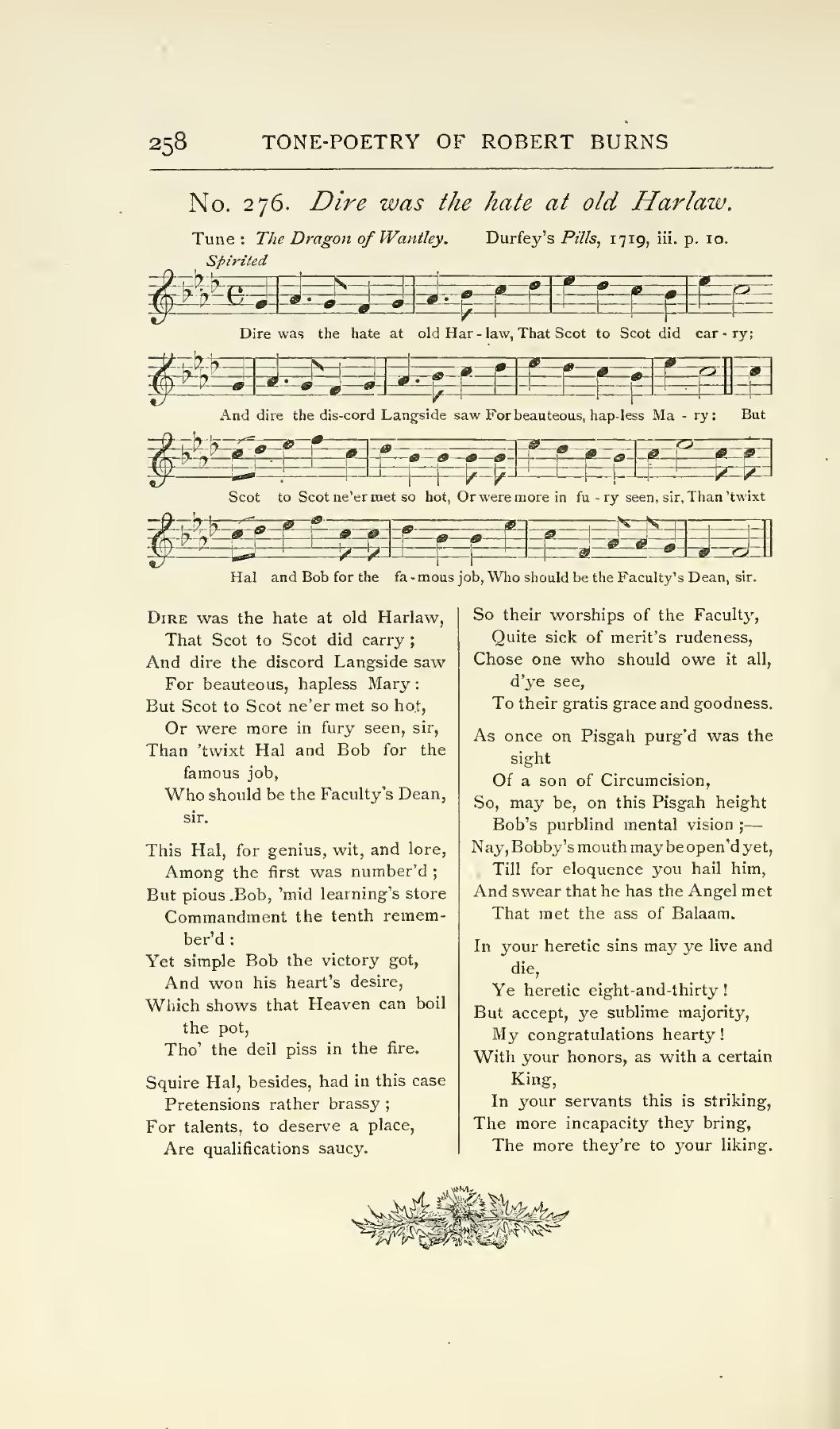 View score Dick’s Songs of Robert Burns (1903)
Poem
Choose an edition
Cunningham (1855)
Dire was the hate at old Harlaw,
  That Scot to Scot did carry;
And dire the discord Langside saw,
  For beauteous, hapless Mary:
But Scot with Scot ne’er met so hot,
  Or were more in fury seen, Sir,
Than ’twixt Hal and Bob for the famous job—
  Who should be Faculty’s Dean, Sir.—

This Hal for genius, wit, and lore,
  Among the first was number’d;
But pious Bob, ‘mid learning’s store,
  Commandment tenth remember’d.—
Yet simple Bob the victory got,
  And won his heart’s desire;
Which shows that heaven can boil the pot,
  Though the devil p—s in the fire.—

Squire Hal besides had in this case
  Pretensions rather brassy,
For talents to deserve a place
  Are qualifications saucy;
So, their worships of the Faculty,
  Quite sick of merit’s rudeness,
Chose one who should owe it all, d’ye see,
  To their gratis grace and goodness.—

As once on Pisgah purg’d was the sight
  Of a son of Circumcision,
So may be, on this Pisgah height,
  Bob’s purblind, mental vision:
Nay, Bobby’s mouth may be open’d yet
  Till for eloquence you hail him,
And swear he has the angel met
  That met the Ass of Balaam.
Digital text from Project Gutenberg.
View the source edition · p. 143
About this edition
Cunningham’s preface discusses several poems he left out of the collection.
Dick (1903) · no. 276
The words are on the score page.
View the source edition · no. 276; p. 258
Music
View historical scores
Dick’s Songs of Robert Burns (1903)
no. 276; p. 258
Written by Burns
Cunningham presents the ballad as Burns’s and reports its appearance in the Reliques of Burns; his proposed connection with the earlier Dundas elegy remains tentative.
Words Robert Burns
Burns’s role Author of the satirical ballad