Now Nature cleeds the flowery lea
Behind the song
The invitation lasts through a whole year. ‘Now Nature cleeds the flowery lea’ asks a fair-haired lass to share the landscape’s pleasures and the singer’s affection, moving from spring flowers to a winter embrace. Its promise is companionship through changing seasons, with tenderness adapting to each new setting.[1]
Read the fuller story
The chorus asks her to ‘tent the flocks’, or tend them, beside him. ‘Lint-white locks’ are flax-white hair; ‘cleeds’ means clothes, and the ‘lea’ is grassland. The first verse makes Nature’s fresh clothing a likeness for the young woman herself. Primroses, the winding burn, cuckoo and playful lambs then appear as a company ready to welcome her.[1]
The imagined day and year advance together. A summer shower revives the flowers before the lovers shelter in a fragrant honeysuckle bower at noon. Cynthia, the moon, lights the harvest worker’s homeward journey while the couple walk through yellow fields. Winter finally drives the scene inward: when wind disturbs her sleep, the singer will hold and comfort her. The sequence turns an invitation to enjoy beauty into an assurance of care.[1]
James C. Dick’s note quotes Burns describing the completed song to Thomson in November 1794 as a regular pastoral, with spring morning, summer noon, autumn evening and winter night properly arranged. Dick also reports an earlier fragment sent around September. The source therefore supplies Burns’s own reported explanation of the design visible in the verses.[2]
The tune is ‘Rothiemurche’s rant’, marked ‘Slow’ in Dick’s setting. In the letter extract Dick prints, Burns defends his enjoyment of old dance tunes despite anticipating Thomson’s disapproval. He credits Clarke’s advice to use the first part of the air for the chorus and the fourth or last part for the song. Dick says his setting follows that arrangement from Bremner’s Reels. The visible D.C. and Fine signs return the singer to the opening invitation, making the chorus the stable centre of this changing pastoral world.[1][2]
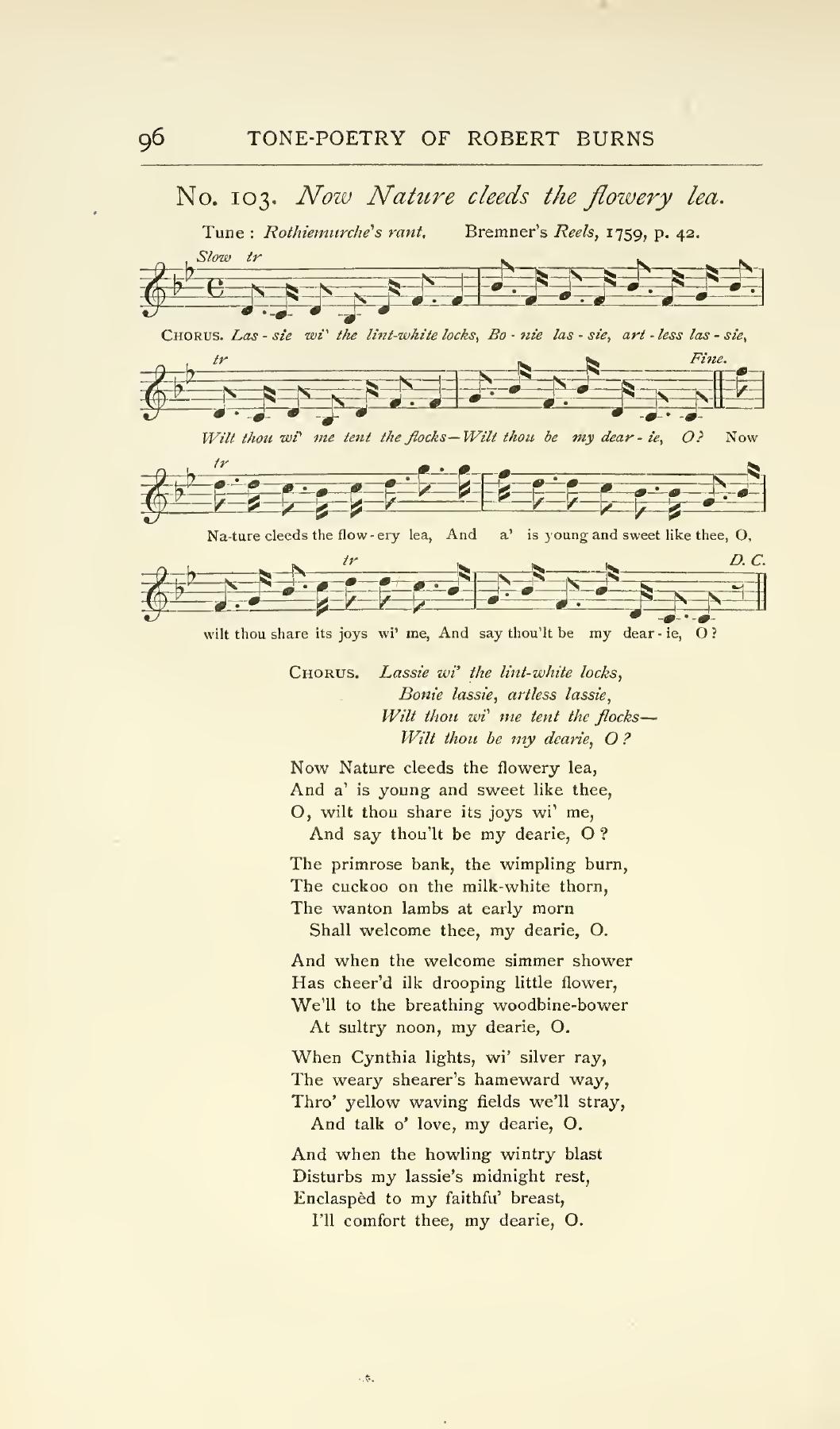 View score Dick’s Songs of Robert Burns (1903)
Lyrics
Dick (1903) · no. 103
CHORUS
Lassie wi' the lint-white locks,
Bonie lassie, artless lassie,
Wilt thou wi' me tent the flocks—
Wilt thou be my dearie, O?

Now Nature cleeds the flowery lea,
And a' is young and sweet like thee,
O, wilt thou share its joys wi' me,
And say thou'lt be my dearie, O?

The primrose bank, the wimpling burn,
The cuckoo on the milk-white thorn,
The wanton lambs at early morn
Shall welcome thee, my dearie, O.

And when the welcome simmer shower
Has cheer'd ilk drooping little flower,
We'll to the breathing woodbine-bower
At sultry noon, my dearie, O.

When Cynthia lights, wi' silver ray,
The weary shearer's hameward way,
Thro' yellow waving fields we'll stray,
And talk o' love, my dearie, O.

And when the howling wintry blast
Disturbs my lassie's midnight rest,
Enclaspèd to my faithfu' breast,
I'll comfort thee, my dearie, O.
View the source edition · Dick1903 no. 103; p. 96; PDF [152, 152]
About this edition
Syllables separated by the musical notation are joined into words in this reading.
Music
View historical scores
Dick’s Songs of Robert Burns (1903)
Dick1903 no. 103; p. 96; PDF [152, 152]