Behold, my love, how green the groves
Behind the song
A shepherd invites his love to look at the green groves, primroses and flowers around them. The breeze moves her fair hair as it wakes the flowers, bringing her into the same gentle scene. From this opening, the song develops an argument about worth: the pleasures of the countryside and the truth of the shepherd’s affection can stand beside everything wealth and rank have to offer. [1]
Read the fuller story
The first stanza gives nature an equal generosity towards shepherds and kings. Its lark even seems to prefer the cottage to the palace. “Lav’rock” is the Scots word for a lark, while “ween” means think or suppose. The singer makes the bird part of his case, imagining its song over an ordinary dwelling as a sign that a cottage can offer as much happiness as a palace. [1]
The next stanza sets two kinds of music and dancing beside each other. Minstrels play skilled strings in a brightly lit lordly hall; the shepherd fingers the stops of his simple reed among birches. “Birken shaw” means a birch wood or thicket. The princely company may look scornfully at the rustic dance, but the singer asks whether their hearts are as light as his and his companion’s beneath the flowering thorn. His question makes pleasure a matter of experience, which display and social standing cannot settle. [1]
The final stanza brings the argument home to courtship. A courtier may speak more elegantly, but the shepherd questions whether his heart is as true. The wild flowers he has picked become his own gift to set against courtly jewels. By the last line, the claim has become intensely personal: whatever those gems express, the singer believes his love has its own unmatched value. The invitation to admire a landscape has led to a declaration about the person offering it. [1]
Dick reports that an earlier opening named Chloris, and that Burns sent a first copy to Thomson in November 1794 with a letter saying that she had suggested the verses. He also describes Burns rejecting words Thomson had chosen for the intended tune and supplying this song for it. These details explain the lyric’s place in their work on songs, through Dick’s account of the correspondence. [2]
The printed setting is headed “On the cold ground” and marked “Slowly”. Dick distinguishes the older melody he prints, which he attributes to Matthew Locke, from a later popular air bearing the same name. His note connects the older tune with Playford’s Dancing Master of 1665. That distinction matters when choosing music for these words: a shared tune title can conceal different melodies. In this setting, the slow pace leaves space for the shepherd’s successive comparisons and his final declaration. [1][2]
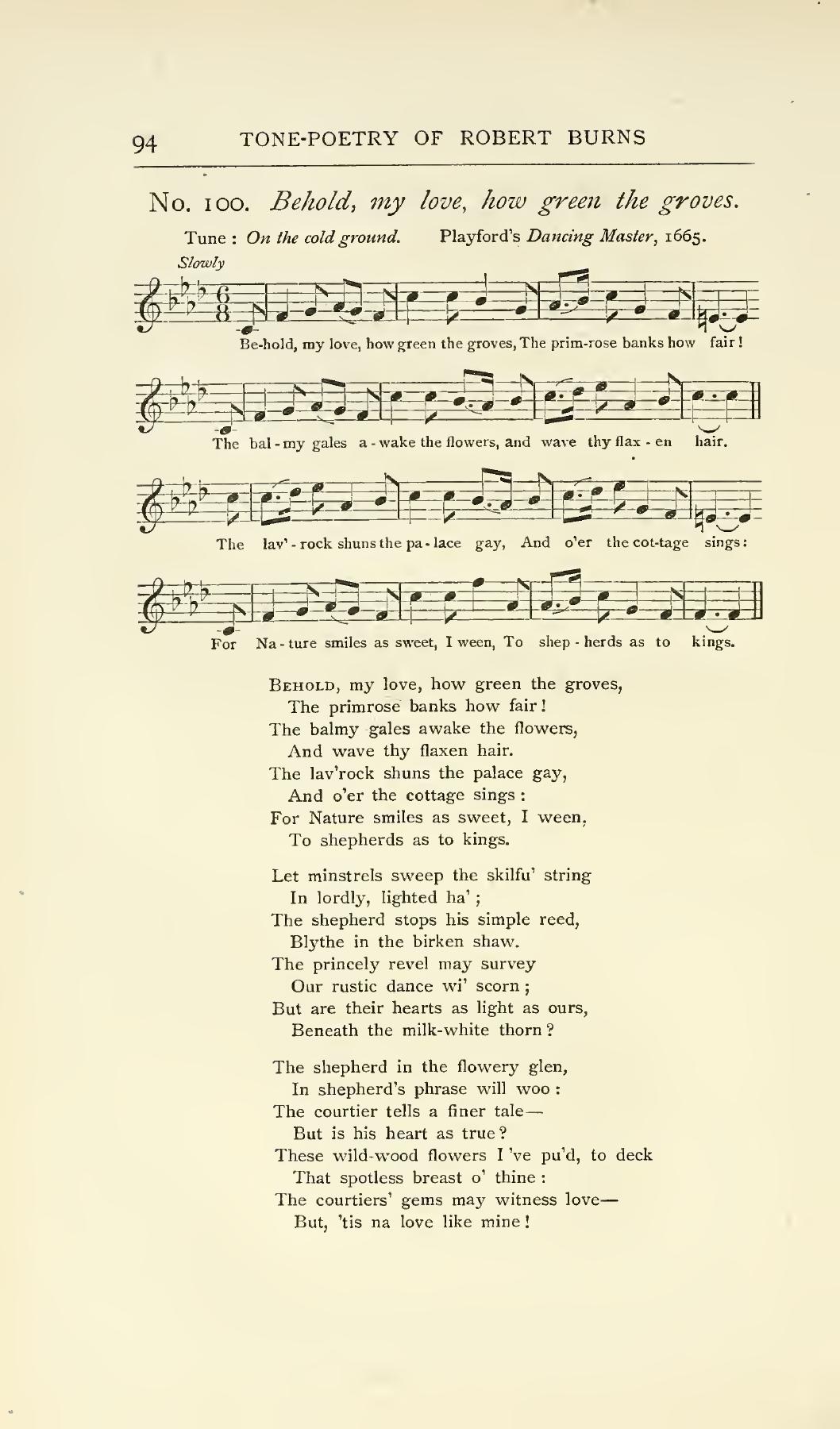 View score Dick’s Songs of Robert Burns (1903)
Lyrics
Dick (1903) · no. 100
Behold, my love, how green the groves,
The primrose banks how fair!
The balmy gales awake the flowers,
And wave thy flaxen hair.
The lav'rock shuns the palace gay,
And o'er the cottage sings:
For Nature smiles as sweet, I ween,
To shepherds as to kings.

Let minstrels sweep the skilfu' string
In lordly, lighted ha';
The shepherd stops his simple reed,
Blythe in the birken shaw.
The princely revel may survey
Our rustic dance wi' scorn;
But are their hearts as light as ours,
Beneath the milk-white thorn?

The shepherd in the flowery glen,
In shepherd's phrase will woo:
The courtier tells a finer tale—
But is his heart as true?
These wild-wood flowers I've pu'd, to deck
That spotless breast o' thine:
The courtiers' gems may witness love—
But, 'tis na love like mine!
View the source edition · Dick1903 no. 100; p. 94; PDF [150, 150]
About this edition
Syllables separated by the musical notation are joined into words in this reading.
Music
View historical scores
Dick’s Songs of Robert Burns (1903)
Dick1903 no. 100; p. 94; PDF [150, 150]